
Beard Styles: How to Choose by Face Shape and Upkeep
Compare common beard styles and choose by face shape, facial proportions, natural growth, maintenance level, and grooming routine.
Table of Contents
There’s no single “correct” beard style. Instead, you’ll need to choose based on a mix of personal fit and how well it aligns with your overall look.
The choice of the right beard style isn’t simply about matching a trend or a celebrity; rather, it is about making sure that it fits your face shape, proportions, and natural growth pattern. The upkeep time and effort will also play into your decision, but there’s nothing worse than having an overgrown beard when you’re in a professional setting.
A beard can help draw attention away from one part of your face while highlighting another — which means that facial features such as nose size or chin shape should be considered before committing to a particular beard style. In addition, how thick your beard grows and whether it grows evenly across your face will influence what kind of beard is most suitable for you.
Face Shape
To start with, determine what face shape you have. You might already have some ideas, but the easiest way to assess this is to measure where your jaw begins and ends, and then find out the widest part of your face. Use the measurements and tools at AttractivenessTest.com to get an idea of your face shape.
There are a number of options for how you can use the AttractivenessTest.com tools. The website offers both an oval face shape and oblong/rectangle face shape as well as round, square, diamond, triangle, heart, and jawline shapes. You can check how each option matches up with your own shape using their FWHR (Face Width to Height Ratio) tool, facial-thirds tool, and symmetry tool. Compare your jaw shape and the widest part of your face, then look at forehead, cheekbone, jaw, and face-length measurements. These tools quantify your proportions rather than simply assigning you a face-shape label.
Short and Full Faces
The short-face category includes all beards that don’t require a full growth of hair. Stubble qualifies as one of the shortest types of beard. Typically, stubble only needs to be 2–5 mm long. For scruffy stubble, you’ll use a clipper setting around 1–1.5 mm; a short boxed or corporate beard is usually trimmed to about one-half to 1 inch after roughly a month of growth. If you don’t mind a little extra maintenance, then a beard of this type can take 1–4 weeks to fully grow out.
On the other hand, a full face beard requires you to let your hair grow completely. The minimum length would be about 2–4 inches, with longer styles needing even more patience. However, a full beard will require more time and effort, since it can take 4–8 months to fully grow. A full beard may also not be the best option if you aren’t growing dense facial hair. A short boxed or corporate beard needs dense, even growth for the same reason. Longer styles also need regular beard wash, oil, softener, brushing, and combing. There are many names for different styles, though they tend to fall within these categories.
Partial and Shaped Styles
In addition to choosing between a partial beard and full beard, there are a few more classifications to consider. First, does the facial-hair zone stay connected or do parts of it get shaved? For instance, a goatee typically keeps the facial-hair zones connected. Alternatively, the shadow goatee keeps a five o’clock shadow on the cheeks with a goatee on the front, while the circle beard connects the chin hair to the mustache in a neat circle. Then there’s the Van Dyke, with a disconnected pointy chin beard and mustache, and the anchor, where the sideburns and cheeks are shaved clean.
Other shaped beard styles include the Hollywoodian, with an extended goatee, full mustache, and wide horizontal chinstrap but minimal or no sideburns, and the horseshoe, which sends long mustache bars downward toward the chin. Mutton chops use bushy sideburns that extend across the cheeks while leaving the chin and mouth clean-shaven. A friendly mutton chop adds a mustache that connects the sideburns. Similarly, the soul patch is basically a mutton chop without any extension.
The detached mustache is perhaps the most common name for what we refer to as a mustache alone. Meanwhile, the chin strap outlines the jawline and circles the chin without a mustache.
Fuller Named Beards
Some beards may sound like a mouthful, but once you understand them, they’ll make sense. A Garibaldi beard is a bold, fuller named beard with its own broad, rounded silhouette. The Verdi beard is similar, except it has a ducktail. The classic full beard, on the other hand, is just a full beard that is trimmed around the cheeks and chin. While the Verdi is a full beard, the natural full beard doesn’t necessarily have to be styled.
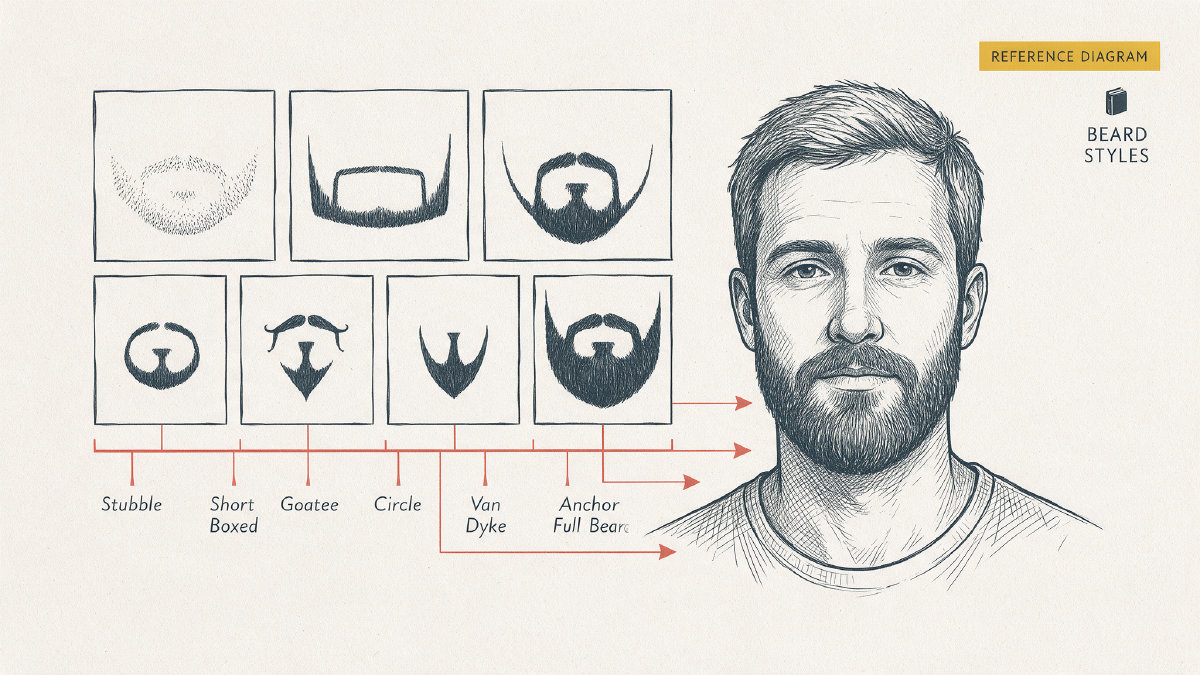
The beardstache focuses on a longer mustache with shorter hair on the cheeks, jaw, and chin. It’s somewhat rare today, but still quite popular in historical settings. The gunslinger adds more width to the lower portion of the beard, leaving the sides of the face clean. A chin strip is basically a narrow vertical line of facial hair running down the center of the chin. The Balbo adds even more width to the lower portion of the beard, creating something resembling a bowtie. The Royale is a mustache anchored by a thin, disconnected chin strip.
While the petite goatee is exactly what it sounds like, the chevron is a thick, bold mustache covering the upper lip. Finally, the original stache is the most common type of mustache that men wear. These silhouettes differ in terms of the amount of upkeep involved, so consider how much time you’re willing to invest.
Square Versus Round Faces
Choosing a beard can also be tricky depending on your face shape. If you have a square face, you’ll want to preserve its angular jaw. A fuller beard could add too much bulk to your face. However, you don’t want to avoid beards entirely because you may actually be able to pull it off.
For those who have a square face, the key styling problem is trying to keep the sides short without letting the beard grow too long down the front. That said, the most important factor in a beard design for a square-shaped man is preserving the angular jaw. Otherwise, the whole purpose of a square-shaped beard disappears.
If you have a round face, the challenge is trying to add structure and direction to the chin. This can be done by creating angled cheek lines, keeping the sides shorter, and letting the hair stay fuller on the chin. You’ll want to avoid too-long, heavy beards and instead focus on adding dimension.
Oval Versus Oblong Faces
Oval and oblong faces are probably the easiest to work with when it comes to selecting the perfect beard. The key difference is that the oval face is a balanced, versatile shape that looks great with pretty much any beard. On the other hand, an oblong face tends to lean toward being rectangular in shape.
The main challenge with the oval face is getting the right balance between the top and bottom of your face. Too often, men forget to incorporate some form of styling at the bottom of the face, such as a beard or mutton chop. Because of that, oval-shaped faces tend to appear taller and thinner than they actually are.
Men with an oblong face may benefit from choosing a shorter beard on the bottom while keeping the sides a little longer or fuller, so the face looks more balanced rather than stretched. A bit of contrast in terms of sideburns or mustaches can go a long way.
Diamond, Triangle, and Heart Shapes
While there are named charts that match various face shapes to different beard styles, none of them agree on everything. As a result, you might benefit from doing some additional research and taking a look at the measurements provided to see if they apply to you.
Diamond face shapes generally mean that you have a pointed chin, wide cheekbones, and a narrower forehead and jawline. You’ll need to pick a beard that helps define your face rather than make it disappear. A full beard or goatee can balance the cheekbones and chin. Avoid a pointed ducktail, Van Dyke, or anchor, since those silhouettes make the chin look even sharper.
Triangle-shaped men have a broad jawline and a narrow browline, so you’ll want a beard that adds width to the jawline and fills out the chin while keeping the sides short. Men with triangle-shaped faces should avoid any pointed shapes at the top of the face and also steer clear of overly large cheek areas. You’ll want to stick with a beard that allows you to keep control of your cheek area, but also provides sufficient volume to fill out the lower portions of your face.
Heart-shaped men are typically blessed with good proportions, so your choices should reflect that. Basically, you’ll want to ensure that the lower half of your face isn’t underrepresented compared to the rest of your face. In short, you’ll want to avoid pointing your chin or using any of the more angular shapes associated with other face types. If you prefer to keep your jawline clean, then you can try a short crop, but be careful not to cut too far into your beard.
Patchy or Thin Growth
When choosing a beard, you’ll obviously want to pick a style that works with your existing density. If your facial hair grows unevenly or sparsely, then you’ll want to consider some styling tips to help maximize the effect.
Stubble seems to work with most beard styles, including a goatee. However, if you don’t mind a bit of upkeep, then you can also consider a closely cropped beard that you trim every week. You can also opt for very short, closely cropped lengths. In general, the more you can clean up the edges of your beard, the better, but if your beard doesn’t grow evenly, then you may not enjoy cleaning up every day.
Workplace- and Lifestyle-Compatible Beards
One of the most crucial considerations when choosing a beard is how well it matches your lifestyle and workplace expectations. In fact, if you’re unsure about the right beard style for you, you can simply ask yourself a few simple questions:
How neat do I need to look?
How often am I going to shape my beard?
What level of tolerance is there for specific settings?
Most workplaces allow for a certain amount of variation, so if you can afford to have a beard that requires minimal shaping, then you should definitely go for it. Conversely, if you have a job that expects a certain degree of professionalism, you might want to consider a more traditional approach. Some examples of neater styles include a circle beard, a short boxed/corporate beard, and stubble.
On the other extreme, you could choose a more dramatic-looking style, such as Hollywoodian, mutton chops, or a full beard. Naturally, you’ll have to be careful when considering the latter. If you’re not willing to spend a considerable amount of time on upkeep, then you might find that a full beard isn’t ideal. A yeard is a year-old beard grown for 365 days with no major trimming, usually reaching 6–12 inches depending on growth; it works best if you have the patience and confidence for it.
Maintaining Your Beard
Regardless of the beard style you ultimately decide upon, you’ll need to maintain it on a regular basis. This is especially true if you have a full beard, which requires frequent trimming to keep its shape. Once you’ve chosen your preferred style, however, you’ll need to establish a schedule of sorts for maintaining it.
As long as you follow your schedule, you can expect your beard to remain neat and tidy between trims. Obviously, the effort involved increases as your beard gets longer and the volume increases. The basics are covered below, along with suggestions on how to implement the process effectively.
Trimming and Shaping
Every beard needs to be kept trimmed. Whether it’s a short crop or a full beard, it will eventually grow out. When it does, you’ll need to trim it down again, either to your desired length or to maintain your current shape. Keep in mind that the effort required to maintain your beard will increase dramatically as it gets longer.
You’ll also need to consider the neckline. A longer beard will cover more of your neck, so you’ll need to leave some room beneath the neck for the beard itself. Trim your beard accordingly. Additionally, you’ll need to maintain a consistent height between the sides of your face and the center of your forehead. Trimming your beard periodically should be sufficient.
Hygiene and Conditioning
Once you’ve finished trimming, it’s time to clean up the mess. After all, no one wants to look like a dirty old man! Whether your beard is short or long, wash and condition it to keep the hair soft and the skin comfortable, then apply beard oil afterward to lock in moisture and reduce dryness.
You’ll want to make sure your beard is adequately hydrated as well, otherwise it can become dry and lifeless. Applying a bit of moisturizer to your beard will also help to keep it looking fresh. A bit of beard wax is also helpful if you want to add some texture and definition.
Brushing and Combining
Finally, it’s time to brush and combine your beard. Start by combing through the neck hair, then work upward over the chin, cheeks, and mustache. Comb everything in the direction you want it to lie, paying extra attention to tangles under the chin and along the jawline.
Maintenance
The final step is to maintain your beard by trimming it regularly. If you’re not going to maintain your beard on a regular basis, then you might not want to choose a long beard at all. After all, a long beard that goes unnoticed and untrimmed can look like a complete disaster.
Ultimately, you need to choose a beard style that suits you and the occasion. If you choose the wrong one, it could really impact your self-confidence. Fortunately, there are plenty of beard styles available, so chances are there’s one that will suit you.
So, now you know the basics of how to choose a beard style based on your face shape, proportions, and natural growth pattern. You can choose from a range of options, each offering a unique look and feel. With the right beard style, you can add to your appearance and express your personality.
Now that you understand the basics of beard styles, you’ll be ready to choose one that fits your face shape and personality.
Narrowing Down Options
So, how do you go about narrowing down your options and choosing the best beard style for you? Well, here’s a simple sequence to guide you through the process:
Measure your face and body proportions to identify what face shape you’re looking at.
Identify the widest area of your face to help guide you to the right beard.
Check your jaw shape to see what sort of beard you might be best suited for.
Assess the density of your beard to see what you might be capable of.
Choose between a short, partial, or full beard style.
Estimate your daily and weekly upkeep requirements to gauge what’s feasible for you.
Test one of the adjustable styles to see what you might be best suited for.
That’s it!
Sources
Measure your own face
Free, in your browser. Your photo is never uploaded.
- Attractiveness TestFace rating, PSL range and eye type.
- Face Symmetry TestHow evenly the two sides match.
- Jawline AnalyzerJaw angle, jaw width and chin taper.