
What Does the Facial Golden Ratio Actually Tell You?
Understand what the facial golden ratio means, what research supports, and why photo measurements and calculator scores need context.
Table of Contents
It doesn't tell you much of anything.
I recently wrote an article about how beauty is defined by society, not by mathematics. In that article, I noted that there’s a concept called the “facial golden ratio,” which some people think defines beautiful faces. The idea behind this concept is that when you divide a person’s face into parts, certain proportions tend to follow the so-called “golden ratio” φ (φ ≈ 1.6180339…). This is supposed to be a mathematical proportion that we humans find especially attractive. For example, if you take the length from the hairline to the chin and divide it by the width between the cheekbones, you should get something close to φ. If you do that for many people, their average value might also come out close to φ.
The mathematical proportion behind the golden ratio
But here’s the thing: There are two different things going on here. First, there’s the general mathematical proportion that gives rise to the golden ratio, which is simply:
whole line / longer part = longer part / shorter part
That’s all it is. It’s just a number that comes up in nature and in art and architecture. But it’s not necessarily a proportion that we’re biologically programmed to like. And it’s certainly not something that has been demonstrated to predict attractiveness.
The facial golden ratio and attractiveness research
The second thing going on is research on whether facial measurements that follow the golden ratio correlate with attractiveness. Here’s what a recent review of such studies concluded, according to the supplied abstract of Naini’s 2024 review, rather than a full-text assessment:
There is no convincing evidence that the golden ratio or its related ratios are associated with idealized human proportions or facial beauty…
So even if you measure your own face and see that the length from your hairline to your chin divided by the width between your cheekbones comes out close to φ, this doesn’t mean that you’re more beautiful than someone else who gets a different result. That’s because the experiments cited above were not measuring the correlation between facial proportions and attractiveness. Instead, they were measuring the correlation between facial proportions and attractiveness preferences.
Preferences for certain facial proportions
In this case, researchers asked participants to rate the attractiveness of altered versions of female faces, with identical facial features except for the distance between eyes and mouth, or the distance between pupils. Participants preferred faces where eye-to-mouth distance was about 36% of hairline-to-chin length, and pupil-to-pupil distance was about 46% of the width between the inner edges of the ears. They didn’t prefer any specific absolute value, but rather a preferred proportion. So while the golden ratio came up in these experiments, the researchers weren’t saying that it predicted attractiveness — they were saying that people have a preference for certain proportions. But calling those measurements the golden ratio is misleading: the preferred 36% and 46% spacings aren’t φ.
Other experiments compared different facial dimensions. For example, one experiment had participants compare pairs of female faces, rating them on attractiveness. Researchers then found that participants preferred female faces with eye-to-mouth and pupil-to-pupil distances near the average proportions, rather than smaller or larger proportions. These results suggest that there may be separate preferences for male and female faces. However, since these findings are conditional on the experimental comparisons used, they don’t establish targets for all adults or rankings between different people.
How measurement endpoints affect facial ratios
AttractivenessTest’s calculator explains the effect of measurement endpoints on facial ratios. It measures face height from the top of its mesh to the chin and divides it by face width. Because the mesh stops below the hairline, the shorter measured height gives a lower ratio than measuring from the hairline. This suggests that the choice of measurement endpoint affects the value of the ratio.
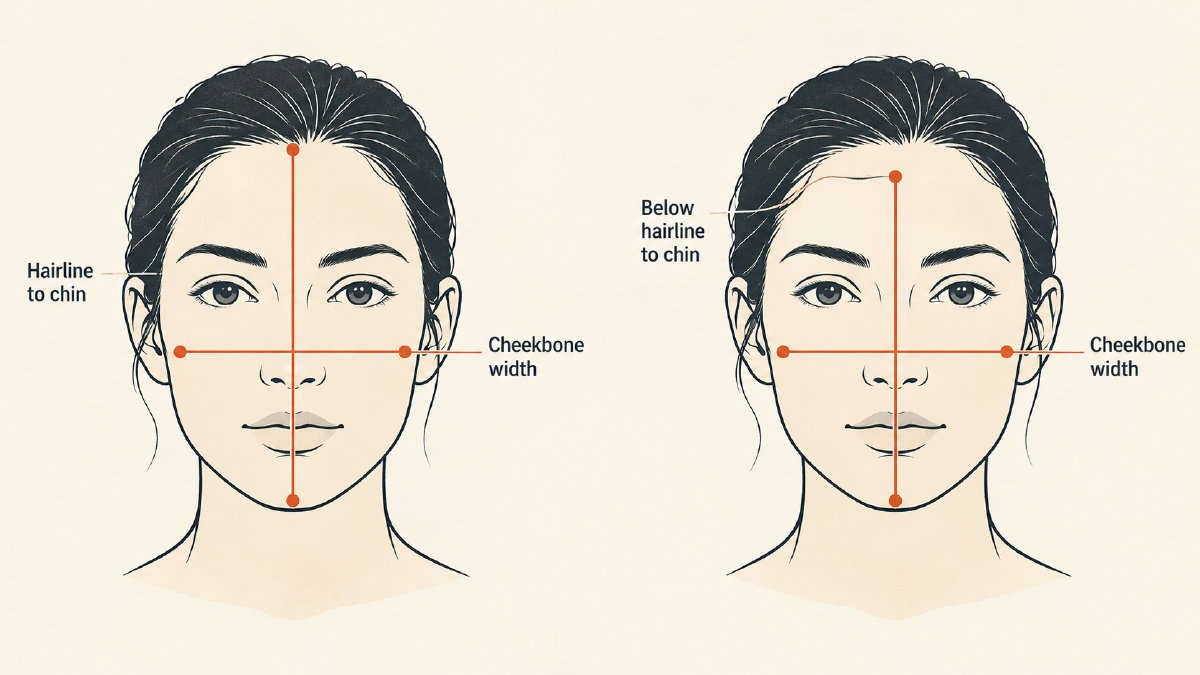
This means that if you want to use the golden ratio to judge your own attractiveness, you need to make sure that you’re measuring the same parts of your face each time. Otherwise, you’ll get different results. This is probably why some online calculators show proximity percentages to the golden ratio, instead of scores or percentiles.
Proximity percentages and population percentiles
When you look at the documented endpoints, reference values, and outputs of various golden ratio calculators, you can see that proximity to a tool’s target doesn’t necessarily equate to a population percentile or attractiveness grade. Some tools, for instance, adjust the golden ratio reference target to account for the visible-face window they measure. Others calculate a percentage based on a fixed reference. AttractivenessTest gives no golden ratio percentage score. The Face Report’s percentage measures proximity to an adjusted visible-face reference, not a percentile or clinical beauty rating. Either way, proximity to a target isn’t a population percentile, though some tools also compare your proportions with other faces or an average face model.
If you really want to use the golden ratio to evaluate your own attractiveness, you’ll need to look at your face from a variety of angles and under different lighting conditions. You won’t get the same results every time, and this variation will probably change depending on your age and appearance. For calculator measurements, though, AttractivenessTest recommends front-facing, well-lit photos with a neutral expression and closed lips. It warns that photographic conditions affect ratios, so compare multiple photos under similar conditions. What’s important is that you realize the golden ratio is just a number that happens to be popular in art and science. It doesn’t tell you anything about your attractiveness.
Sources
Measure your own face
Free, in your browser. Your photo is never uploaded.
- Attractiveness TestFace rating, PSL range and eye type.
- Face Symmetry TestHow evenly the two sides match.
- Jawline AnalyzerJaw angle, jaw width and chin taper.