
Choosing a Hair Cut for Round Face and Thin Hair
Choose a hair cut for round face and thin hair by comparing bobs, lobs and pixies, with advice on fuller-looking ends, layers, bangs and styling.
Table of Contents
I’m not sure how it is that I’ve never thought of this before, but here’s something to consider when choosing the right haircut for your round face and thin hair. While we all know that fine hair needs volume in order to look full, there are two different ways to define “fine” – strand diameter and density.
Strand Diameter
Fine refers to individual hair-shaft diameter, which means the actual thickness of each strand. Fine hair can be either low or high density (which is defined as strands per square inch), so ask your stylist to assess both diameter and density.
Density
Thin refers to density, or strands per square inch. Thin hair has low density, whether the individual strands are fine or coarse. So thin hair can be fine or coarse, but it just has fewer strands than thick hair.
The difference between these two definitions of “fine” or “thin” is important because the way you cut and style your hair will vary depending on what you have. For example, if you have very fine, low-density hair, you’ll want to preserve as much bulk as possible so that you don’t end up with gaps along the perimeter of your head. But if you have thicker, lower-density hair, then you can actually afford to remove some strands from the perimeter of your head and still retain enough weight to keep your hair looking full.
So the next time you’re looking for inspiration, think about whether the hairstyle you’re considering would work with your hair type. If you have very fine, low-density hair, then anything with lots of over-layering won’t work well because it compromises the appearance of fullness. On the other hand, if you have medium to thick strands but low-density hair, you’ll still want to keep layering minimal because thicker strands don’t mean you have more of them.
Haircut: The Foundation Of The Shape
In addition to knowing your own hair type, it’s also important to remember that the shape of your hair isn’t necessarily determined by the amount of lift or movement you create while styling. That’s where most people get confused when comparing pictures of their ideal haircuts with the finished product they end up with after getting their hair cut.
When looking for inspiration, you should always compare finished pictures to reference photos rather than to the technical styling and finish. Styling adds lift and movement, but it doesn’t change the foundation of the shape. The foundation of the shape is the haircut itself, and the styling adds movement and lift on top of that foundation.
You’ll notice that the overall shape is pretty much the same, but the second one has more lift and movement. It’s easy to assume that the first one was simply cut wrong, but it wasn’t. It was just styled differently. And yet, even though it was styled differently, the shape remained the same.
So when choosing a hairstyle for your round face and thin hair, don’t focus on how much lift or movement you can get out of your hair. Focus instead on the shape, and how the shape will frame your face. Think about how you’d like your hair to look around your face, and how much weight you want retained in the perimeter. Then choose a haircut that will give you that shape, and allow you to build upon it using your natural texture and the usual styling routine you use on a daily basis.
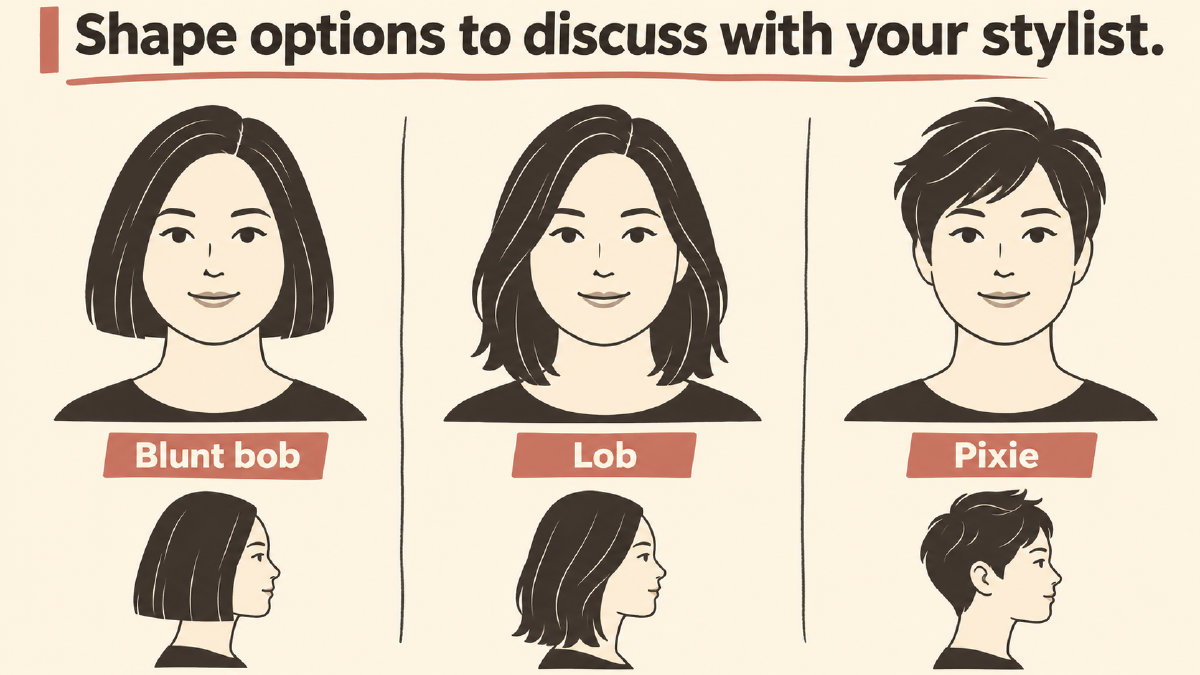
Blunt Bob
If you’re someone who prefers a blunt bob and wants your hair to look fuller at the ends, then you’ll definitely want to go with a blunt cut. This will help preserve as much weight as possible along the perimeter of your head, so that you don’t end up with gaps.
Lob
If you prefer a longer shape, then a lob is probably the best option. A shoulder-length or collarbone-length lob will give you plenty of framing, and it’ll allow you to keep your hair longer without losing too much weight.
Pixie
A pixie is a great choice if you’re willing to sacrifice length for shape. You can still get a great shape with a shorter length, but it’ll require more styling. The Right Hairstyles has a great example of a collarbone-length lob that gives a really nice long framing fringe, but you’ll want to ask your stylist what styling you’d need to recreate that finish. In my opinion, it’s better to go with a shorter length if you’re hoping to maximize movement and body in your fine or thin hair.
Short-Cut Alternative
Of course, you could also go with a short-cut alternative if you don’t need the volume, and you’re okay with keeping your hair short and simple.
But again, it’s important to remember that the shape of the haircut isn’t necessarily going to match exactly with how it looks when you’ve got it blow-dried and styled. That’s just how the styling contributes to the final result.
Defined Outline & Strategic Layering
There’s nothing wrong with strategic layering, but if you want visible fullness, you’ll need to do it in a very limited way. Over-layering will compromise the appearance of fullness. The key is to define the outline and add just enough layers to support the weight.
A shorter length can help maximize movement and body in low-density fine hair. Ask your stylist about minimal, strategic layers and precise blending to provide internal movement while retaining enough weight and bulk. Sam Villa recommends longer layers to keep the ends looking full, so ask whether those would give you the movement you want. Around your face, more defined pieces can help too. Conventional face-framing layers, where the hair is lifted away from your head for cutting, can leave fine or thin hair looking less dense.
If you want a bit more movement and layering, ask your stylist how much your available density can support while keeping the outline full. If your hair is sparse around your forehead, that doesn’t mean you can’t have a fringe. Sam Villa supports fringe on fine hair when the width and depth of the section are adjusted to your density. For a side-sweeping fringe, you’ll also want to consider your desired length and your hair’s texture.
Professional Recommendations
As you can see, the answer really depends on your preferences, and the recommendations you receive will be based on those preferences. So the next time you’re looking for advice on choosing a haircut for your round face and thin hair, don’t just ask for a recommendation. Ask your stylist what kind of haircut would be best for you, and why. What are the reasons behind their recommendations? What do they hope to achieve by making those specific cuts?
It’s also a good idea to bring along any examples of hairstyles you like. Not only will it give your stylist a better idea of what you want, but it’ll also give them a better idea of what your expectations are. After all, if you don’t like the look of the finished product, then it won’t matter what your stylist said.
So don’t be afraid to share your favorite hairstyles with your stylist. They might just surprise you with their recommendations!
Sources
Measure your own face
Free, in your browser. Your photo is never uploaded.
- Attractiveness TestFace rating, PSL range and eye type.
- Face Symmetry TestHow evenly the two sides match.
- Jawline AnalyzerJaw angle, jaw width and chin taper.