
Why an Asymmetrical Face Can Look Different in Photos
Understand why an asymmetrical face looks different across photos, take comparable shots, and interpret a symmetry index without treating it as a diagnosis.
Table of Contents
Mild facial asymmetry is the norm, not an anomaly. Most people have an asymmetrical face, with at least a slight unevenness of features.
This article explores how photos can capture different appearances and even give false impressions of facial structure.
It also clarifies why one-sided sleeping or chewing does not establish a link between these behaviors and facial development.
If you are concerned about sudden changes to your appearance, such as a drooping face or weakness in your face, arm, leg, or other body part, call 9-1-1 immediately.
Why an asymmetrical face looks different in photos
You may be surprised to learn that many people consider themselves “perfectly symmetrical” when it comes to their face. But this isn’t actually true.
While we might say someone has a beautiful face because of perfect bilateral symmetry, this isn’t something you’ll often see in practice. Instead, mild facial asymmetry is the norm. You’re more likely to look at a photo of yourself and notice a tiny difference between the left and right sides of your face, if you ever do.
But what explains these differences? Why would one photo show a perfectly symmetrical face while another shows some minor discrepancy? And why do people who take selfies with smartphones often think their faces aren’t symmetrical?
The short answer is perspective. The camera itself captures a snapshot of the subject’s face in whatever orientation that subject presents to it. That includes portrait-style perspectives, where you’re typically looking up or down at the camera. Other factors — like how the subject poses, where the light hits them, and what expression they make — can all change the way their face appears.
Flipped images and camera perspective
A flipped image doesn’t mean much in the grand scheme of things
When I took the first photo of my face using the site’s documented photo setup, my camera was very close. In the second photo, I moved further back. This changed the angle of view, which created two very different images.
Moving further away changes perspective. Flipping an image horizontally so that the left becomes the right side doesn’t undo that change.
The site uses its own formula for computing what it calls a symmetry index. It looks at the positions of the features on the face and measures their relative distances. When you rotate an image upside-down, the symmetry index doesn’t change much. Flipping an image horizontally leaves the symmetry index unchanged. However, changing the camera’s position significantly affects the symmetry index calculation.
What causes this discrepancy? The camera’s perspective and distance from the subject play a big role. Flipping an image doesn’t mean anything specific about facial structure; the camera just took a slightly different shot of the same face.
The documentation behind this site makes this point clear: a documented photo setup offers a repeatable way to make comparisons. A few checks will help ensure that you get comparable results. There are limits, though, as to what consistency establishes. You can’t prove that your facial structure is anatomically accurate based on consistent readings of a photograph.
For instance, if you take several photos of yourself using the same settings, you’ll get similar measurements, but this doesn’t mean that your facial structure hasn’t changed over time. All of us grow, and the bones and soft tissues of our faces shift. These differences are too subtle for cameras to capture consistently.
One thing is clear, however: a neutral expression and an unflinching eye gaze produce a clearer reading. Otherwise, the outline of the face gets distorted by expressions, making it hard to determine symmetry. A level, front-facing camera, even lighting and a reasonable distance from the camera help create the most consistent comparison between shots.
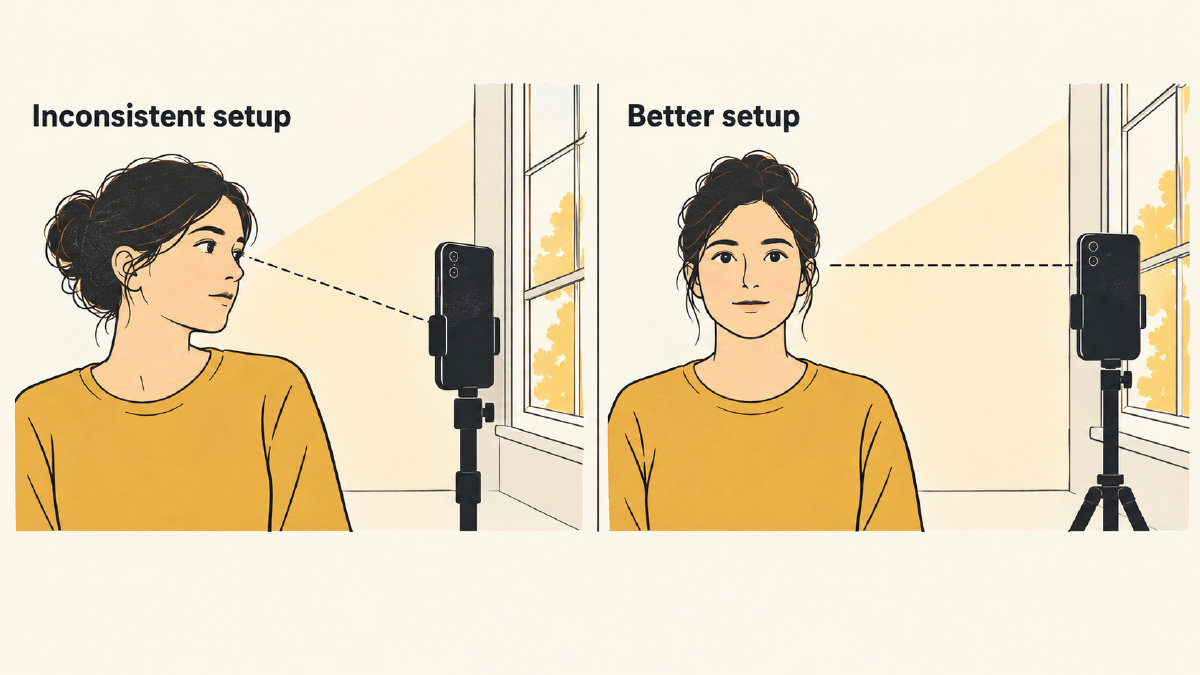
Strong close-up perspective and beauty filters can exaggerate or distort facial proportions, so avoid them when comparing images. If you take the test and find out that you have a very high asymmetry index, that means that the software finds larger mismatches between mirrored features. If your index is low, that means the software finds smaller mismatches. Try comparing two or three photos with similar framing, keeping the corners of your eyes and mouth visible. If the readings differ, check your pose, expression and the outlines the software detected in each photo.
But remember, the site explains that lower means more symmetric and compares your index with its typical range. So how can you tell what’s going on with your face?
How the symmetry index works
The symmetry index uses a mathematical algorithm that attempts to measure your face, and then computes what it considers to be a score for that. The site explains how it computes that index. Here’s how the algorithm works.
To compute your index, you upload a photo, and the software detects 478 points on your face in your browser. It uses 12 left-right pairs of those landmarks to measure the gaps after one side is reflected across the face’s centre line.
Once the software detects those points, it levels the pupil line. Then it averages the horizontal coordinates of eight midline points to set a vertical axis and reflects one side across that axis. Once that’s done, it calculates the average paired gaps and divides them by the width between your cheeks to calculate your symmetry index. The lower your index, the smaller the mismatch between the reflected left-right landmark pairs.
The site gives a range of values that appear to be among the values of the rated calibration faces. For example, approximately 0.007–0.032 represent the vast majority of values. However, these values are within the site’s calibration range, and shouldn’t be interpreted as medical thresholds for either symmetry or attractiveness.
The symmetry index measures symmetry in the image, but it doesn’t establish your complete three-dimensional facial structure or measure how attractive you are. Rather, the software simply calculates what it considers to be a measure of symmetry based upon the coordinate mismatch of each detected feature.
Can you compare the photos?
Comparing photos and measurement limits
We can look for a recurring appearance in the photos. If you take the test and you find that you have an identical score, then you’ve captured the same appearance in the photo. This might suggest that the photos have shown the same result, although that’s not always the case.
In individual images, you’re trying to understand what your anatomy is doing, combined with how the camera captures that. Perspective plays a large role, but you also have detection noise, as well as variations in camera positioning.
I performed an experiment of sorts by generating 52 cases constructed with known coordinates. Using that, I found that I could generate scores ranging from zero to about 0.14. But none of the photos used in this experiment, or any of the people or detector runs involved, were author tested. I only looked at the output, calculated the sensitivity of the model and did basic calculations to check the accuracy of the method.
I wasn’t able to perform any sort of real selfie measurement or determine the accuracy of the method against a clinical ground truth. There was no way to confirm that the method had been proven correct, nor was there any basis for diagnosing individuals or establishing a change in attractiveness due to any of these tests.
Is one-sided sleeping the reason?
One sided sleeping and chewing
Some researchers believe that habitual one-sided chewing leads to increased unilateral skeletal development. Others have speculated that constant pressure during sleep exclusively on one side may cause the face to become increasingly asymmetrical over time. Some studies suggest that sleeping with your head on one side may increase the risk of snoring and obstructive sleep apnea. While the evidence remains inconclusive, some research suggests that it may be possible to change sleep habits in adults.
However, researchers have yet to agree whether sleeping on one side increases the chances of developing an asymmetric face. While this hypothesis has been proposed, it hasn’t been adequately validated through longitudinal studies.
Habitual chewing on one side has been proposed as a cause of changes in facial shape over time. But the review describes this hypothesis as controversial and unvalidated because well-controlled longitudinal studies are lacking.
There’s no established evidence that changing sleep or chewing habits will improve facial symmetry. So unless you develop symptoms of sudden facial droop or weakness, the answer isn’t necessarily in your habits.
Warning signs of stroke
If you experience any of the following warning signs of stroke, call 9-1-1 immediately:
Sudden facial droop or one-sided facial weakness
Sudden numbness or weakness of the face, arm, or leg, especially on one side
Arm drift
Slurred or strange speech
Sudden confusion, difficulty speaking or understanding speech
Sudden severe headache with no known cause
Any warning sign requires emergency attention, regardless of whether it is caused by something else. Delaying care could put your life at risk.
Sources
Measure your own face
Free, in your browser. Your photo is never uploaded.
- Attractiveness TestFace rating, PSL range and eye type.
- Face Symmetry TestHow evenly the two sides match.
- Jawline AnalyzerJaw angle, jaw width and chin taper.