
Should I Get Bangs? Decide by Texture, Styling and Upkeep
Should I get bangs? Weigh your texture, cowlicks, styling routine and trim commitment, with curtain bangs and longer layers as options.
Table of Contents
I’ve been thinking a lot lately about bangs. Not necessarily getting them (unless I’m dreaming of the possibility), but more about how to determine whether or not someone should get bangs. I know that people often ask me if they should get bangs, but it’s hard for me to answer because I don’t know their hair type, lifestyle, habits, etc. So rather than just giving a general “yes” or “no,” I like to ask questions to help them decide.
So let’s talk about bangs…
Framing the Face
The first thing I always ask when considering bangs is whether or not the person prefers an open sweep or a defined edge. This has nothing to do with permission, but rather how you want your face framed. Open sweeps allow more room around the face, while defined edges give a more structured look.
I also consider the natural shape of the face as a starting point for styling. It doesn’t mean that we can’t have bangs that are anything other than what the face shape naturally allows. But I do start from there.
Texture & Length
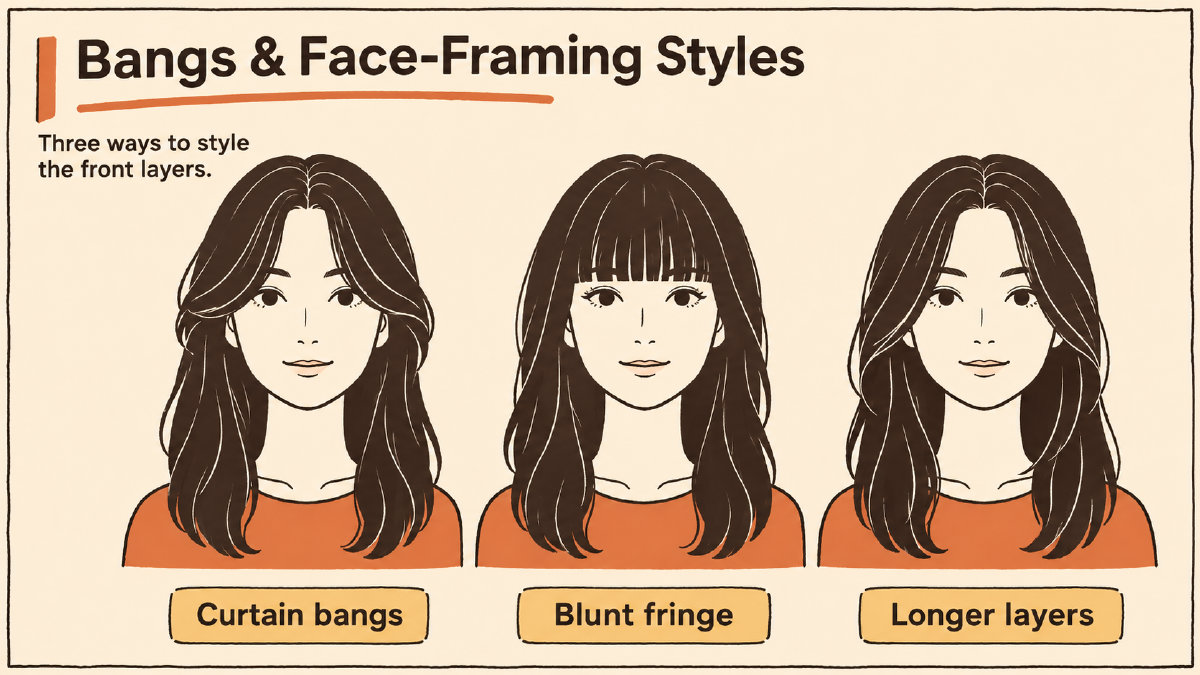
Next, I think about texture. If you have straight hair, then curtain bangs would probably be ideal. Curtain bangs part near the center, and then sweep outward. The lengthening into the haircut helps keep things balanced on the forehead.
If you have wavy or curly hair, curtain bangs may be difficult because those textures tend to shrink, move, and dry out in different ways. Curtain bangs require a bit more work to maintain. If you’re willing to put in the effort, then curtain bangs might be the way to go. But if you’re looking for something easier, then maybe a blunt cut would be better.
And if you have really thick, coarse hair, then curtain bangs will probably take even more effort to maintain. But again, if you’re willing to put in the effort, then curtain bangs could still work for you. I also look at how cowlicks, density, your part, and texture make the bangs separate around your face. For waves or curls, I’d want to see how the fringe dries naturally and springs up before choosing a length, especially if you switch between blowouts and your natural texture.
Styling Commitment
Then there’s the issue of styling. Curtain bangs aren’t as easy as they appear. I love them, but I absolutely hate having to spend time every single day styling my bangs. I prefer to air-dry my hair, and I don’t like having to blow dry and style my bangs each morning. And since I usually wear my hair back, I need to make sure that the bang area is dried first after washing before I dry the rest of my hair. That’s not really a problem for me, but some people find that their fringe tends to dry differently than the rest of their hair, and that can lead to an unwanted part in the middle of the bangs, or an emphasis on cowlicks.
But if you’re okay with spending a little extra time styling your bangs each day, then curtain bangs might be perfect for you.
Upkeep
And finally, there’s upkeep. Curtain bangs require a trim every three to six weeks depending on how fast you grow your hair. I know this sounds ridiculous, but it’s true. My bangs have never looked worse right after a trim than they do right before a trim. They’ll start growing out, and then I’ll forget to trim them, and the longer pieces will start blending into the longest pieces. So unless I trim them, they’ll look like curtains instead of bangs.
If you’re looking for something that requires less upkeep, then you might want to consider a longer face-framing layer. The longer pieces will blend into the longest pieces without requiring a trim. Plus, it’s easier to lose the shape between washes, and all you’d have to do is mist your hair lightly with water and restyle the fringe alone.
Hair Habits
Also, I like to ask about everyday habits. For example, if you wear glasses, you’ll probably want the shortest acceptable length. Longer fringe can work with glasses, but you may need to style it so it doesn’t curl over the top rim. Or if you pull your hair back for work, exercise, etc., then you’ll probably want longer pieces that are easier to tuck behind your ears. Shorter pieces may fall loose around your face.
Choosing Bangs at Your Consultation
My consultation process is similar to most salons. When someone comes in to see if they want bangs, I’ll show them pictures of various styles and lengths, and then ask about glasses, heat-styling frequency, usual part, and how often they pull their hair back. All of these factors influence how short or long the bangs can be.
So when you come in for your consultation, don’t bring a picture of the exact look you want. Bring pictures of the looks you’re inspired by, and explain which parts you like best. Ask how short the shortest piece will be, how the bangs will connect to your layers, and how often you’ll need to come back for trims. Then use the answers to practical questions to choose between bangs, longer framing, or waiting until your hair grows out.
For example, if you’re inspired by a certain look, and you tell me that you’d like the bangs to be softer on your cheekbones, or that you’d like more volume on top of your head, or that you’d like your brows to be more visible, or that you’d like something that grows out easily, then I can use that information to create a realistic request for the stylist.
Sources
Measure your own face
Free, in your browser. Your photo is never uploaded.
- Attractiveness TestFace rating, PSL range and eye type.
- Face Symmetry TestHow evenly the two sides match.
- Jawline AnalyzerJaw angle, jaw width and chin taper.