
How to Match Face Shape and Haircut to Your Styling Goals
Match face shape and haircut choices to your goals, hair texture, preferred length and styling routine, with practical options to discuss with your stylist.
Table of Contents
I’m always surprised by how many people seem to think that their face shape determines the only possible haircut they can ever wear. And while it’s true that your face shape will have a huge influence on what kind of cut you choose, it doesn’t mean that there are no other possibilities.
But once you know your face shape, don’t assume that means your haircut is limited to those that look good on someone with that same face shape. In fact, you’ll probably find that there are more options for you than you ever imagined.
So let’s take a look at some of the basics, and then we’ll discuss how different haircuts and styling goals affect the way we approach our face shapes.
Face Shape as a Starting Point
Your face shape is a great starting point when choosing a hairstyle, but it’s not the end of the process. It gives us a general idea of which styles would work well, and which wouldn’t be a good fit for you.
That said, face shape isn’t the only thing that matters. You also need to consider your desired effect. For example, if you want a shorter style, or if you want something longer, your face shape might suggest one type of cut, but another might actually work better for you depending on your preferences.
It’s also important to consider your natural texture and density. Some textures and densities lend themselves more easily to certain types of cuts than others. But again, it’s just a starting point, and not the final decision.
And finally, your face shape isn’t a hard-and-fast rule. Sometimes your face shape will fall into two categories, and sometimes you’ll fall somewhere in between. That’s okay! We’re all unique, and that’s part of the fun.
So while your face shape gives us a general idea of what kinds of styles will look best on you, it’s not the only factor that determines the perfect cut for you.
Lengths and Widths
Let’s start by talking about length and width. Most people who aren’t familiar with face shape identification think that the goal is to make your face appear longer or wider, but that’s not always the case.
You can choose to add apparent length (to give the illusion of a longer face), or you can choose to add apparent width (to give the illusion of a wider face). These choices determine how the lengths of your hair will look on your head.
For instance, if you have a round face, you might be looking for a visual length to counteract the roundness. If you have an oblong face, you might be looking for a visual width to counteract the elongation.
If you have a square face, you might be looking for a visual softness to soften the angles, or you might be looking for a visual sharpness to showcase your jawline.
Of course, these are just examples. Your desired effect may not necessarily be adding length or width, but rather making your face look smaller. Or perhaps you want your face to look larger.
The key is to remember that while your face shape is a good starting point, it’s not the only consideration.
Matching Your Desired Effect to Your Face Shape
So now that we’ve discussed the difference between adding apparent length and adding apparent width, let’s talk about how the shape of your face affects how you approach the length of your hair.
First, if you have a round face, you’re going to want to add apparent length. This can be achieved through a number of methods. One of the easiest is to simply raise the crown height. This gives the illusion of length without changing anything else.
Another method to add apparent length is to add straighter sides. The more straight the sides, the longer your face appears.
One of the easiest ways to add apparent length is to add layers. Layers create movement, and movement creates the illusion of length.
Side-swept bangs also help add length. Since they’re off-center, they create the illusion of a longer face.
If you’re considering bangs, keep in mind that straight-across bangs can visually shorten the forehead and face, while wispy or side-swept bangs will create the illusion of width.
Now, if you have an oblong face, you’re going to want to add apparent width. The easiest way to do this is to add horizontal volume. Horizontal volume adds width, while vertical volume adds length.
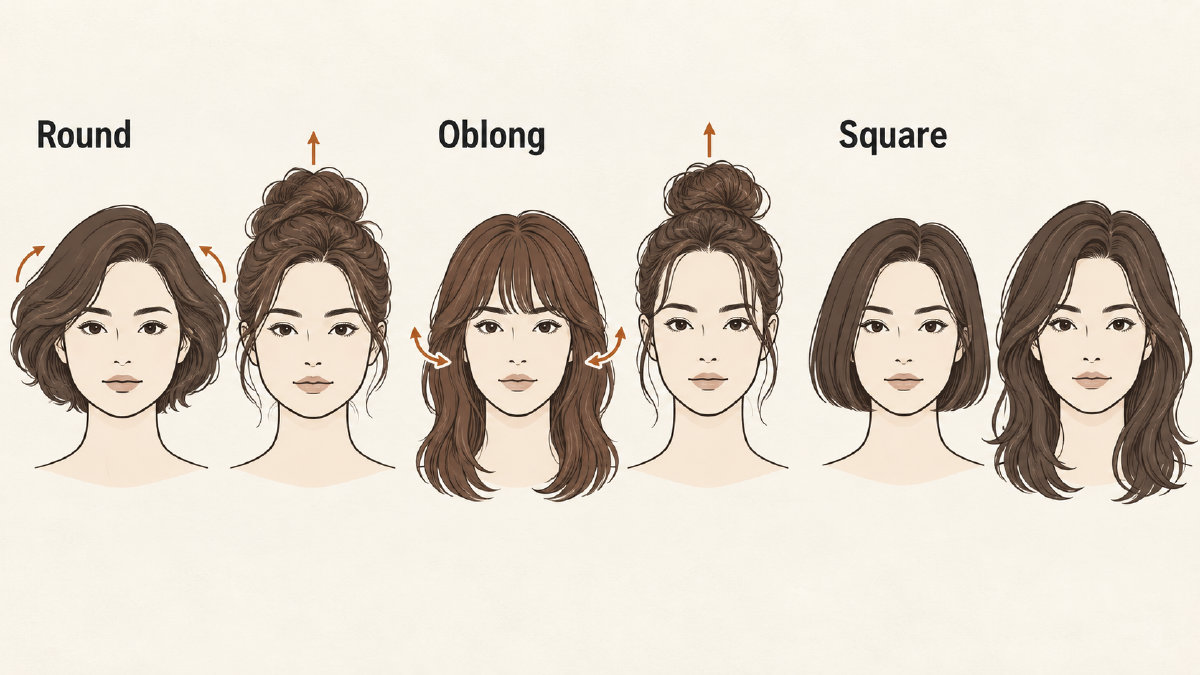
Adding layers is one of the easiest ways to add horizontal volume. Side-swept bangs also help add width, but since they’re off-center, they also add length.
Finally, if you have a square face, you might be looking for a visual softness to soften your angles, or you might be looking for a visual sharpness to showcase your jawline. Either way, the length of your hair will play a role in achieving your desired effect.
A jaw-length bob will emphasize your strong jawline, while a soft layered style or a textured shag will provide texture and movement to soften your angles.
If you want to add apparent width around your narrower lower face, you’ll need to add fullness. Heart shapes often benefit from a lob at or just below the shoulder, while diamond shapes tend to benefit from a textured lob.
If you want to add fullness around your narrower chin, you can use collarbone-grazing layers to create a fuller look.
Oval Faces
While oval faces are generally considered to be the most versatile face shape, that doesn’t mean you can’t still get creative with your cut. An oval-face shortlist could include pixies, blunt bobs, sleek shoulder-length cuts, long flowing layers, etc.
However, you should never base your choice solely on the length of your hair. Texture and willingness to style also play a big role in determining what kind of cut will work best for you.
For example, if you have fine strands of hair, you may find that a pixie with straight hair is easier to maintain than a pixie with waves or curls. On the flip side, if you have low-density fine hair, you may find that a short cut without a volume requirement is easier to maintain than a long cut with a lot of volume.
Texture and Density Considerations
Fine strands of hair are individual strands that are thin in diameter. Thin hair is overall hair density that’s low, meaning that there are fewer strands covering each square inch of your scalp. Both of these factors affect the way you approach layering, fringe and length.
With fine hair, you’ll usually want to avoid aggressive texturizing because it can reduce the natural volume of your hair. However, you may still want to remove weight from your hair, especially if you have thick hair. Just keep in mind that excessive weight removal can reduce the amount of natural volume in your hair.
When removing weight from your hair, you’ll also need to consider your natural texture. Thick hair tends to retain its weight and volume better than thin hair. That means that thick hair can handle more weight removal than thin hair.
Waves and curls need enough retained weight to hold their shape, but you’ll need to be careful about over-layering. Over-layering can cause your hair to lose silhouette and can also lead to more frizz.
On the flip side, if you have very fine hair, you’ll probably find that you need to keep your layers long in order to preserve the natural weight and movement of your hair.
So while the length of your hair is an important factor, it’s not the only one. Your natural texture and density also play a role in determining the best way to achieve the effect you’re looking for.
From Shortlist to Stylist Consultation
Once you’ve got your shortlist of potential hairstyles, it’s time to turn it into a stylist consultation. You’ll need to decide what you want to accomplish with your new look, and whether you’ll be willing to put in the work to make it happen.
Some people are perfectly content to go to the salon once every few months for a quick trim and call it a day. Others prefer to have their hair styled daily, and will put in the extra effort required to keep their look fresh and fabulous.
Before you sit down with your stylist, you’ll want to be prepared with inspiration photos, so your stylist has an idea of what you like. Be prepared to talk about your desired visual effect, preferred length, and available styling time.
You’ll also want to be prepared to talk about your preference for a fringe, and how much hair density you’d like to see. If you’re interested in a specific texture, such as waves or curls, be prepared to talk about how much you’re willing to put into maintaining that look.
Finally, be prepared to talk about your preference for layer placement. If you have a natural part, or if you have cowlicks, you’ll want to make sure your stylist knows where to place the layers. Also be prepared to talk about your hairline, growth patterns, and any areas of concern.
Remember, your hair is a reflection of your personality, and your personal style plays a huge role in how your hair looks and feels. Make sure your stylist understands your vision, and that you understand how much upkeep your chosen look will require.
Sources
Measure your own face
Free, in your browser. Your photo is never uploaded.
- Attractiveness TestFace rating, PSL range and eye type.
- Face Symmetry TestHow evenly the two sides match.
- Jawline AnalyzerJaw angle, jaw width and chin taper.