
How to Compare Face Shapes and Find Your Closest Match
Compare face shapes using forehead, cheekbone and jaw widths, face length and outline, with guidance for overlapping features and reference photos.
Table of Contents
If you’re like me, you’ve probably spent hours trying to determine your face shape. And if you’ve read my posts on identifying the different face shapes, then you know that there are many variations of each basic shape.
I also know that sometimes people have a hard time comparing their face shape with others. So I wanted to give you a few tips for how to compare your face shape to other people’s or to see which face shape is closest to yours.
Create a Consistent Reference Photo
First, let me explain how to create a consistent reference photo for comparing an adult facial outline. The key here is consistency — so when comparing photos or using a face shape detector, you need to make sure that the conditions are as similar as possible in order to get a good comparison.
Start by taking a clear front-facing photo. You don’t want any shadows or glare obscuring the details of your face. Use even lighting, and if you can’t take it during the day, use a soft light source. Avoid harsh overhead lights, because those will cast shadows over your forehead and across your cheeks. Soft light from the side (like natural light) is best.
Make sure that your hair is away from your forehead. If you’re going to be comparing your face shape to others, you’ll need to see your entire forehead.
Also, make sure that your expression is neutral. Don’t smile or frown, and avoid tilting your head up or down. The more neutral your expression, the more accurate your comparison will be.
Camera Distance and Facial Proportions
Now, position your camera around 5 feet away. This seems pretty arbitrary, but I did some research about nasal perspective and found this mathematical model that describes how distance affects our perception of size:
Using a mathematical model and population-average facial measurements, the researchers calculated how apparent nasal width relative to cheekbone width changes with camera distance. Their results were startling. When they used 12-inch images, they found that the apparent nasal size increased by 30% in males and 29% in females. However, when they took images at 5 feet, they found no perceived nasal-size difference from orthographic projection (i.e., the actual size). In other words, we don’t perceive a significant change in nose size when we move further away from someone’s face. So unless you’re standing right up close to someone, you won’t notice a big difference in the size of their nose. But this research was about nasal proportions. It didn’t test whether a photo taken at 5 feet gives you the right face-shape label.
So if you want to find your closest match among the basic face shapes, start by creating a consistent reference photo of yourself. Then compare it to other people’s photos under the same conditions, or use a face shape detector. If the two disagree, repeat the comparison until they agree. But even under consistent conditions, they may still disagree. Your outline, face length and widths can combine in different ways, so it’s fine to keep a tentative description instead of repeating the comparison until you get agreement. It’s possible that you might not find a perfect match, but you should be able to find one that’s very close.
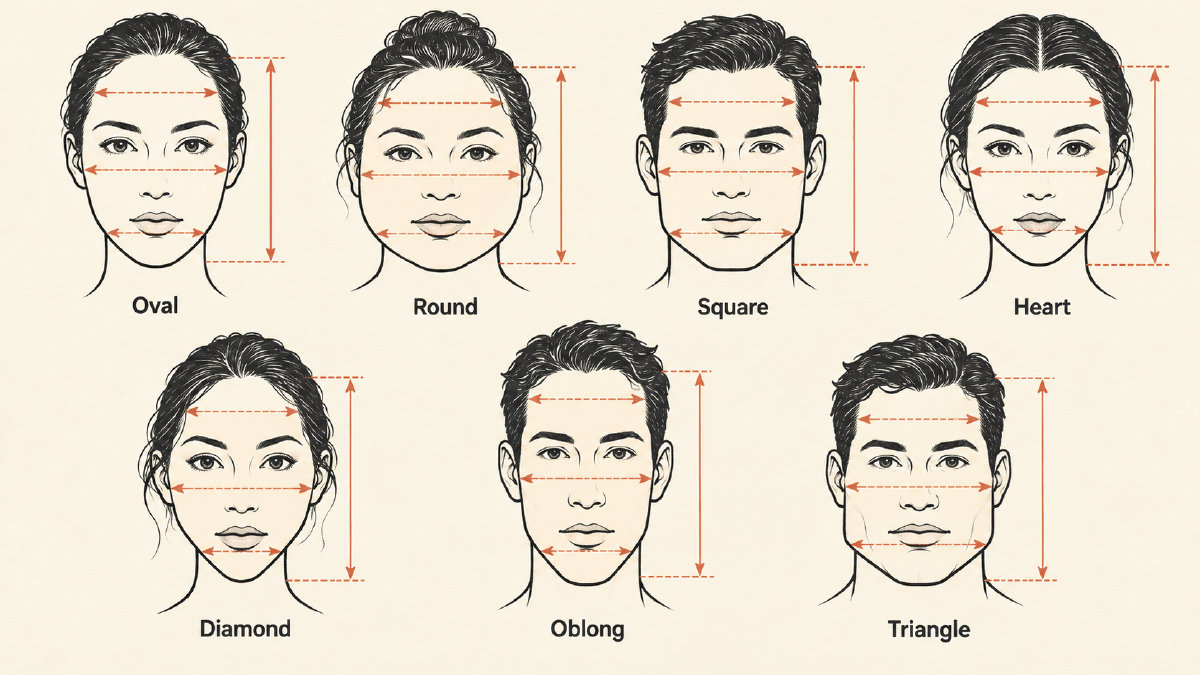
Compare Four Dimensions
Once you have a general idea of what your face shape is, then you can look for more specific descriptors. But first, let me explain how to do a four-dimension comparison on the same frontal reference. That way, you can preserve straight-across widths while distinguishing them from a measurement that follows the jaw edge.
Forehead width: Measure from one side of your hairline to the other side of your hairline.
Cheekbone width: Measure from the outermost soft-tissue points over the cheekbone arches.
Jaw width: Measure from the outermost soft-tissue points over the jaw angles.
Face length: Measure from the center of your hairline to the bottom of your chin.
Some guides measure from the jaw angle along the jaw edge to the chin, then double that distance. That follows the jaw edge, so you can’t use it in place of the straight-across jaw width described above.
Now, once you’ve got these measurements, you can start looking for comparisons. For example, if your face looks roughly square in all four dimensions, then you can label your face shape as “square.” But if your face looks round in some ways and square in others, then you might want to describe it as “elongated with rounded jaw” or “squarer with rounded jaw.”
In the absence of a perfect match, I recommend finding the closest match and then adding a secondary descriptor. For example, if your face looks most like a rectangle, but has a slightly elongated outline, then you could describe it as “elongated rectangle” or “rectangle with elongated outline.”
Round and Square Face Shapes
Let’s go back to the basics now. Let’s talk about how to distinguish between the basic outlines of the face shapes. First, let’s look at the round and square outlines.
The easiest way to distinguish between round and square outlines is to look at the jaw contour. A round face will have a nearly equal face length and width. The sides of the face will taper gently from the forehead to the jaw. And the jaw itself will be soft and curved, rather than angular.
A square face will also have a nearly equal face length and width. However, the sides of the face will be straighter, and the jaw itself will be more pronounced and angular.
Oval Oblong and Rectangular Faces
Now let’s move on to oval vs. oblong vs. rectangular faces. These three categories are often confused, but they aren’t really interchangeable. Here’s how to tell them apart.
An oval face is longer than wide, but isn’t necessarily significantly longer. An oval face tapers gently from the forehead to the jaw, with the cheekbones being the widest part of the face.
An oblong face is noticeably elongated. It’s longer than wide, and much longer than an oval face. An oblong face has straighter, more parallel sides with minimal taper from the forehead to the jaw, with the cheekbones being only slightly wider than the forehead and jaw.
A rectangular face is longer than wide, but isn’t necessarily significantly longer. A rectangular face has straighter, more parallel sides and squarer jaw angles, with the cheekbones being relatively comparable in width to the forehead and jaw.
The key distinction between oval and oblong faces is in the proportions and outline. Oval faces have a gentle taper, while oblong faces are noticeably elongated with straighter, more parallel sides. Rectangular faces are longer than wide, with comparable forehead, cheekbone, and jaw widths and squarer jaw angles.
Heart Diamond and Triangle Faces
Now let’s move on to heart, diamond, and triangle faces. These three are quite similar, but they aren’t interchangeable either. Here’s how to tell them apart.
A heart-shaped face has a broad, prominent forehead, high cheekbones, and a narrow, often pointed chin. The sides of the face taper gently from the forehead to the jaw, and the jaw itself is soft and curved.
A diamond-shaped face has a narrow forehead, wide cheekbones, and a narrow jaw. The sides of the face taper sharply from the forehead to the jaw, and the jaw itself is soft and curved.
A triangular-shaped face has a narrow forehead, narrow cheekbones, and a wide jaw. The sides of the face widen from the forehead to the jaw, and the jaw itself is angular.
It’s important to note that none of these face shapes are entirely defined by just one feature. They’re combinations of features, so you shouldn’t expect to find one exact label that perfectly matches your face. Rather, you should look for the closest match and then add a secondary descriptor.
For example, if your face looks most like a triangle, but has a slightly rounded jaw, then you could describe it as “rounded triangle” or “triangle with rounded jaw.” If your face looks most like a heart, but has a slightly pointed chin, then you could describe it as “pointed heart” or “heart with pointed chin.”
Choose Your Hairstyle
Once you’ve decided on your closest match, you can choose your hairstyle accordingly. Some styles work better with certain face shapes than others, so knowing your face shape is helpful when choosing a haircut. If you want more specific ideas, my diamond and heart face-shape guides cover identification and styling. My beard-style guide also lets you compare options by face shape and how much upkeep they need.
But if you’re unsure, then you can always experiment with different styles and see what looks best on you. There’s no one-size-fits-all approach to hairstyles. What works for one person may not work for another. So feel free to experiment, and don’t be afraid to try new things!
Sources
Measure your own face
Free, in your browser. Your photo is never uploaded.
- Attractiveness TestFace rating, PSL range and eye type.
- Face Symmetry TestHow evenly the two sides match.
- Jawline AnalyzerJaw angle, jaw width and chin taper.