
Diamond Face Shape: How to Tell and Style It
Learn how to identify a diamond face shape from forehead, cheekbone and jaw width, then choose hairstyles, beards, brows and glasses that balance it.
Table of Contents
I’m pretty sure you’ve heard of the “heart” face shape, but have you ever heard of the “diamond” face shape? I know it sounds like a very specific term, but but in reality, diamond faces are one of the less common face shapes. They’re often mistaken for heart-shaped faces because they also have a narrow forehead, a narrow jawline, and a pointed chin.
The difference is that a diamond-shaped face has a much more pronounced point at the cheekbones. The widest point on the face isn’t at the forehead or the jawline, but rather at the cheekbones. And if you look closely, you’ll notice that the diamond face shape is angular at the top and bottom, whereas the heart face shape is softer all around.
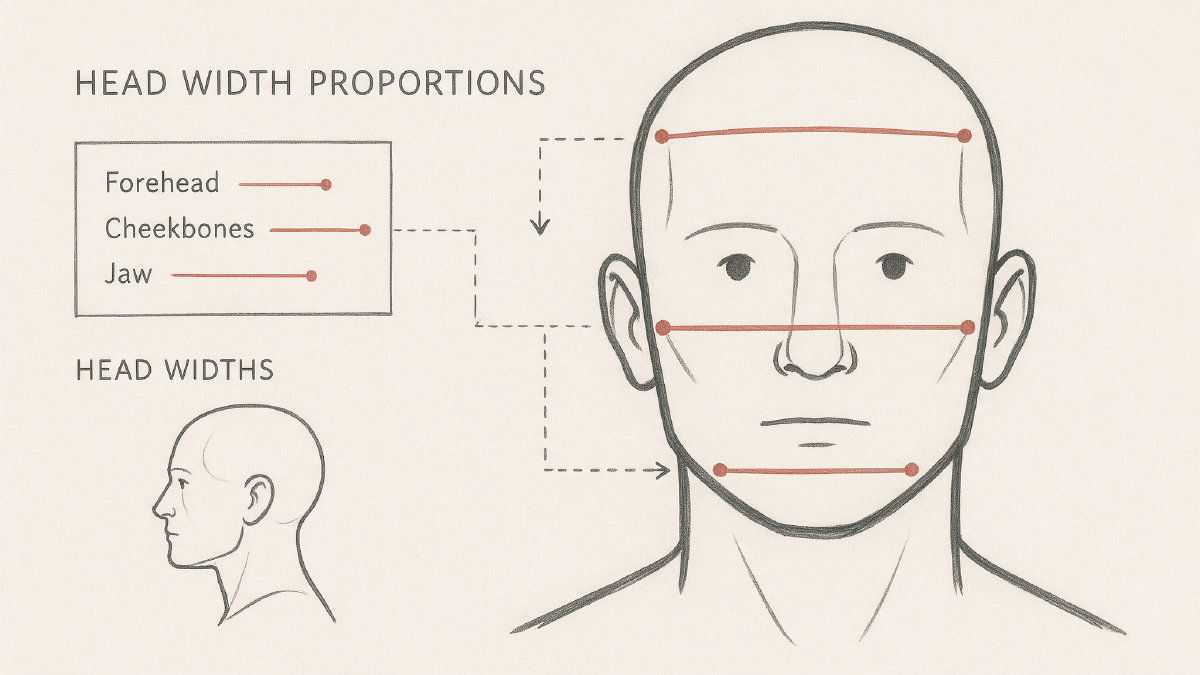
If you’re not sure if your face is diamond-shaped, here’s how to tell:
How to Identify a Diamond Face Shape
Take a front-facing photo of yourself with your hair pulled back and a neutral expression. Then measure the width of your forehead (the area above your eyebrows), your cheeks (at their highest point), and your jaw (across your jaw corners). Measure from the middle of each measurement to the other side. Then measure the length of your face from your hairline to your chin.
Here’s what the measurements should look like on a diamond face shape:
Your forehead is narrow.
Your jaw is narrow.
Your cheeks are wide.
The length of your face is about the same as someone with an oval face shape.
And your face is very angular at the top and bottom.
Diamond vs Heart and Oval Faces
Now let’s compare that to a heart-shaped face.
Heart-shaped faces also have a narrow jawline, but the forehead is wider — it’s the widest part of the face. The cheeks aren’t as prominent as on a diamond-shaped face, and the face is generally softer than a diamond face shape.
Oval face shapes are the most balanced of all face shapes, with a soft and evenly tapered structure. Oval face shapes are usually slightly longer than diamond or heart-shaped faces, but they’re similar in size to diamond face shapes.
So now that we know how to tell if we have a diamond face shape, let’s talk about how to style it.
How to Style Diamond Face Shapes
My goal when styling any face shape is to balance out the areas of the face that are too narrow and soften up the areas that are too angular.
For diamond face shapes, that means adding some width near the forehead and near the chin or jaw. Those are the two narrowest parts of the face. Adding some width there will help to create a better balance.
It also means minimizing the emphasis on the cheekbones. If we add too much width to the cheekbone level, we risk creating visual weight at that level of the face. That’s just one more thing pulling attention away from the rest of the face.
Of course, we can’t forget about texture! Textured cuts are always a great option for diamond face shapes, especially those with lots of volume. But we do want to be careful where we place that volume. We don’t want it concentrated only at the cheekbone level, and we definitely don’t want it sitting right on the cheekbones. Volume should be distributed throughout the head, but it should never be so heavy that it creates a new widest line across the cheekbones.
We also want to avoid anything that draws attention to the narrow outline of the face. That means avoiding things like flat center parts, tightly pulled-back hair, and very short crops.
In terms of direction, these are my go-to options for people with diamond face shapes:
Soft layers
Side-swept bangs
Face-framing fringe
Textured cuts
Textured crop
Sweeping fringe
Faux hawk
There are certainly exceptions to every rule, and some of the advice about fringe or chin-length cuts might depend on how they’re executed. For example, a textured crop could actually work well for someone with a diamond face shape, depending on where the fullness is placed. Or if someone really wants a fringe, then side-swept bangs are probably a safer bet than a heavy straight fringe.
On the flip side, these styles are usually bad choices for someone with a diamond face shape:
Flat center part
Tightly pulled-back hair
Very short crops
Volume only at cheekbone level
Excess crown height
But again, there are exceptions to every rule, and it depends largely on execution. For example, a textured crop that’s full on the upper face and shorter on the lower face could work well for someone with a diamond face shape. Or a faux hawk that’s swept high over the forehead and tapers off at the temples could also work.
Facial Hair for Diamond Faces
Facial hair can be a great addition for men with diamond face shapes, but it needs to be done carefully. You don’t want to add unnecessary width to the face by adding facial hair. A full, squared beard, for example, can add perceived width around the jaw, which can help balance a narrow jawline.
A full squared beard can add visual jaw width, which is perfect for someone with a narrow jawline. But it’s a bit of an upkeep nightmare. So if you’re thinking of adding facial hair, keep it simple. A mustache is a lower-upkeep option, but it adds width to the upper face rather than the jaw, so it doesn’t create the same balancing effect as a squared beard.
Brow Grooming for Diamond Faces
Brows can make or break a face shape, so I think this is one of the most important considerations when deciding how to style your face. Fortunately, brows can be used to enhance any face shape, including diamond face shapes.
Since the upper face is relatively narrow, I think fuller defined brows will help to give the upper face more presence. However, I think it’s still important to maintain the natural brow shape. Don’t try to change the brow shape completely to something that doesn’t match your face shape. Brows shouldn’t override the overall structure of the upper face.
Glasses for Diamond Faces
Glasses can be tricky for diamond face shapes. You don’t want the glasses to emphasize the narrowness of the upper face, so I’d steer clear of frames that sit too low on the face. Also, you don’t want the glasses to create a new widest line across the cheekbones. So while I wouldn’t automatically say no to a frame that sits directly on the bridge of the nose, I would prefer something that sits a little higher.
Frames with upward emphasis, such as oval frames, cat-eye frames, or lightly rimless frames, tend to be the best options for diamond face shapes. Frames with downward emphasis, such as bottom-heavy frames, tend to be worse choices.
Glasses with decorative temples, such as those with dangling beads or tiny flowers, are also a good option for diamond face shapes.
AttractivenessTest Geometry Tools
I realize I haven’t mentioned the AttractivenessTest geometry tools yet, but they’re actually incredibly helpful for checking whether you have a diamond face shape. In fact, I use them daily to check my own face proportions.
You can find the FWHR calculator here.
Or if you’re interested in comparing your cheekbone width to your upper face height, you can use this tool.
Or if you want to analyze your jawline, you can use the jawline analyzer here.
Or if you want to see how your jaw angle looks from the front, that measurement is included in the jawline analyzer here.
Or if you want to compare your jaw width to your cheekbones, you can use the jaw width against cheekbones calculator here.
Or if you want to see how your chin tapers, you can use the chin taper calculator here.
Or if you want to calculate your face proportions using the facial thirds calculator, you can use that here.
Or if you want to test your face symmetry, you can use the face symmetry test here.
None of these are specifically designed to classify your face shape, but they’re all incredibly helpful for checking proportions.
I hope you found this article helpful!
Sources
Measure your own face
Free, in your browser. Your photo is never uploaded.
- Attractiveness TestFace rating, PSL range and eye type.
- Face Symmetry TestHow evenly the two sides match.
- Jawline AnalyzerJaw angle, jaw width and chin taper.