
Different Eyebrow Shapes and How to Choose Yours
Compare different eyebrow shapes, identify your natural arch, and choose grooming options based on growth, face proportions and upkeep.
Table of Contents
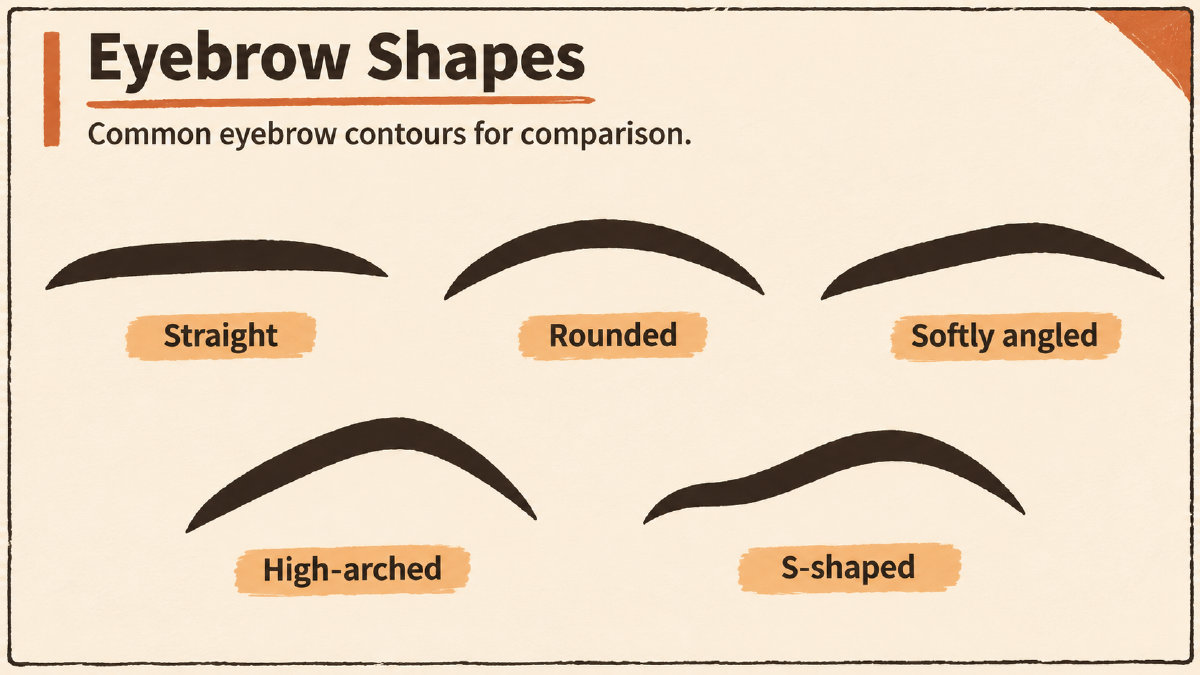
There are so many different ways to shape eyebrows, but most of them fall into one of five general categories. Let’s take a look at those options, and then we’ll talk about how to choose the best eyebrow shape for you.
Straight Brows (Little or No Arch)
These brows have very little or no arch. They’re basically straight across with only a slight curve near the end. Straight brows can be natural or they can be shaped that way. I’ve seen some people who naturally have straight brows, and then there are others who shape their brows in such a way that they appear straight.
Rounded Brows (Continuous Curve)
This is another brow shape that can be either natural or shaped. Rounded brows have a continuous curve from start to finish, and usually don’t have an actual peak. When identifying this shape, look for a smooth curve rather than a sharp angle.
Softly Angled Brows (Slight Arch)
The softly angled brow has a slight arch that doesn’t really stand out. It’s still considered a soft angle because the arch isn’t dramatic.
High-Arched Brows (Dramatic Rise)
High-arched brows are just what they sound like. There’s a very noticeable rise in the middle of the brow.
S-Shaped Brows (Upward Curve Near Front)
S-shaped brows are often confused with high-arched brows, but these two shapes are actually quite different. The S-shaped brow starts with an upward curve near the front, which continues on down toward the tail of the brow. Most S-shaped brows have a classic arch, but sometimes they have a rounded one.
Now, when looking at these brow shapes, keep in mind that the labels are overlapping descriptions. For instance, an S-shaped brow might also be referred to as having a classic arch, and an S-shaped brow might also be described as a rounded brow. So if you’re trying to determine what kind of brow shape you have, try to think about your natural growth pattern rather than relying solely on terminology. Also, keep in mind that some of us may not have any of these brows exactly as described, and instead have a mix of these styles. That’s okay! As long as you know what your natural contour is, you can work with that.
Contour vs. Thickness
When talking about shaping eyebrows, it’s important to distinguish between contour and thickness. Contour refers to the shape, while thickness refers to how wide your brows are. That width can vary from one part of your brow to another. Density is how many hairs you have within the brow. Lilac St. also describes tail length and upward tail direction separately, so think about whether you want to change the tail rather than the whole contour. So if you’re considering whether you want thick brows or thin brows, you need to make sure you understand the difference. When choosing between a thick brow and a thin brow, consider how much time you want to spend filling and styling your brows every day. If you prefer to have little makeup and an effortless, low-maintenance brow, then a thin brow is probably your best bet. But if you enjoy filling and styling your brows every day, then a thicker brow may be more to your liking.
Face-Proportion Suggestions
Some experts recommend certain brow shapes based on face proportions. For example, Vogue’s experts suggest that square faces should go for softer angles. On the other hand, Garcia from Vogue recommends flatter, more horizontal brows for longer rectangular faces. Garcia also says that round faces should opt for either softly angled or higher-arched brows, while heart-shaped faces should stick with rounded brows. Lilac St. offers both more arched and softer rounded options for heart-shaped faces, so rounded brows are one option rather than a requirement.
But keep in mind that these suggestions are attributed to styling preferences, not necessarily natural growth. Just because someone suggests a certain brow shape for a particular face shape doesn’t mean that it’s right for you. In fact, you should always start by determining what your natural brow shape is before making any decisions about trends or popular choices.
Mapping Your Brows
If you’re interested in changing your brow shape, you might want to map your brows first. Mapping is simply a way to sketch out a proposed contour for your brows before shaping. You’re marking a proposed start, peak and end. Meghan at MMM Beauty explains that arch placement depends on your individual face and brow growth. You can use individual growth patterns to guide placement, or you can use approximate home marks to support your decisions. Keep in mind that mapping doesn’t demand exact symmetry, so don’t stress over getting everything perfect. A rough pencil mark will do.
I’ve had my brows mapped professionally once, and it was absolutely amazing to see how much of a change could be made. However, since my brows were pretty dramatically changed, I would never consider doing something like that without professional help.
Previewing Changes
If you’re planning on making modest changes to your brows, then temporary filling and brushing will give you a good idea of what you’ll look like with the new shape. Fill in your brows with brow pencil and brush them up slightly, and then compare your current brows to the filled-in ones. This comparison will help you determine if you prefer a fluffier appearance or a denser, more controlled look.
It’s also a good idea to preview changes with temporary filling and brushing before removing hair. It helps me judge how much contour I want, and it gives me an idea of how much daily upkeep I’m willing to handle. If I find that I’m spending too much time working with my brows each day, then I’ll decide against making the change.
And remember, if you’re not sure about the contour you want, then you can stick with temporary filling and brushing while you decide. I’d rather have a little bit of asymmetry than to have a perfectly symmetrical brow that doesn’t look right.
Sources
Measure your own face
Free, in your browser. Your photo is never uploaded.
- Attractiveness TestFace rating, PSL range and eye type.
- Face Symmetry TestHow evenly the two sides match.
- Jawline AnalyzerJaw angle, jaw width and chin taper.