
Is Your Face Shape Square? How to Tell and Style It
Is your face shape square? Compare forehead, cheekbone and jaw widths, account for photo perspective, and choose haircuts and glasses.
Table of Contents
If you’re wondering if your face shape is square, then the first step in determining that is to actually look at your face. That might sound strange, but it’s true. If you’ve never looked at your face before, or if you’ve only ever looked at it in a mirror (and I know how frustrating that can be), then you probably don’t realize just how angular your face might be.
How to Tell if Your Face Is Square
So take a minute to grab a flexible measuring tape and see if your face measures up to the following:
Angular outline
Strong, defined jawline
Defined cheekbones
Forehead, cheekbones and jaw about the same width
Broadly comparable face length and width
It doesn’t have to be perfect, and there are no exact numbers that define a square face. But when compared side by side, they should all be pretty close to each other. If any one of those areas stands out as being much wider or longer than the others, then it’s not a square face.
But again, this is just an overall general idea. If you want to get really detailed, then I recommend using the jawline analyzer tool to check out your lower outline. It takes four measurements from a front photo to help you check that part of your face.
My jawline is very angular. My jaw angle is extremely sharp, and my jawline tapers very little. The jawline itself is also fairly wide, which makes sense because my jawbone is so prominent. My jaw width is almost exactly the same as my forehead and cheekbone widths. And since my jawline isn’t tapering much, it creates a straight line from my forehead down to my chin. So that means that the entire outline of my face is very angular, and it looks like a square.
I’m still quite angular, but it’s not quite as pronounced as it is in a selfie. A close camera makes the features nearest to it look bigger compared with those farther away. So try moving the camera back and keeping the lens near eye level for a more neutral comparison.
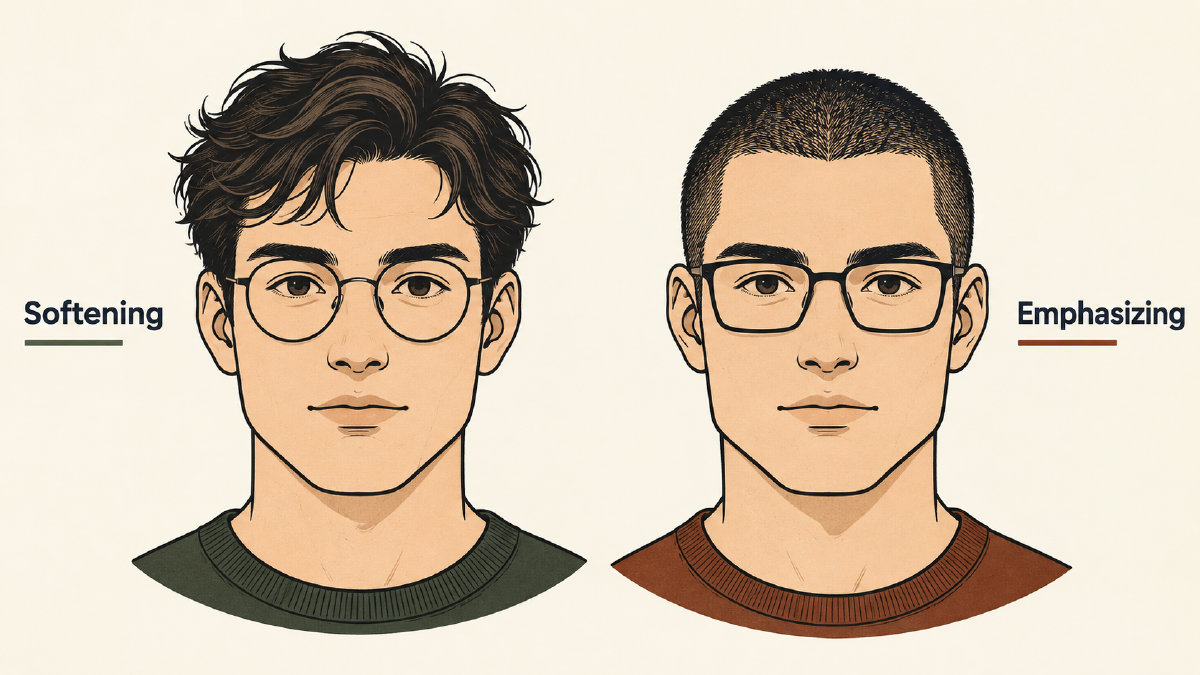
Now that we’ve determined that my face shape is square, let’s talk about styling tips for square faces. For people with square faces, the goal is to soften the angles. This can be done in two ways — either through haircuts or through glasses. Let’s start with haircuts.
Textured Crop
This style has a lot of softness, dimension and added volume. The top layers will help to create softness around the forehead, while the choppy waves will add movement and softness to the rest of the face. You’ll want to use some texturizing cream or pomade to keep the ends looking messy and textured. A low taper on the sides will also add softness and reduce the emphasis on the strong jawline.
Long Layers
These long layers are another great option for softening the angles of a square face. These styles add softness and dimension, and the layers also help to add volume to the front of the face where the angles tend to stand out most.
Soft Waves
If you love waves, then this is a great way to achieve them without creating a very angular effect. Because the layers aren’t as short as they are on the textured crop, these waves won’t be as dramatic, and the softness will make your face appear less angular.
Shortest-Layer Alternatives
If you’re considering a lob, then keep in mind that the shortest layer should generally fall somewhere below the jawline. If it falls directly on the jawline, then it may draw attention to the jawline and make your face appear even more angular. The guides differ here, though. wikiHow suggests below-jaw layers for softness, while Empire Beauty School recommends a chin-level shortest layer. So I’d talk to your stylist about where yours should fall, since there isn’t one placement that everyone recommends.
If you prefer a shorter cut, then consider a soft, layered lob.
You’ll notice that the shortest layer on this haircut is right at the jawline. This could be a problem for someone with a square face, but since it’s a layered style, the emphasis is on the layers rather than the jawline itself.
For people who prefer a very short cut, I recommend keeping the shortest layer away from the jawline.
You’ll notice that the bottom of the longest layer is well away from the jawline, and the shortest layer is actually below the jawline. The layers are soft and textured, and the back of the head is tapered off. This helps to give the illusion of a softer, more rounded face.
French Crop
The French crop is another excellent choice for people with square faces. It’s a very short style with a blunt fringe and a low fade on the sides. The short top and blunt fringe will help to highlight your angular features. This is a great option if you want a very short, modern look.
Buzz Cut
The buzz cut is another option for people with square faces. Since this is such a short style, it tends to emphasize the angles of the face. However, if you choose a buzz cut that leaves a bit of length along the jawline, then it can create a very soft, rounded effect.
Cat Eye Frames
Square faces can sometimes be difficult to style with glasses. When choosing frames, it’s important to find a balance between contrasting and echoing the angles of your face. Round and oval frames are great options because they provide curved contrast against the sharp lines of a square face.
On the flip side, square, rectangular and geometric frames echo the angles of a square face, so they’ll accentuate the hard edges and make your face appear even more angular. They’re definitely not a bad choice, but they’re simply not the best choices.
Cat eye frames offer a nice middle ground between the two extremes. They echo the angles of a square face, but they also add a curve at the top and bottom that helps to soften the appearance of the face.
Of course, frame shape is a visual styling choice, and it’s completely based on personal preference. The physical fit of the glasses on your face is a separate consideration.
Sources
Measure your own face
Free, in your browser. Your photo is never uploaded.
- Attractiveness TestFace rating, PSL range and eye type.
- Face Symmetry TestHow evenly the two sides match.
- Jawline AnalyzerJaw angle, jaw width and chin taper.