
How to Choose Hair for Square Face Shape and Texture
Choose hair for square face shape by comparing short cuts, bobs, layers and bangs for your texture, styling routine and desired effect.
Table of Contents
When I first started learning how to cut hair, I remember being so fascinated by the idea of a “perfect” haircut. It didn’t matter what face shape someone had. There was always one perfect length, style, and shape that would work perfectly on everyone—including anyone choosing hair for square face shape.
And then I realized that it wasn’t about perfection at all. It was about personal preference. It was about texture and density. And it was about finding the right balance between emphasizing angles and softening them.
It’s also important to remember that when choosing a haircut, your face shape is just one starting point. Your personal preferences are equally as important. That said, here are some things to keep in mind when choosing a hairstyle for a square face shape and texture.
Short Haircuts for Square Faces
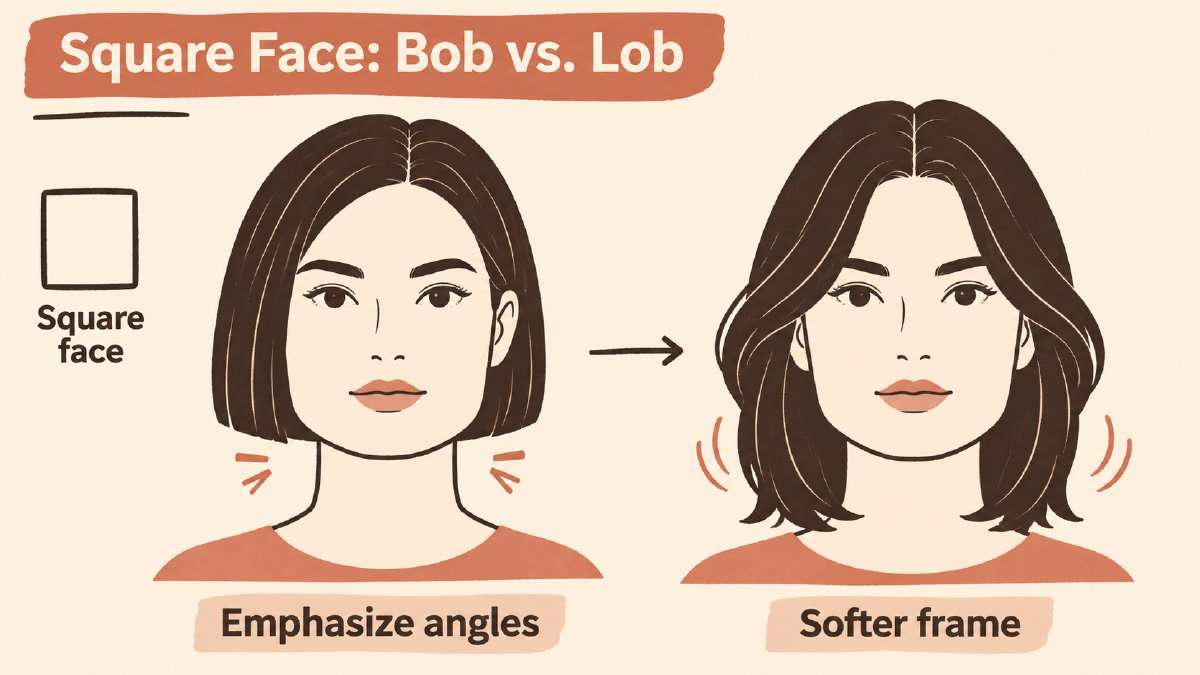
When thinking about short haircuts for square faces, the goal is to create a softer frame while still keeping the structure of the face intact. The key is to make sure that you’re not cutting off too much of the jawline or cheekbones.
The most popular short haircut for a square face is the blunt bob. But this isn’t necessarily the only option. If you want more movement and an open frame, try a textured pixie with tapered sides and a crown height that’s higher than the rest of the head. This will elongate the face and help balance out the squareness of the face.
You can also go longer with your hair and use layers around the cheekbones and jaw to add movement and create an open frame. Keep in mind that the longer the layers, the more movement you’ll have, but you won’t lose any length from the top of the head.
Medium-Length Haircuts for Square Faces
For medium-length haircuts, the goal is similar to what we discussed above — to soften the angles of the face without losing the definition of the jawline. So rather than going straight across, look for styles that have some movement in them.
A collarbone lob is a great option because it has enough length to provide some movement, but it’s still short enough that it doesn’t draw attention to the squareness of the face. It’s also a great choice if you prefer shorter lengths, because the layers aren’t quite as dramatic.
If you’d like to take it a little bit further, consider a longer haircut with lots of soft layers around the cheekbones and jaw. These types of styles usually have a lot of movement, and they give the illusion of length even though you’re keeping your hair pretty short.
Long Haircuts for Square Faces
If you prefer long hair, there are still plenty of options available to you. In fact, many of the styles that work well on other face shapes can be adapted to work well on square faces. Just make sure that you don’t go too long, because you don’t want to end up with a hairstyle that draws the eye downward and makes your face appear even larger.
In general, anything below the jaw should work well for a square face shape, and a lob that ends at the collarbone with soft movement can help soften a strong jawline. If you want to emphasize your jaw instead, a blunt bob is an option. Keep in mind that the overall length and the length of your first layer are two different things. You can keep your hair longer and have the first layer start at chin level, so you’ll want to agree on both placements with your stylist.
Bangs and Partings for Square Faces
Bangs can work well for square faces, but it depends on how you style them. Curtain bangs, parted through the center and swept outward, generally work best because they’re a bit softer and they blend into the surrounding layers. Curtain bangs are typically cut to graze the cheekbones, which helps elongate the face.
On the other hand, heavy blunt fringe tends to sharpen the overall look, and it emphasizes the symmetry of the face. It’s definitely something that should be avoided if you’re looking for a softer frame.
Keep in mind that partings also play a role in framing the face. A center part creates a very sharp line, and it tends to emphasize the symmetry of the face. A natural part gives a much softer effect, and it embraces the natural structure of the face.
So whether you prefer a center part or a natural part, keep in mind that a slightly off-center part between the side and the middle of the forehead gives a much softer frame than a true center part does.
Fine Strands vs. Low Density
One of the biggest mistakes people make when choosing a haircut for fine strands is assuming that the solution to thin hair is more volume. While adding volume is certainly a good thing, it doesn’t mean that you need to aggressively texturize your hair. Texturizing removes some of the natural volume you already have, so you may end up looking thinner than you did before.
That’s why it’s important to determine whether you have fine strands or low density. Fine strands refer to the diameter of the individual strands, while low density refers to the number of strands per square inch of scalp.
If you have fine strands, you’ll probably find that you’ll need to go a little longer than you might think you need to in order to get the desired fullness. You might even be able to get away with a light overall shape that seems really full when it’s dry, but when it’s styled, it looks a bit sparse.
If you have low density, you’ll probably need to go a little shorter than you might think you need to in order to get the desired fullness. Because you have fewer strands to begin with, you won’t be able to hide the gaps as easily as you could if you had fine strands. If your concern is fine strands, ask your stylist about long layers or a gently textured bob. Both are options for creating the impression of fullness.
Textured vs. Straight Hair
I’ve written extensively about how curly and coily hair behaves differently than straight hair, but I haven’t yet addressed the question of how the texture affects the overall shape of the haircut. For example, if you have straight hair, you might want to look for a style that allows your hair to move around your face. On the other hand, if you have wavy hair, you’ll probably find that your existing movement through the cheekbones and ends will do a lot of the work for you.
Curly and coily hair requires a different approach. Rather than creating a rigid line against the jaw, you’ll want to focus on creating a balanced silhouette using both volume and layers.
Texture aside, the main thing to remember is that curly and coily hair shrinks when it dries, so you’ll need to account for that shrinkage when deciding how long you want your fringe and layers to be. When you cut your hair, you’ll also want to leave a little extra length at the ends so that you’ll have enough weight at the bottom to support the shape you’re trying to achieve.
Adapting the Shortlist
Now that you have a list of potential hairstyles, you can start adapting it to your own unique needs. Here’s how to go about doing that:
-
Start by looking at the photos of the styles you’ve chosen. Ask yourself, “What do I like about each of these styles?” Once you have a list of the things you like about each style, compare those lists and see where you overlap.
-
Next, ask yourself, “What do I dislike about each of these styles?” Again, compare those lists and see where you overlap.
-
Now you should have a shortlist of styles that you really like, and you should know exactly what you don’t like about each of those styles. From that shortlist, you can eliminate the styles you don’t like, and then narrow down your choices until you have a manageable number of options left.
-
Then, go back and compare the remaining styles to each other. What are the similarities? What are the differences? Which styles seem to be the closest to the ones you actually like?
-
Continue comparing and contrasting styles until you finally arrive at the final answer — the style you actually want to wear.
-
At this point, you’ll probably realize that none of the styles you considered are exactly what you want. But now you’ll have a better understanding of what you’re looking for, and you’ll be able to tell your stylist exactly what you want, and he or she will be able to come up with something that works for you.
-
Finally, you’ll want to turn that shortlist into a list of questions for your stylist. Ask him or her to show you the results of several styles, and then compare those results to see which style you like the best. Bring your inspiration photos and ask, “Will this emphasize my jaw or soften it? Can we keep the length I want? How much time will I need to spend styling it?” Be clear about how much time you actually have, and ask how your natural parting, cowlicks, hairline, and growth patterns will affect the styles you’ve chosen.
-
Be sure to ask your stylist to explain the reasoning behind his or her recommendations, and then compare those reasons to your own thoughts and opinions.
-
Finally, once you’ve decided on a particular style, you’ll want to make sure that you understand exactly how it will look once it’s finished. Don’t assume that you’ll like it simply because it’s something you’ve seen in magazines or online. Make sure that you understand exactly how it will look, and then ask your stylist to explain the reasoning behind his or her recommendation.
Once you understand exactly how the haircut will look, you’ll be ready to make your decision.
Sources
Measure your own face
Free, in your browser. Your photo is never uploaded.
- Attractiveness TestFace rating, PSL range and eye type.
- Face Symmetry TestHow evenly the two sides match.
- Jawline AnalyzerJaw angle, jaw width and chin taper.