
How to Tell If You Have High Cheekbones
Learn how to identify high cheekbones using approximate facial landmarks, distinguish height from width, and understand the limits of photos.
Table of Contents
It’s a common question I get asked, and I’m always happy to help out with it. But since I’ve been asked so many times, I thought it might be helpful for me to explain how you can tell if you have high cheekbones.
What high cheekbones means
The first thing to understand is that the term “high cheekbones” isn’t really a medical classification. It’s more of an everyday description that people use to describe where on their face the most prominent point of the cheekbone is located. So in other words, some people describe themselves as having high cheekbones, and others describe themselves as having low cheekbones, but those are just approximate descriptions of where that most prominent point is located vertically on your face.
Here’s what that means…
High cheekbones = The most prominent point on the cheekbone is close to the eyes, roughly level with the nasal bridge.
Low cheekbones = The most prominent point on the cheekbone is nearer to the nostril level.
Most people fall somewhere between those two extremes, and they’re not necessarily either/or types. That said, I think that when people talk about having high cheekbones or low cheekbones, they’re usually referring to where that most prominent point is located relative to the nose.
Find the most prominent point
So how do you figure that out? Well, here’s my favorite way…
Using your fingertips, start at the outer corner of one eye and gently press along the bone toward the ear until you find the most projecting point. Then lift your fingers up from the bone and compare that height to the nose. If the most projecting point of your cheekbone is near the level of your nostrils, then your cheekbones are considered to be lower. If that point is roughly level with the bridge of your nose or close to your lower eyelid, then your cheekbones are considered to be higher.
That seems pretty simple enough, right? And while it doesn’t give you any sort of numerical measurement (like inches), it’s an informal way to observe the placement of your cheekbones without needing to measure anything independently.
Projection and facial fullness
But wait! There’s also the issue of projection. A very sharp or broad contour on the cheeks may appear quite different depending on the angle from which you view them. For example, someone who has flat cheekbones may look like they have high cheekbones from certain angles because of the sharpness of the projection.
Similarly, having very wide cheekbones doesn’t necessarily mean they project further forward or sit higher on your face. So if you want to determine if your cheekbones are truly high, then you’ll need to consider both the vertical height of the cheekbone and the projection of the cheekbone. But forward projection itself doesn’t determine whether they sit high; that’s a question of vertical placement. The side-to-side distance across your face at cheekbone level is called bizygomatic width.
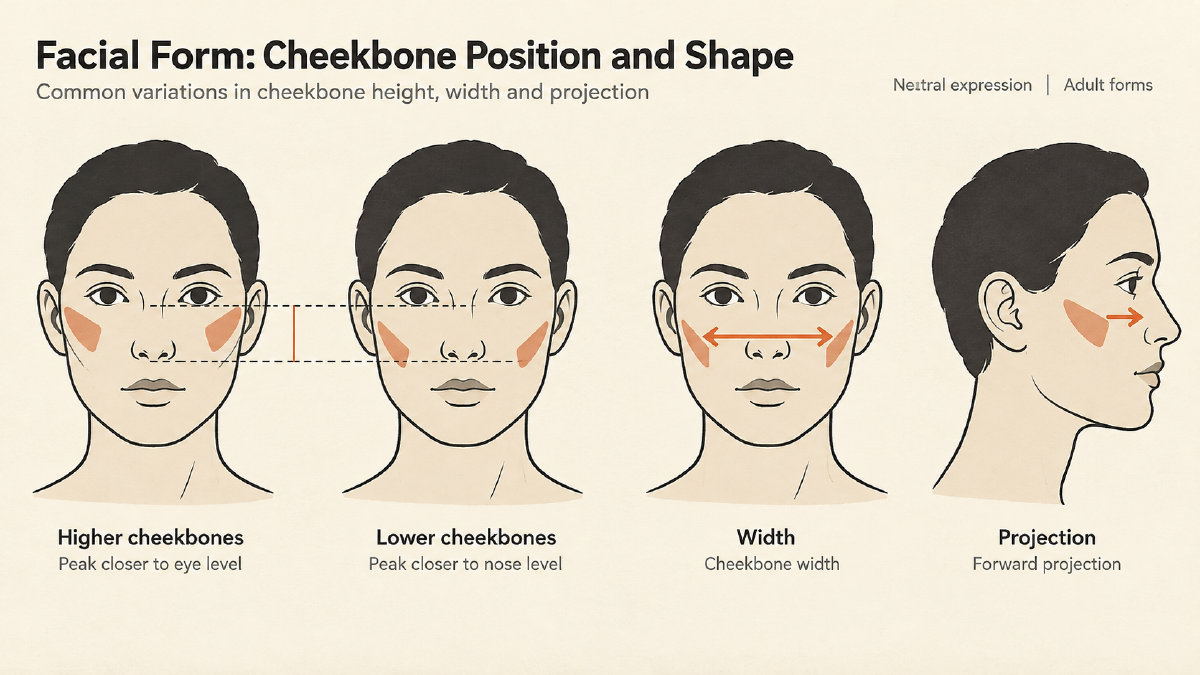
Also, remember that this is only considering the shape of the bone itself. It doesn’t take into account overlying fat, muscle, and skin. In fact, facial fullness and covering tissues will affect how much of your cheekbone is visible, and thus how high or low it appears. So if you have a lot of facial fullness, then your cheekbones won’t show as much definition as someone who has less facial fullness.
Check your cheekbones in a mirror
So if you’d like to try figuring out where your cheekbones sit on your face, I suggest using a mirror. Here are a few things to keep in mind:
-
Look at yourself in the mirror with overhead light, no make-up, and looking straight ahead.
-
Try looking at yourself with a bit of lighting coming from the side to see if the shadow beneath the cheekbone changes the appearance of the cheekbone’s height.
-
Use your finger to highlight over the most prominent cheekbone area, and then use your finger to highlight under the cheekbone area. Under the overhead light, look for a highlight over the cheekbone and a shadow beneath it.
-
Compare your face to photos of other people who have high cheekbones or low cheekbones.
And if you’re ever wondering why someone else looks like they have high cheekbones or low cheekbones, don’t forget that we all change expressions. Some expressions lift the soft tissue around our face, and bunched cheek apples cause the cheekbones to appear higher. Other expressions flatten the soft tissue, causing the cheekbones to appear lower. So even though the cheekbones haven’t moved, the surrounding soft tissue has. For the check, keep your face relaxed rather than smiling. And remember that a photo only gives you one view, so it can’t show the full three-dimensional shape of your face.
I know that’s probably more information than you wanted, but I figured it was worth explaining. 🙂
What the FWHR calculator measures
One final note: When I refer to someone with high cheekbones, I’m talking about where the cheekbone sits on the face, not about the width of the cheekbone. The FWHR calculator measures the proportion of cheekbone width to upper face height, and that proportion answers a completely different question than whether or not someone has high cheekbones.
Sources
Measure your own face
Free, in your browser. Your photo is never uploaded.
- Attractiveness TestFace rating, PSL range and eye type.
- Face Symmetry TestHow evenly the two sides match.
- Jawline AnalyzerJaw angle, jaw width and chin taper.