
What Are Hunter Eyes? Traits and Photo Limits Explained
What are hunter eyes? Learn the informal term's common traits, how they differ from canthal tilt alone, and what a photo test can tell you.
Table of Contents
If you've ever looked at the site AttractivenessTest, it's possible that your eyes were classified as "hunter." What does that mean?
In casual language, the phrase refers to a combination of traits. These can be considered as part of a look — what some might refer to as “looksmaxxing” — rather than a clinical or medical diagnosis.
AttractivenessTest uses a stricter classification for this, though: its rules state that the eyes must have a “canthal tilt ≥4° AND eye height divided by width ≤0.31.”
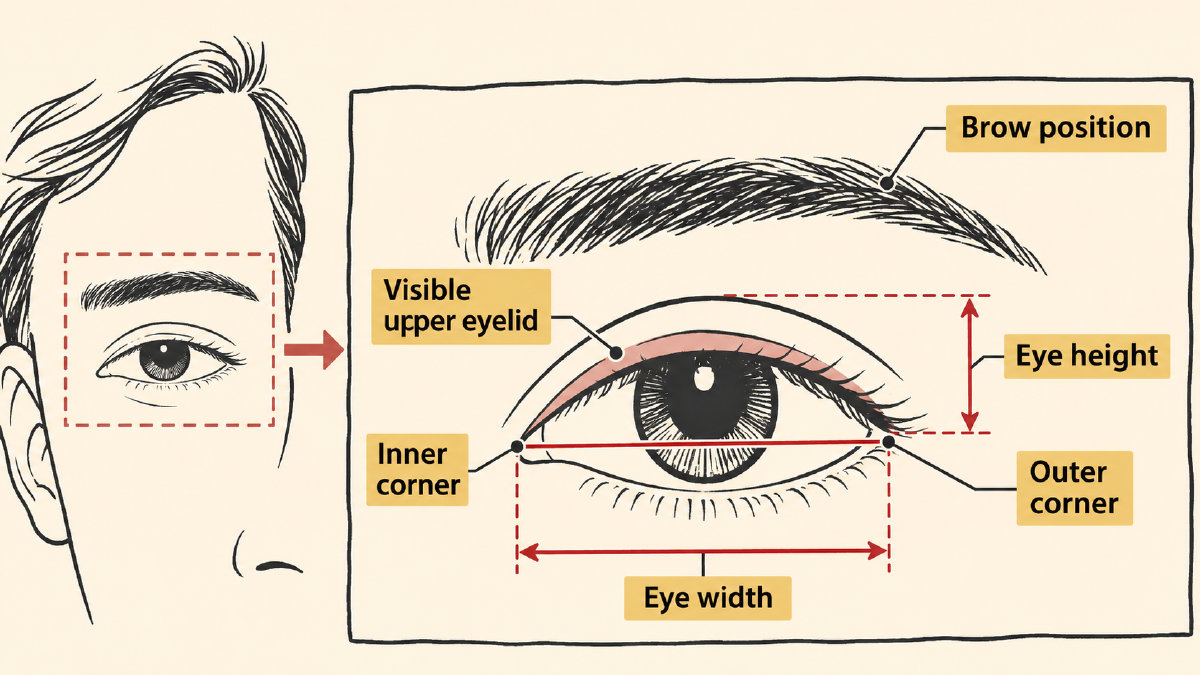
The first value is about the angle between the inner and outer corners of the eye (a canthal tilt). The second measures how tall and wide the eye is. If both are met, the eye is marked as a hunter.
Neither of these have universal anatomical cutoffs, however. They’re just thresholds defined within the specific rules of AttractivenessTest, which means they may not apply elsewhere.
It’s possible that neither of those conditions apply to you, but that doesn’t matter. After all, AttractivenessTest says it only classifies photos that meet certain criteria. In our opinion, this makes sense: if we classify someone based on something that can’t be measured consistently, then why do it at all?
We’ll walk through the rules used here and examine their limits. Then, finally, we’ll place the free browser test’s geometry label in context.
A combined eye-area look
There are other informal terms to describe similar looks, including almond-shaped eyes. But the term “hunter eyes” appears to refer to a broader set of traits that combine into an overall look.
In one definition, the informal meaning includes:
-
Deep-set eye area
-
Neutral to positive canthal tilt
-
Relatively low or flat brow close to the orbital rim
-
Compact, almond-shaped eye opening
While these aren’t exact measurements, there’s still enough to define a general appearance. Almond shape describes how the eye tapers toward the inner and outer corners; canthal tilt describes the line that connects the inner and outer corners, while upper eyelid visibility determines how much of the upper eyelid shows. Put them together, and the result is a compact, almond-shaped opening that could contribute to the overall look described by the informal term.
Narrower rules lead to discrepancies
Some people who’ve been classified as hunters say that they don’t match the more narrow rules applied by AttractivenessTest. Why? Because that site seems to consider the eye’s overall proportions, as well as the angle between its inner and outer corners.
According to the site, a hunter has a canthal tilt greater than or equal to 4 degrees. That’s a steeply tilted corner, with the outer corner higher than the inner. A neutral tilt has the corners level, and negative tilt places the outer lower than the inner.
Hunter eyes also require that the height of the eye divide by its width be less than or equal to 0.31. According to the site, this ensures that the eye remains narrow.
These two thresholds need to be met: the angle of the eye’s outer corners must be raised (i.e., tilted), and the eye opening must appear relatively narrow in a front-facing photo. That’s not just because of the almond shape, nor simply because of the tilt. Both contribute to a combined appearance.
It’s worth noting that the narrower classifications don’t take the amount of the upper eyelid showing into account, either.
Photos prepare you for measurement
To reduce avoidable changes in apparent eye opening and corner placement, AttractivenessTest documents how each photo should be prepared. It’s important to follow these steps carefully, because even small shifts in head position or expression can affect how your face appears.
You’re told to shoot straight into the lens, keeping your eyes level with the camera. Don’t turn or tilt your head, because that will alter the apparent corner angles slightly. Relax your eyes and express yourself naturally; don’t squint, because that narrows the opening. You’re advised to remove glasses, too, and keep your hair away from your eyes and brows.
Lighting should be even and soft to avoid overhead shadows.
Classifying your corner heights
One way to judge how well the site captures the geometry of your face is to see how consistent it is across different photos. This requires measuring the corner heights and comparing them against the results of other photos taken using the same camera settings.
AttractivenessTest suggests looking at a straight-on photo and imagining that you’ve drawn a line connecting the inner and outer corners of your eyes. When you imagine where that line would end, you’ll get a sense of how high or low your outer corners actually appear to be.
The inner corner sits beside the nose. The outer corner meets where the upper lid meets the lower lid. If the outer endpoint is higher up than the inner, that suggests a positive tilt. Head roll, or tilting to one side, can also suggest that one eye appears to be upturned, while the other is turned down.
This is where AttractivenessTest’s instructions help out. The site states that it levels the pupils before separately measuring each eye. It recommends taking two or three photos to compare, because lighting, lens distance, head angle and expression can shift the facial ratios.
All in all, there are limitations to what AttractivenessTest can measure. The site shows both classification numbers and the measured lines, but there’s no guarantee that its classification labels agree with what human raters think.
But when placed in context, the browser test offers nothing that isn’t already available elsewhere. It doesn’t make any kind of universal attractiveness judgment, but it can rate the geometry of adult faces.
After all, adults 18+ can take this for fun, and everything stays on your device.
Sources
Measure your own face
Free, in your browser. Your photo is never uploaded.
- Attractiveness TestFace rating, PSL range and eye type.
- Face Symmetry TestHow evenly the two sides match.
- Jawline AnalyzerJaw angle, jaw width and chin taper.