
How to Ask for the Italian Beard Style and Maintain It
Choose a faded or full Italian beard style, explain the cheek line and mustache connection to your barber, and plan regular upkeep.
Table of Contents
I have a new beard. Well, not really new, but I did get it cut yesterday. And after having had so many questions about my new beard, I decided that maybe other people might also want to know how to ask their barber for this style.
So today, I’ll walk you through exactly what I said to my barber when I asked him for the Italian beard style (also known as the Italian fade). I’ll also show you exactly how I kept things simple while still giving enough detail so that he knew exactly what I wanted. And then I’ll give you some tips on how to maintain it once you get it done.
What Is an Italian Beard Style
Let me start by explaining what an Italian beard style is. If you search “Italian beard” on Google Images, you’ll see several different variations of the style, which can be confusing because they’re all called Italian. But the term “Italian” is just a grooming label used to describe certain types of fades. There are two main variations: faded cheeks with fullness at the bottom, and full cheeks with fullness down to the jaw.
The name alone isn’t enough to specify the cut, though, because the amount of cheek fullness and whether or not the mustache ends are connected varies from one version to another. So I think the confusion comes from the fact that each person who uses the term “Italian” has a slightly different idea of what it means.
My barber described it in more detail as follows:
Jacob Joseph’s Italian beard fade (via wikiHow)
“The Italian fade is when you take your beard and fade the sides and cheeks up to the guideline. The cheeks should be faded back very short, but you keep the fullness right there at the bottom. The edges should be close to the jaw, but not touching. You don’t connect the ends of the mustache like in a goatee. It’s just disconnected. The most fullness is at the bottom.”
He then went on to describe the full variation of the Italian fade.
“Cheeks are trimmed to the guideline, and the fullness is retained down to the jaw. The mustache ends are connected.”
So if you’re going to ask for the Italian beard style, you’ll need to decide whether you want the faded cheeks with disconnected mustache ends, or the full cheeks with connected mustache ends. That will determine the amount of cheek fullness and whether or not your mustache ends are connected.
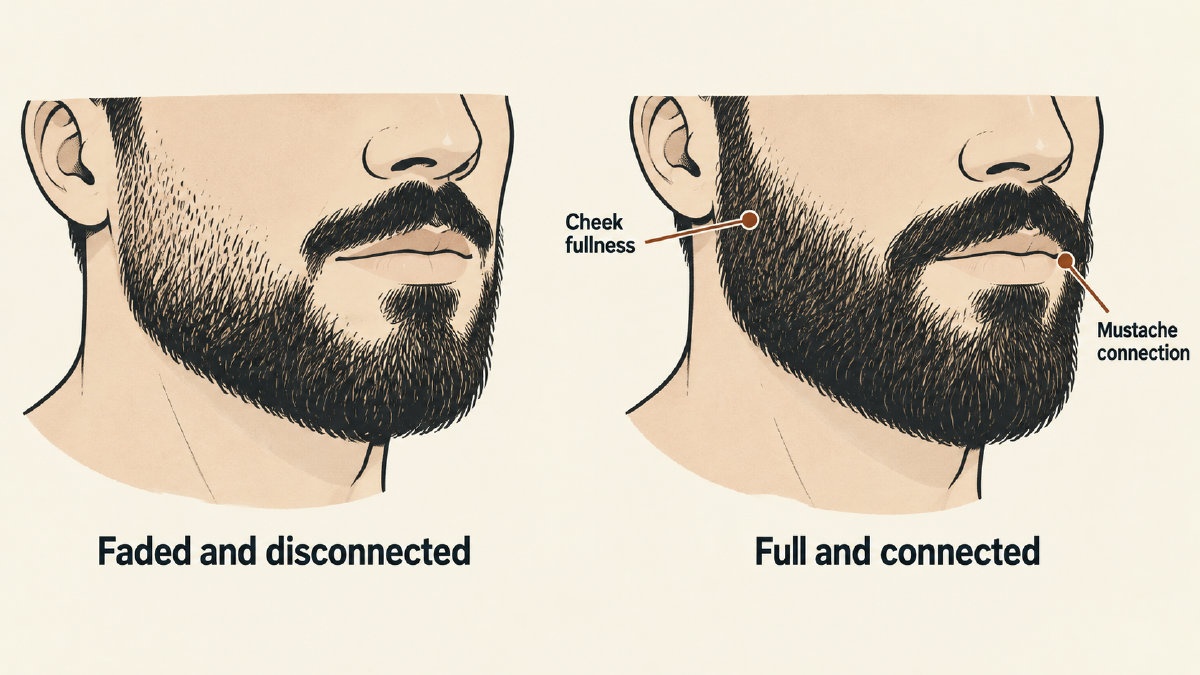
Once you’ve made that decision, you’ll also need to decide how much fullness you want near the jaw. For example, do you want your beard to be full all the way to the jaw, or just full near the jaw?
And finally, you’ll need to decide how long you want the neckline. Do you want it to end just below the Adam’s apple, or do you want it to extend further down? This is probably the easiest thing to figure out based on your existing growth. If you already have a full beard, then you’ll probably know where you want it to end.
Here’s the concrete request I gave my barber to get my Italian beard style done:
“I want the cheeks faded back very short, but I want the fullness right there at the bottom. I want the edges close to the jaw, but not touching. I don’t want the ends of the mustache connected like in a goatee. I want the fullness near the jaw. I want the neckline right there.”
That was pretty much all I needed to say. He understood exactly what I wanted, and we came up with a plan. He said he’d make sure the diagonal line on the side of my face wasn’t too pronounced, since I don’t like anything that looks like a triangle. He also mentioned that he’d treat the diagonal reference line as a discussion point, and would either fade my cheeks completely or leave them full depending on how he felt it looked on me. The guide describes that cheek guideline as running from the corner of the lips toward the earlobe.
But here’s what I’m hoping you’ll understand — there’s no fixed rule for proportion adjustments. These are styling choices, and they depend on your face shape. What works well for one face shape may look totally wrong on another. And yes, these are definitely choices that can be adjusted once the beard is grown out. So don’t feel like you need to get everything perfect before you even start growing it out. Just use your best judgment, and set expectations for yourself based on what your beard currently looks like.
For example, if you have a round face, you’ll probably find that you’ll want the cheeks angled back quite a bit, and you’ll want your sides shorter than your chin. If you have an oblong face, you’ll probably find that you’ll want your sides longer or fuller than your chin. If your beard is uneven, or if you have sparse growth, you’ll probably find that you’ll want stubble or a closely cropped beard. And if you’re looking for something extremely conservative, you’ll probably find that you’ll want to keep your beard very closely cropped, and only trim it every week or so.
And if you have sparse cheeks, you’ll probably find that you won’t be able to get a dense fade guaranteed, since your facial hair is so thin.
Now, let’s talk about the neckline. There are several landmarks that can be used to determine the length of the neckline, but none of them are established as coinciding on every face. Here are the three I’ve seen used most often.
-
About 1⁄2 in (1.3 cm), or a finger’s width, below the jawbone (via Jacob Joseph)
-
Chin lifted (via Rivas)
-
Biggest, deepest neck curve around the Adam’s apple, found by lifting your chin as in #2 (via Marlon Rivas on wikiHow)
Each of these landmarks can work, but none of them are interchangeable. For example, if you choose to base your neckline on landmark #1, then you’ll probably find that it ends above the Adam’s apple. If you choose to base your neckline on landmark #2, then you’ll probably find that it ends around the Adam’s apple. And if you choose to base your neckline on landmark #3, you’ll look for the curve around the Adam’s apple and shave below that curve.
So it’s important to agree on the visible outline of your beard before removing any of the hair from your neck. And the key is to make sure that you agree on the visible outline that you want. You don’t want to assume that the measurements are interchangeable. That’s just not how it works.
Once you’ve agreed on the visible outline of your beard, then you can begin trimming the hair along the edge of the neck. If you’re using a Wahl guard, then the attachment you’ll use determines how long the hair will be cut. If you’re using a taper lever, then the position of the lever determines how close the cut will be between the lengths of the guards.
If you’re unfamiliar with how the guards and lever work together, here’s a quick explanation.
Wahl Guards
The number on the guard tells you how long the hair will be cut.
Taper Lever
This adjusts the cutting closeness between the guard lengths. Moving the lever down or open leaves the hair longer, while moving the lever up or closed cuts closer to the skin. In the middle position between down/open and up/closed, the blades will cut halfway between those two positions.
There are contradictory directions given for the lever movements on this page. On the main page, it says:
Down/open – Cut longer
Up/closed – Cut shorter
Then on the FAQ page, it says:
Down/closed – Cut closer
Up/open – Cut farther away
So there’s a contradiction here, and there’s no universal guard-and-lever sequence that applies to all brands. So if you’re not familiar with your equipment, you’ll need to refer to the instructions that come with it.
So once you’ve got your beard outlined, you’ll need to decide how much blending you want. Since I didn’t want a ton of blending, I chose to blend conservatively. I basically kept the same cutting length throughout the entire beard, and showed him exactly what I wanted to look like.
Woody Lovell shows us how to keep a neutral expression while getting a beard cut, and how to avoid pursing or stretching the lips to get a better view of the beard.
You can see that I chose the disconnected version of the Italian fade. My barber aligned the ends of the mustache with the corners of my mouth. His reasoning was that if the ends of the mustache were connected, then they wouldn’t be clearly defined anymore, and the connections would disappear into the beard. So instead, he lined the ends up with the corners of my mouth and kept them separate from the beard. And he made sure that the edges of the mustache were off the upper lip and out of the nostrils.
He also made sure that the edges of the beard were clear of the upper lip and out of the nostrils. And he made sure that the fullness was right there at the bottom, but faded back very short on the cheeks. And he made sure that the edges of the beard were close to the jaw, but not touching.
And finally, he made sure that the neckline was right there.
Since I didn’t want to overdo the blending, I chose to keep the beard fairly short and simple. But if you prefer a bit more blending, you can always add more blending in the future.
And of course, I left the beard at the top of my head untouched. I’ll deal with that once the beard has grown out a little more.
Trimming and Checking Beard Proportions
I also found that I need to trim my beard weekly to keep it looking good. And I’ve noticed that I also need to keep my cheeks and neck trimmed quite frequently. If I wait until they get too long, then they tend to grow unevenly, and it doesn’t look so great. So I try to keep them trimmed every 1–2 days if I want a cleaner finish.
As far as proportions go, I think I’ll stick with the disconnected version of the Italian fade. I don’t like anything that looks like a triangle. But I also don’t like the mustache connection that goes all the way to the center of the face. I think it’s better to preserve the connections at the corners of the mouth, and allow them to fade out naturally.
And if you want to double-check the proportions, I recommend doing a front photo check. It’s a fun way to consider the visible outline of your beard.
I used the site’s Jawline Analyzer to analyze mine.
Jaw Angle
My jaw angle is straight.
Jaw Width Relative to Cheekbones
My jaw width is wide relative to my cheekbones.
Chin Taper
My chin tapers slightly.
Straightness of the Visible Jaw Outline
My jawline is straight.
I think that’s about all there is to it. Have you ever gotten an Italian beard style done? How did it turn out?
Sources
Measure your own face
Free, in your browser. Your photo is never uploaded.
- Attractiveness TestFace rating, PSL range and eye type.
- Face Symmetry TestHow evenly the two sides match.
- Jawline AnalyzerJaw angle, jaw width and chin taper.