
How to Choose and Maintain Long Beard Styles
Compare long beard styles by rounded, pointed or structured outlines, then choose side bulk, chin length and an upkeep routine that fits you.
Table of Contents
I’ve written quite a few articles about beard styles, including this article on how to choose a beard style.
But in this article, I’m going to focus on how to choose the right beard style for you. There are so many different options available now, especially since we’re seeing so many “long” beards these days. But even among long beards, there are a lot of differences. So how do you know which one is right for you?
First, let me show you what I mean when I refer to “long” beards. These aren’t just any old long beards, but specific types of long beard styles that have been defined by their shape and/or structure.
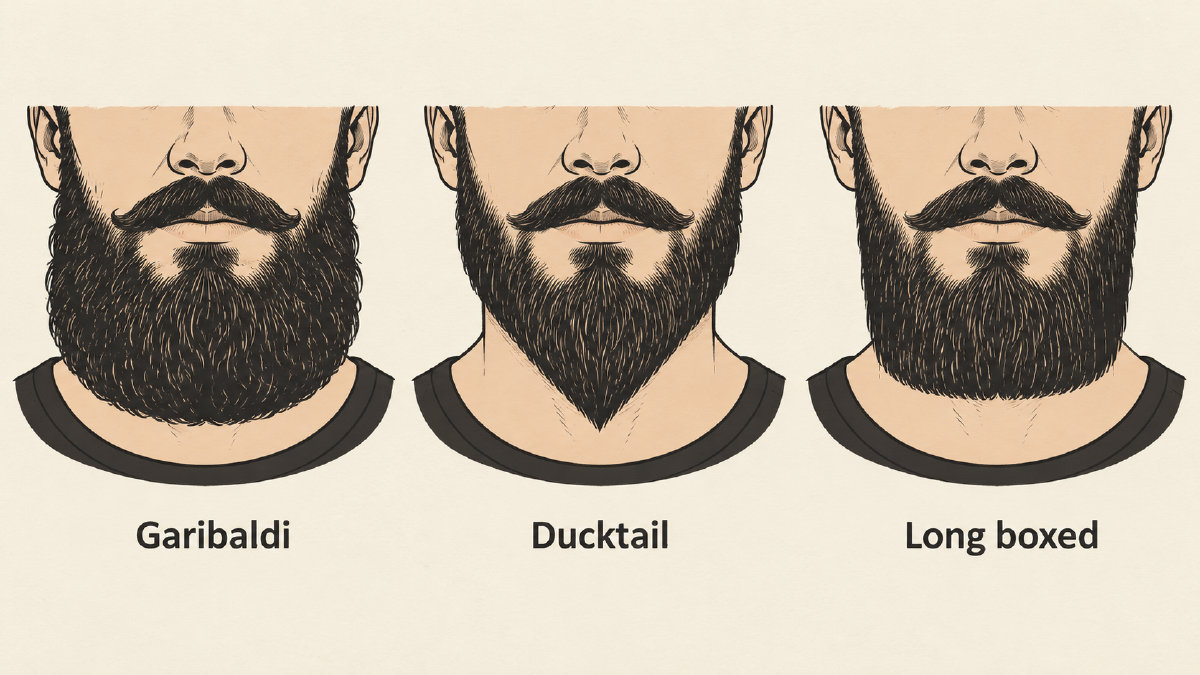
Garibaldi
The Garibaldi is relatively short on the sides, with a broad rounded bottom. The mustache is connected, but trimmed just above the upper lip.
Ducktail
The Ducktail has a pointed bottom. It’s usually kept very clean and neat, with regular trimming to retain the taper. It can be a bit difficult to maintain because the taper requires repeated attention.
Long Boxed
The Long Boxed beard has a structured outline. The cheek and neckline edges are well-defined. The length is often shorter than a full beard, but still longer than the average beard.
Bandholz
The Bandholz is a long, thick, full beard. The mustache is typically blended into the beard.
Natural Full Beard
The Natural Full Beard is basically what you already have — existing fullness with less extensive trimming or shaping. It’s probably not something you’ll find at a barber shop, but rather something you’ll see in pictures of celebrities and famous people.
Choosing Long Beard Styles for Your Face and Growth
So, now that you understand the difference between these five types of long beard styles, here’s how to decide which one is right for you.
Start by looking at the overall shape of your face. You’ll notice that some of these beard styles are designed to make your face look longer (i.e., taller), while others are designed to make your face appear shorter. The key is to determine what proportion effect you’d like to achieve with your beard style.
For example, a longer-looking beard silhouette will generally require shorter sides, with a fuller chin. This makes your face look longer because your hair is filling in the lower half of your face, but your sides remain relatively short.
Conversely, a less apparent length beard silhouette will require fuller sides, with a shorter bottom. This makes your face look shorter because your hair is filling in the top half of your face, but your bottom remains relatively short.
You might also notice that some of these styles use angled cheek lines as part of their design. These add additional structure to your beard, directing the hair toward the chin and making your face look smaller.
These effects are all about proportions. So unless you’re looking for dramatic change, you don’t need to worry about universal prescriptions for beard styles based on your face shape. Instead, think about what proportion effect you’d like to achieve, and then choose a beard style accordingly.
Now, the next step is to consider what kind of beard growth you currently have. If you have dense facial hair that grows evenly, then you should be able to support a full beard silhouette. However, if you have sparse areas, then you’ll need to choose an outline that either trims those areas out or removes them entirely.
If you have nearby hairs that are longer than your beard, then you may be able to cover up some of those sparse areas by arranging the longer hairs over them. If you have very little facial hair at all, then you won’t have much of a choice. You’ll have to choose an outline that works with your current density.
And if you have facial hair that’s too long, you might be able to fill-in those sparse areas by allowing your beard to grow out. But again, there’s no guarantee that this will work for everyone.
Tell Your Barber What You Want
So now that you understand how to choose a beard style, you’re ready to go talk to your barber. But remember, just saying “I want a Garibaldi” doesn’t give your barber enough information to get you exactly what you want. What he needs to know is what you want preserved, and what you want removed. And that starts with the bottom shape, side fullness, chin length, and mustache treatment.
So instead of saying “I want a Garibaldi,” tell him that you want a beard with a broad rounded bottom, relatively short sides, and a connected mustache that’s clear of the upper lip.
Similarly, instead of saying “I want a Ducktail,” tell him that you want a tapered beard with a pointed bottom. And instead of saying “I want a Long Boxed beard,” tell him that you want a structured beard with defined cheek and neckline edges.
And if you’re looking for something like a Bandholz, tell him that you want a long, thick, full beard with an integrated mustache. And finally, if you’re looking for a Natural Full beard, tell him that you want a beard that requires minimal sculpting, with more emphasis on maintaining cleanliness and grooming.
Trimming and Everyday Beard Care
A Garibaldi needs trimming to keep its rounded bottom, while a Long Boxed beard needs its cheek and neckline edges maintained. Natural growth needs less shaping, but still needs grooming. If you’re trimming at home, scissors are an option for longer hairs. Go slowly, because you can’t immediately put that length back.
Of course, there are exceptions to every rule, but in general, the preferred balance is to keep your sides shorter than your bottom, and your bottom fuller than your sides. That’s the basic idea behind most long beard styles.
For everyday care, wash your face and beard daily with a gentle cleanser made for your skin type. Once your beard is established, choose a conditioner, oil, or moisturizer to suit your skin type, and apply it after washing. Use oil or conditioner sparingly. Then comb your beard to spread the product, work out tangles, and arrange the hair.
So now that you understand how to choose a beard style, you’re ready to move on to learning how to maintain your beard once you’ve decided on a style. As always, if you have questions about anything I’ve covered in this article, please feel free to leave a comment below.
Sources
Measure your own face
Free, in your browser. Your photo is never uploaded.
- Attractiveness TestFace rating, PSL range and eye type.
- Face Symmetry TestHow evenly the two sides match.
- Jawline AnalyzerJaw angle, jaw width and chin taper.