
What Does a Long Midface Mean? Photo Checks and Styling Tips
Understand what a long midface means, compare photo landmarks and ratios, and explore optional hair, brow and glasses choices.
Table of Contents
This is an article about how to measure the midface, what it means, and how to use this measurement in your life. I’m going to be writing in my own personal style, which is very conversational and includes many opinions, but not all of them are mine — some of them come from sources like wikiHow.
What a Long Midface Means
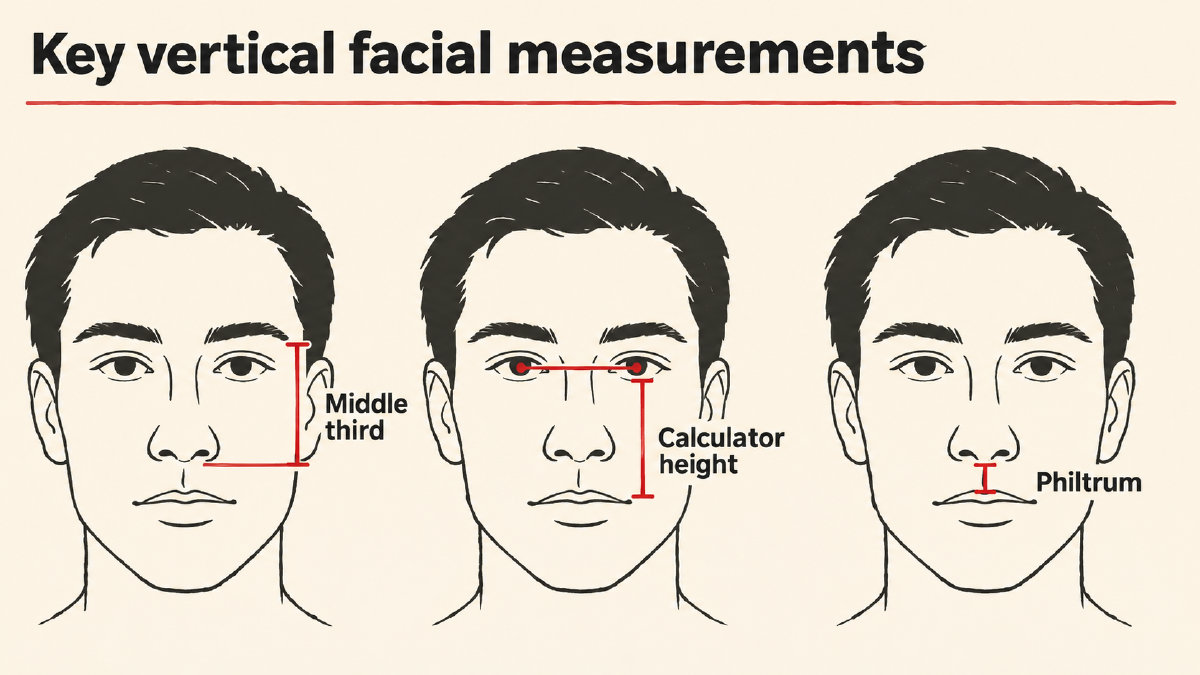
A long midface is usually defined as having a relatively longer middle third of the face. The middle third is measured from the eyebrows down to the base of the nose (the point where the nose meets the face), while the overall length of the face is measured from the hairline down to the chin. A long midface is not necessarily a long face overall, because the upper and lower thirds can also vary in length.
The middle facial third is sometimes called the “middle face”, and its height is often measured from the glabella (the area between the eyebrows) to the subnasale (the base of the nose). This is an anthropometric measurement that is used in various fields such as anthropology and plastic surgery.
The philtrum is the vertical groove that runs from the base of the nose down to the upper lip. It is not part of the middle facial third, although it does fall within the calculator’s longer vertical span. If you want to measure the philtrum, you should do so carefully, since measuring short distances on soft tissue can be difficult and potentially misleading.
Comparing Facial Measurements
There are several ways to compare the measurements of the face. One way is to compare the middle-to-lower ratio, which is calculated by dividing the height of the middle third by the height of the lower third. This is the site’s facial-thirds comparison, which leaves out the upper third. The calculator’s actual ratio divides pupil distance by the height from the pupil line to the top of the upper lip. Other midface tools may reverse the division or measure to the base of the nose. Another way is to compare the upper-to-middle ratio, which is calculated by dividing the height of the upper third by the height of the middle third. Neither of these ratios alone tells you much about the shape of the face, however, since they don’t take into account the width of the face. Other tools, such as a height-to-width comparison, or a nose-base endpoint comparison, may be more useful for determining the shape of the face. However, if you want to make a direct comparison between two faces, you’ll need to match the endpoints and divide in the same order. For a hypothetical example, if pupil-to-upper-lip height stays at 60 mm, reducing pupil distance from 66 to 60 mm lowers the calculator’s ratio from 1.10 to 1.00.
It’s important to interpret the reference range of the midface calculator in context of its calibration. The reference range is based on a set of 101 adult faces that were calibrated with 2,513 attractiveness raters. Its 0.94–1.15 range describes what is typical of those faces, rather than an anatomical standard. These faces were taken from the Face Research Lab London Set, and their ratings were published by DeBruine & Jones in 2017 under a CC BY 4.0 license. A compact midface is considered to be a conventional preference among people who rate attractiveness, but there isn’t a universal target or conclusion about attractiveness that can be drawn from the number alone, including outside of the range.
Taking Photos for a Midface Ratio Check
AttractivenessTest has documented a browser photo check for adults with its midface ratio calculator. They recommend taking photos of yourself in front of a camera at eye level, making sure the light is even on both sides from a window or lamp, and keeping your arms away from your face. They also suggest avoiding side or overhead shadows, which can make landmarks appear to shift. Dark photos should be rejected, and the camera should be placed at arm’s length or a little farther away. You can prop the camera and crop if needed. Close-up photos may seem to widen the nose and middle face, so no numerical perspective correction should be done. A raised chin will apparently shorten the lower face, while a lowered chin will apparently lengthen it. Excessive tilt or turn should be documented and rejected with a hint. The person should relax their expression, keep their lips closed, and open their eyes. Smiling changes cheek, mouth, eye and jaw measurements, so it shouldn’t be included. Full face photos should be taken from the forehead to the chin, and hair should be kept away from the jawline. Glasses should be removed, and hats, hands and heavy filters should be avoided. The browser placement of 478 facial points should be done on-device, and the displayed value should be beside the typical range. Measurement lines should be drawn on the photo. Two or three photos should be taken in the same spot under similar conditions, and the landmarks and result variation should be inspected. The accuracy of the midface-ratio should be noted, but no independent validation is claimed.
wikiHow offers a few styling suggestions for those with a long midface. They suggest chin-length cuts, longer cuts with layers ending above the chin, above-chin face-framing layers, curtain, side-swept or wispy bangs, big, bouncy curls or waves, flatter, less arched brows, vertically deeper glasses frames such as aviators, oversized square, round or geometric pairs, and deeper frames. They note that these are optional suggestions and that there is no experimentally validated or universal effect. They also caution that the whole appearance should be considered when choosing a hairstyle, makeup, or glasses, rather than relying on the ratio alone. They also note that changing your hair, facial hair, or glasses will change your appearance, but your bone structure remains unchanged.
Sources
Measure your own face
Free, in your browser. Your photo is never uploaded.
- Attractiveness TestFace rating, PSL range and eye type.
- Face Symmetry TestHow evenly the two sides match.
- Jawline AnalyzerJaw angle, jaw width and chin taper.