
What Is a Negative Canthal Tilt? Meaning, Measurement and Styling
Understand negative canthal tilt: what a downturned outer eye corner means, how to measure it accurately from a photo, and safe styling options.
Table of Contents
A geometric term for how your eyes sit on your face.
The phrase “negative canthal tilt” is used in online beauty forums to refer to a certain kind of eye shape. In those forums, it’s usually associated with some combination of “puppy eyes,” “cute,” and “adorable.” But I think that people are often using the term incorrectly, or at least without understanding what they’re talking about. The phrase “canthal tilt” refers to a facial geometry concept — the angle between the inner corner (medial) and outer corner (lateral) of the eye relative to a horizontal line across the face. This angle is typically measured as a negative number if the outer corner sits lower than the inner corner. A negative canthal tilt means that the outer corner of your eye sits below the inner corner.
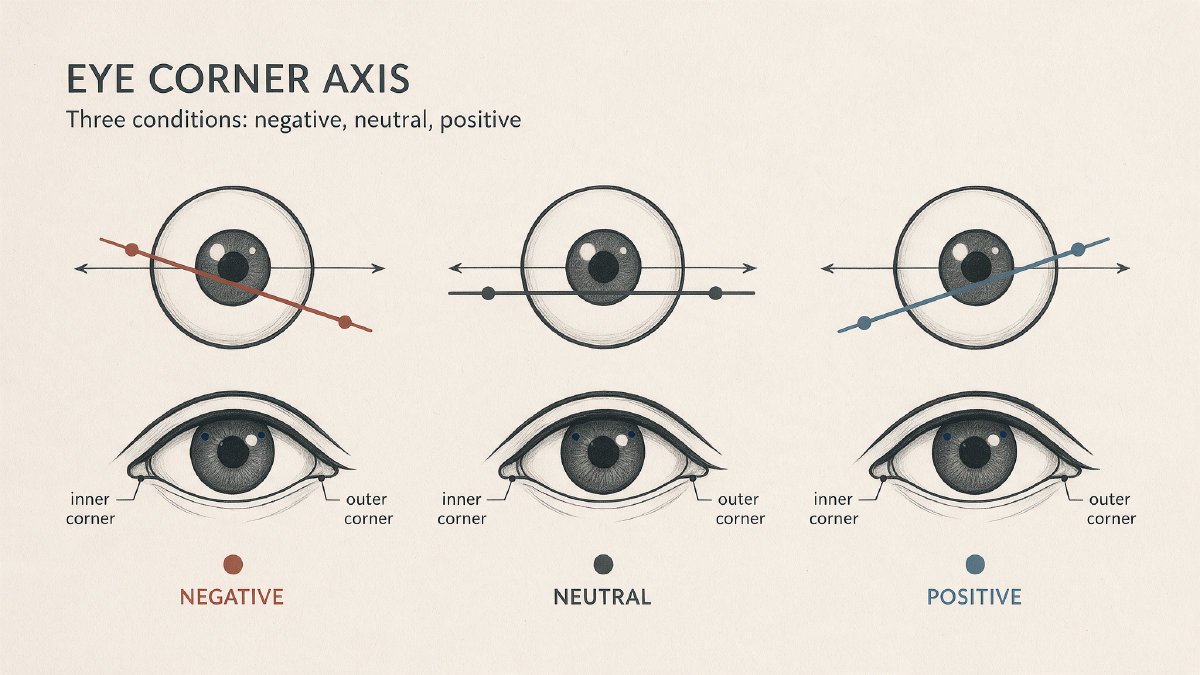
In order to understand canthal tilt, we need to be clear on exactly what the “medial” and “lateral” corners of the eye are. The medial canthus is the inner corner of the eye, where the nose meets the eyelid. The lateral canthus is the outer corner of the eye, where the cheek meets the eyelid. These two points define the width of the eye. To measure canthal tilt, we also need to have a reference line for “horizontal” on the face. Clinically, that’s usually a true horizontal line, often with the head positioned in the Frankfort plane; photo tools may instead fit the face midline and use a line perpendicular to it. For each eye, you draw a separate line from that eye’s inner corner to its own outer corner, then compare that line with the face’s horizontal reference. When measuring canthal tilt, we look at whether the outer end of the eye’s line sits higher or lower than the inner end. We can do this either by looking at the direction of the line itself, or by measuring the angle between it and the horizontal reference. There are three main directional categories for canthal tilt: above zero degrees, near zero degrees, and below zero degrees. The exact values that fall into each category vary depending on the measurement method. Some sources consider anything less than 0° to be a negative canthal tilt, while others use different cutoffs. One source divides the angle bands like this:• Below 0°: Slightly downturned• Near 0°: Neutral• Above 0°: Positive / upturned• Below -3°: Downturned• Between -3° and 0°: Slightly downturned• Between 0° and +3°: Slightly upturned• Above +3°: UpturnedSome sources use similar definitions, but not quite the same cutoffs. It’s important to note that the descriptive labels capture more than just the angle alone. For example, “hunter eyes” isn’t just about an upward tilt; it also implies a lot about eyelid exposure and brow position. Similarly, “downturned eyes” could mean a variety of things, including orbital depth and the amount of space between the eyebrows. And finally, “neutral eyes” doesn’t necessarily mean the angle is exactly zero; it could mean any number of angles that look balanced and symmetrical. So instead of focusing too much on the exact degree numbers, it might be helpful to focus on the overall shape of the eyes. As far as I know, there aren’t any medical cutoffs that divide canthal tilt into different categories. Instead, the bands are simply descriptive terms that help us better visualize the angle. When measuring canthal tilt, you’ll probably want to take a few photos of yourself from the front. Because you’re taking a photo, you’ll only see a 2D image, so you won’t be able to read the actual angle. You can, however, try to estimate it based on the visual cues. To get a good reading, you’ll want to make sure your camera is at eye level, and that your chin is neutral (not raised or lowered). Your expression should be relaxed, and your lighting should be even. If you wear glasses, you’ll probably want to remove them before taking the photo, because they’ll cover part of your eyes. Also, make sure both eyes are visible in the photo. If you take multiple photos, you’ll be able to average out any errors. However, if the value sits right near a boundary between two categories, you may want to take several photos to get a more accurate reading. Here’s how AttractivenessTest categorizes this feature. Their calculator determines the per-eye angle and shows the result alongside a PSL range, geometry scores, eye type, and the lines measured on the photo. They compare the number with a typical range from their rated-face sample, while describing a mild positive tilt as a community convention rather than a medical standard. Their separate hunter-eye test combines canthal tilt with eye height-to-width ratio and labels the result “hunter,” “neutral,” or “prey.” Overall, I think it’s useful that they keep those labels separate from a medical diagnosis or universal rule. One thing that I’m curious about is why they didn’t select a single angle to use as their ideal. Why did they choose 0.6° to 7.4°, instead of picking a single number? Well, the Italian study they’re drawing on actually analyzed a convenience group made up only of attractive Italian subjects selected from beauty competitions, alongside a separate normal Italian group. The researchers cautioned that in a different ethnic or sociocultural context, different kinds of attractive faces might be chosen. AttractivenessTest also mentions that photo-based findings depend on the particular sample, image set, sex, and study design. So in short, they’re saying that there isn’t really any one correct angle for canthal tilt, and that whatever angle you end up with is going to be influenced by your individual anatomy, as well as the way you look in photographs. While the underlying bony geometry is largely stable in adulthood, the soft tissue supporting the outer eye can loosen gradually with age, and facial growth can shift proportions before adulthood. Day to day, the way we look in photos is also influenced by styling choices. Brows, makeup, lashes, glasses, hair framing, and camera angle all play a role in how we appear visually. None of these things will actually change the position of our canthi, though. You can groom your brows to make your eyes look wider, or curl your lashes to make your eyes look larger, but none of these changes will alter the position of your actual canthi. If you want to change how your eyes appear, you’ll need to use makeup, glasses, or other styling techniques to change the way your eyes look. If you’re interested in changing your canthal tilt, there are some styling options you can consider. First, you can style your brows in a way that keeps the outer brow visible. This will help make your eyes look wider and more open. Second, you can use makeup to highlight your eyes. This includes applying mascara, eyeshadow, and eyeliner to create a more dramatic effect. Third, you can use lashes to add volume and length to your eyes. Fourth, you can wear glasses that frame your face in a way that accentuates your eyes. Fifth, you can style your hair to frame your face in a way that accentuates your eyes. Sixth, you can adjust your camera angle to create a more flattering appearance. By making these changes, you can create a more flattering appearance for your eyes. However, if you notice that your eyes appear to be changing over time, you should consult with a doctor to rule out any underlying conditions. Stable and comfortable eyes are a great thing to have. But if you notice that your eyes are suddenly appearing to change, you should see a doctor to make sure nothing is wrong. A new, strong, or one-sided change in the tilt could occasionally reflect age-related laxity or an eyelid condition, such as an outward-turning eyelid; an ophthalmologist is the right person to assess it. If you notice that your eyes are painful, red, watery, dry, gritty, irritated, or producing discharge, you should see a doctor immediately. Lash crusting, difficulty closing your eye, or vision changes could also be signs of an underlying condition. If you experience any of these symptoms, you should consult with a doctor to rule out any potential problems. In addition to seeing a doctor, you should also avoid chasing a score or trying to achieve a certain physical appearance. Instead, you should focus on maintaining healthy habits, getting enough sleep, and avoiding activities that could harm your eyes. You should also avoid trying to change your physical appearance through procedures such as eye pulling, mewing, or bone smashing. In fact, many of the methods that people use to change their appearance are actually harmful to the body. Instead, you should focus on maintaining a healthy lifestyle, and seek professional help if you ever feel distressed or uncomfortable with your appearance.
Sources
Measure your own face
Free, in your browser. Your photo is never uploaded.
- Attractiveness TestFace rating, PSL range and eye type.
- Face Symmetry TestHow evenly the two sides match.
- Jawline AnalyzerJaw angle, jaw width and chin taper.