
Oblong Face Hair Style Men Can Ask Their Barber For
Choose an oblong face hair style men can discuss with a barber, comparing crops, side parts, curtains and layers by texture, length and upkeep.
Table of Contents
For an oblong-face hairstyle for men, I’ve always preferred a silhouette that’s at least slightly rounder than the classic, long face shape. That said, I do like my hair to be as short as possible on top with plenty of side fullness and forehead movement.
But when it comes to haircut names, it’s hard for me to get excited about any one in particular because they all seem so similar to each other. And while their finished proportions may vary from person to person, there’s very little difference between them when you look at them by name alone.
That’s why I prefer to work with barbers who have an understanding of what the finished proportions will look like, rather than just go by the names of the styles. In other words, I don’t care if you call it a “crop,” “cropped fade,” or “short crop.” What matters is how much length remains on the top, how far out the sides are moved, and how much weight stays on the temples.
So with that in mind, here are six options to consider.
Forward Textured Crop
This option features some forehead coverage, but more importantly, the fringe is directed toward the eyebrows instead of away from them. This gives the illusion of a shorter face.
Crop
The crop is also pretty straightforward, featuring 1.5–2.5 inches of hair on top. It has a matte finish, and can be worn either with or without a slight taper at the sides. If you’re a man with medium or thick hair, this is your best bet. Fine hair may require firmer paste or gel to maintain the desired shape.
Deep Side Part
If you want your hair to be really short on top, but you still want to keep your temple fullness, then the deep side part might be your best bet. The longer top is directed across the head, giving you the appearance of a shorter face. Deep side parts are typically associated with men with straight, wavy, or lightly curly hair. They’re also great for those who want to keep things looking professional.
Side Part
A side part is also a good choice for men who want their hair really short on top, but still want to keep their temple fullness. This style usually requires a bit more styling effort, but the result is worth it. Medium-hold pomade or cream works best, and it should be combed while the hair is damp. It’s also important to retain the side fullness, which means keeping your temples full.
Curtains
These curtains are split at the eyebrow level, and they fall naturally. These are especially well-suited for men with particularly wavy or lightly curly hair. Use lightweight sea salt spray or texture spray to maintain the split. If you have fine straight hair, you may need product to maintain the split.
Layered Waves Or Shag
If you’d rather not have such a drastic change, then layered waves or shag could be a better fit. The longer shape helps shorten the face, and the outward volume on the sides adds width. Keep in mind, however, that the closer to the scalp your layers begin, the less outward volume you’ll have. Layers beginning at mid-length give you the most volume. This style is especially suited for men with particularly wavy or curly hair, but straight thick hair can also work well if you use texturizing product.
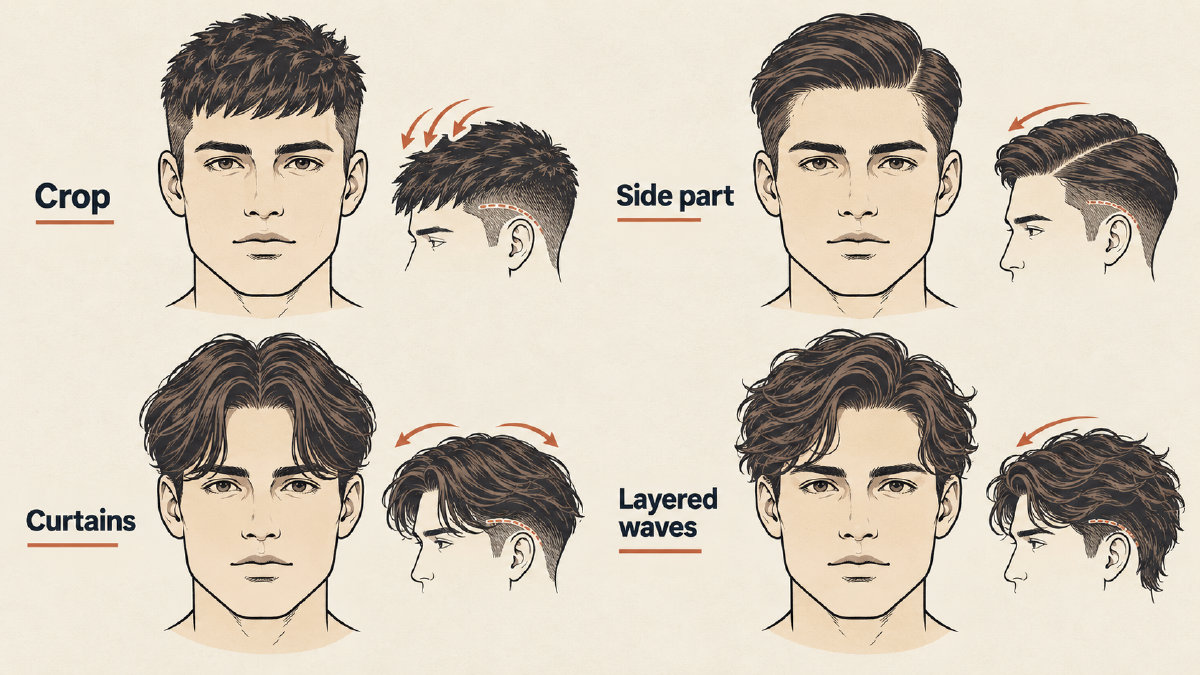
Of course, these are only starting points. You can choose whichever direction suits your personal preference best, but keep in mind that the finished proportions will vary depending on your natural texture, density, and personal preference.
Temple Fullness
When it comes to temple fullness, I’m always amazed at how many people misunderstand the term. Temple fullness simply refers to how much weight you want to retain on the temples. So if you want your hair to be really short on top, you probably won’t want your temples to be too full. But if you’re okay with your hair being a little longer on top, then you’ll want to make sure your temples aren’t cut down too much.
To clarify, temple fullness isn’t determined by where the fade starts. A low fade (the transition starts just above the ear) doesn’t necessarily mean your temples will be cut down. Fade placement has nothing to do with bottom length. The bottom length determines how soft or sharp the edges appear. Skin fades go down to bare skin, while low fades describe where the transition starts, not how short the bottom is.
Also, the amount of weight you retain on the temples depends on how localized your tapering is. A taper that mainly affects the sideburns and neckline will leave more weight elsewhere. Whereas a taper that transitions across more of the sides and back will reduce the overall weight.
Variation in terminology is common among barbers, so don’t feel bad if you don’t understand exactly what a barber means when he says something like, “I’ll show you what I mean.” He’ll demonstrate his idea, but he’ll never show you what the finished structure looks like. So if you’re unsure, ask him to show you what he means before he cuts anything.
Fine Strand Diameter vs. Low Density
It’s easy to confuse strand diameter with density. Fine hair means thin individual strands, while low density means fewer strands per square inch of scalp. Both affect layering, fringe, and length, and aggressive texturizing can reduce natural volume, especially with fine hair.
In fact, I think fine hair calls for restraint with texturizing because removing too much weight can reduce its natural volume. Thick hair can also benefit from extra texturizing, but it’s not necessary.
Now, if you have both fine hair and low density, then aggressive texturizing may undermine the natural volume you already have. But again, that’s just speculation. I don’t know anyone personally who has both fine hair and low density, and I’ve never heard of anyone losing natural volume due to texturizing.
Regardless, I recommend asking your barber to show you what he means by “low density” before he cuts anything. And if you’re not sure, then keep in mind that Bespoke Unit offers individual recession advice. He’ll help you determine which recession options would suit your needs best. In advice to one reader with recession, Bespoke Unit suggests neatly cropped sides with a Caesar or side-directed style. Those are possibilities to discuss with your barber.
Upkeep Estimates
StyleX has published upkeep estimates for each of the styles discussed today, but I haven’t tested them yet, so I can’t confirm whether they’re accurate or not. Its overall haircut estimates are 3–4 weeks for the textured crop, 4–6 weeks for the deep side part, 4–5 weeks for curtains, and 6–8 weeks for the shag. However, I’ve read quite a few posts on Kinsman discussing edge-maintenance estimates, and they’re pretty close to what I’ve seen from other sources.
Tapers: approximately 4–5 weeks
Mid Fades: approximately 3–4 weeks
Skin Fades: approximately 2–3 weeks
Keep in mind that these estimates are based on the finished shape, so they’re assuming that you’ll return for maintenance once the edges start to grow out. If you’re happy with the way your hair looks, and you’re willing to put in the time and effort to maintain it, then the schedule may be adjusted accordingly.
As far as daily styling goes, the amount of effort required will depend on how short you want your hair to be on top, and how much weight you want to retain on the temples. The more weight you retain on the temples, the more styling effort you’ll need to maintain the desired shape.
So, if you’re interested in trying out one of these styles, then let me know, and I’ll help you assemble a request around the desired silhouette and practical routine. I’ll also include room in the request for a preferred buzz cut or quiff, since those are two of my favorite styles. For a crop, you could say, “I want my face to look shorter, with a relatively flat top, 1.5–2.5 inches of length, a forward fringe, and fullness left at the temples. I have [minutes] to style it and can return every 3–4 weeks.” Bring a reference photo, point out your natural part and cowlicks, and discuss your density before he cuts anything.
Sources
Measure your own face
Free, in your browser. Your photo is never uploaded.
- Attractiveness TestFace rating, PSL range and eye type.
- Face Symmetry TestHow evenly the two sides match.
- Jawline AnalyzerJaw angle, jaw width and chin taper.