
Oblong Shape Face: How to Tell and What Styling Suits It
Recognize an oblong shape face by length and outline, understand conflicting ratio rules, and compare haircut, beard and glasses options.
Table of Contents
I’ve been asked several times lately about oblong face shape, so I thought I’d take the time to explain it in detail. I’ll also include some styling suggestions that might be useful for those of you who have an oblong face shape.
But first, let’s talk about how to tell if your face is oblong.
What Is An Oblong Face Shape?
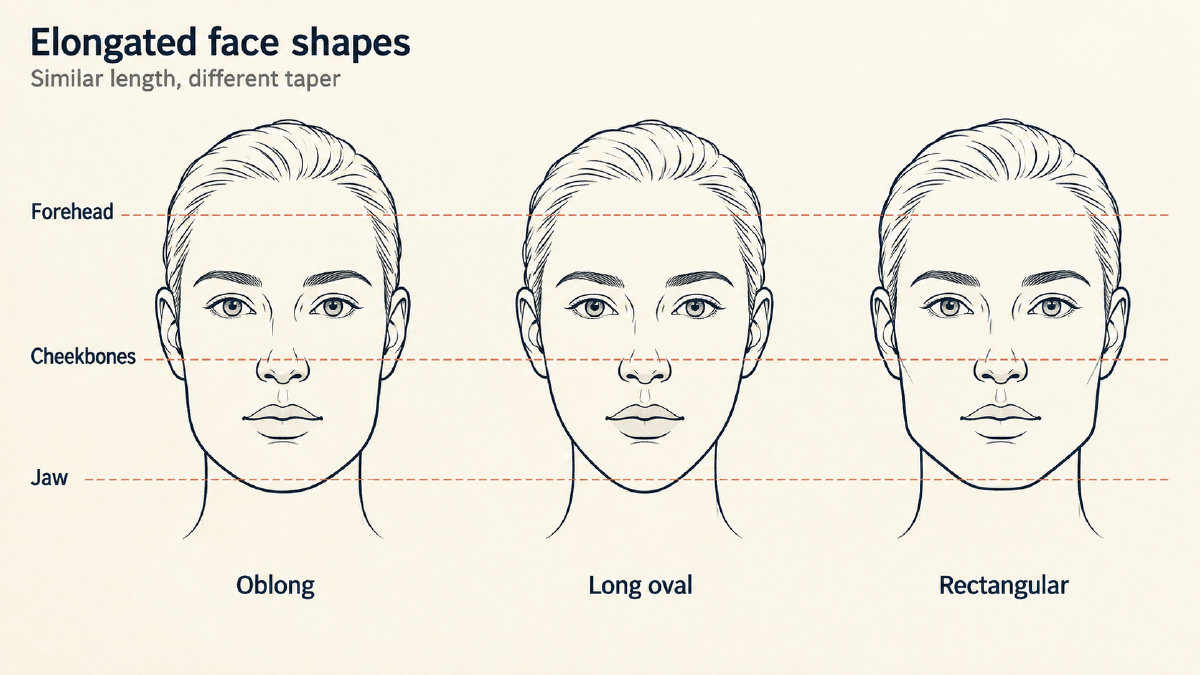
The term “oblong” is often used interchangeably with “oval,” but they are not the same thing. An oval shape tapers toward the chin, which means that the jaw is clearly narrower than the cheekbones.
An oblong shape is relatively uniform in width throughout the entire length of the face, and the jaw has a softer curve than an oval or rectangular face shape.
Long Oval
Oblong
Rectangular
So while an oval shape is long and narrow, an oblong shape is just as long and narrow, but without the tapering at the bottom.
Long Oval
Oblong
Rectangular
When looking at these examples, the difference between the oval and oblong becomes more clear. The oval has a much more pronounced taper at the bottom (toward the chin), whereas the oblong doesn’t really taper at all. And of course, the rectangular face shape has hard angles on both sides of the face, especially at the jaw corners, and a flat chin.
But keep in mind that no one face is perfectly shaped. So even though there are general guidelines, every person will fall somewhere in between.
How To Measure Your Face Shape
Since I’m a firm believer that we should always judge something based on its actual appearance rather than trying to measure it using arbitrary formulas, I won’t give you any specific numbers to measure your face. But I will show you how to find the landmarks on your face that would allow you to do so.
First, take a photo of your face from straight-on, without turning your head left or right, or tilting your head up or down.
Then locate the following landmarks on your face:
Face Length – From the center of your hairline to the bottom of your chin.
Cheekbone Width – From the widest point of your left cheekbone to the widest point of your right cheekbone.
Forehead Width – From the widest point of your left forehead to the widest point of your right forehead.
Jaw Width – From the widest point of your left jaw to the widest point of your right jaw.
You’ll want to use consistent landmarks and consistent methods of measurement each time. For example, if you measure your forehead width across its widest point near the temples and outer brow, away from the hairline, you need to make sure you’re doing that consistently each time.
Also, be aware that straight-line chord distance measurements aren’t exactly the same as surface arc distance measurements. You’ll probably get different results depending on how you measure.
Now, with those landmarks identified, you can try out some of the various formulas published online. But keep in mind that none of these formulas are universally accepted, and they may be presented differently by different websites. For example, I found two very similar formulas, but they were presented quite differently.
On OblongFaceShape.com, the formula they suggest is:
Average width = (forehead + cheekbones + jaw) / 3
Face length / average width = 1.5 or higher
On FaceShapeTool.com, their formula is:
Face length / cheekbone width = 1.6 or higher
And they also mention that your forehead, cheekbones, and jaw should be fairly similar widths.
Keep in mind that these are just formulas. They don’t mean that everyone who falls within those numerical thresholds automatically qualifies as having an oblong face shape. There’s a reason why the word “approximately” is used in many of these formulas.
In fact, I wouldn’t consider myself to have an oblong face shape. I’m pretty close to my threshold on most of these formulas, but not quite over the top. But I definitely have an elongated outline. That’s the key factor. I’m simply not convinced that the slight differences in proportions and shape alone qualify me as having an oblong face shape. But I’m willing to accept that my face could be labeled as oblong since it does have an elongated outline.
That said, I don’t think the exact numbers matter. In fact, I don’t even think that the exact measurements themselves matter. I think it’s more important to look at the shape of your face as a whole and determine whether or not it appears elongated.
Hair And Beard Suggestions For Oblong Faces
I know that the advice given on most sites regarding what types of hairstyles and beard styles work best for oblong faces usually suggests things like side-volume layers, blunt bobs and lobs, outward-expanding waves or curls, side parts, curtain bangs, side-swept bangs, and full straight-across bangs. But honestly, I’ve never really seen any evidence to support the idea that these styles actually help elongate an oblong face. I suppose that makes sense because those styles are meant to add volume to the upper part of the face, making it appear shorter. But I don’t think that’s necessary for someone with an oblong face shape. I think that the problem with an oblong face is that it’s too long, not too short.
Of course, that being said, adding some volume to the top of the head could make the face appear longer. And adding some volume to the sides of the face can help make the face appear wider.
So I’d suggest considering some of the following styles:
Side-volume layers
Blunt bobs and lobs
Outward-expanding waves or curls
Side part
Curtain bangs
Side-swept bangs
Full straight-across bangs
Fringe (horizontal element across upper face)
Short boxed beards
Full beards with fuller sides
Short stubble
But keep in mind that these are just suggestions. These styles don’t necessarily improve attractiveness, nor do they guarantee that you’ll look good with them. This isn’t about finding the perfect hairstyle for you. It’s about giving you options so that you can choose the ones that you like best and that suit your personality.
If you do go with a longer style, such as a long pointed goatee or a chin strap, be careful not to add vertical length. Those styles add vertical length, which isn’t desirable for someone with an oblong face shape.
Frames And Glasses For Oblong Faces
Again, I don’t believe that frames should be chosen based on the shape of your face, but I’m including some information about frame shapes that are commonly recommended for people with oblong faces.
Some sources recommend choosing frames that are wider than they are tall, and that have strong horizontal top lines.
Others recommend deeper lenses with greater brow-to-cheek coverage, which visually shorten the midface.
There seems to be a lot of disagreement among sources regarding what frame shapes are appropriate for oblong faces. Some sources recommend round or oval frames, while others suggest oversized rectangular, browline, or clubmaster frames. Others suggest wide aviators or wayfarers.
It’s interesting that so many sources disagree on what frame shapes are appropriate for oblong faces. I don’t know if that’s due to differing opinions on what constitutes an oblong face shape, or if it’s just due to personal preference.
I personally don’t think that the shape of your face determines the shape of glasses that you should wear. But again, I’m including this information because it’s what you’ll see on other websites.
My own opinion is that frames should be selected based on the shape of your face and the shape of your face is determined by the dimensions and appearance of your face, not by some arbitrary mathematical formula.
AttractivenessTest Proportion Tools
I also wanted to address the issue of the AttractivenessTest proportion tools. Many people ask me questions about those tools, so I figured I’d take a moment to explain what they do and how they differ from each other.
The golden-ratio tool measures face length to width. If you add a front-facing photo, it measures your proportions and compares your face length-to-width ratio to the golden ratio (which is approximately 1.618). However, it’s important to note that the golden ratio is just a comparison value. It’s not a validated identification threshold for determining face shape.
The jawline analyzer measures frontal-photo jaw angle. It also measures jaw width against cheekbones, chin taper, and straightness of jaw outline.
The FWHR tool measures cheekbone width divided by upper-face height.
The facial-thirds calculator divides a photo of your face into thirds and allows you to compare the middle third to the lower third.
All of these are completely different measurements. None of these measurements are interchangeable. Each of these measurements answers a different question, and therefore gives a different result.
None of these measurements are sufficient on their own to definitively identify your face shape. They’re just measurements, and measurements aren’t labels.
Sources
Measure your own face
Free, in your browser. Your photo is never uploaded.
- Attractiveness TestFace rating, PSL range and eye type.
- Face Symmetry TestHow evenly the two sides match.
- Jawline AnalyzerJaw angle, jaw width and chin taper.