
How to Choose Bald Guy Beard Styles That Suit Your Growth
Compare bald guy beard styles by growth coverage, cheek and chin volume, sideburn transitions and upkeep to choose a shape for your shaved head.
Table of Contents
When you’re bald and looking to grow a beard, the first of the bald guy beard styles that comes to mind is probably a full-grown beard.
Or maybe a sculpted full beard.
But if you don’t have much growth yet, those styles might be too ambitious for your current level of growth. If you’ve just started growing facial hair, then there are some styles that will work well with what you have right now.
The key is to start by choosing a style that works around your existing growth, rather than trying to force your face into a certain shape or silhouette. You can absolutely choose a goatee as your starting point, but it’s important to understand that a goatee isn’t necessarily a step toward a full beard. It’s simply an alternative when a full beard isn’t feasible at this time.
If you’re looking for a goatee option, here are a couple of options to consider:
Minimal Goatee
This is pretty much the most minimal goatee I’ve ever seen. The definition is very light, and it’s kept short to keep the overall look more stubble-like. But the fact that he’s keeping his cheeks clear makes me think that this could be a great transition style if he wants to eventually move toward a fuller beard.
Circle Beard
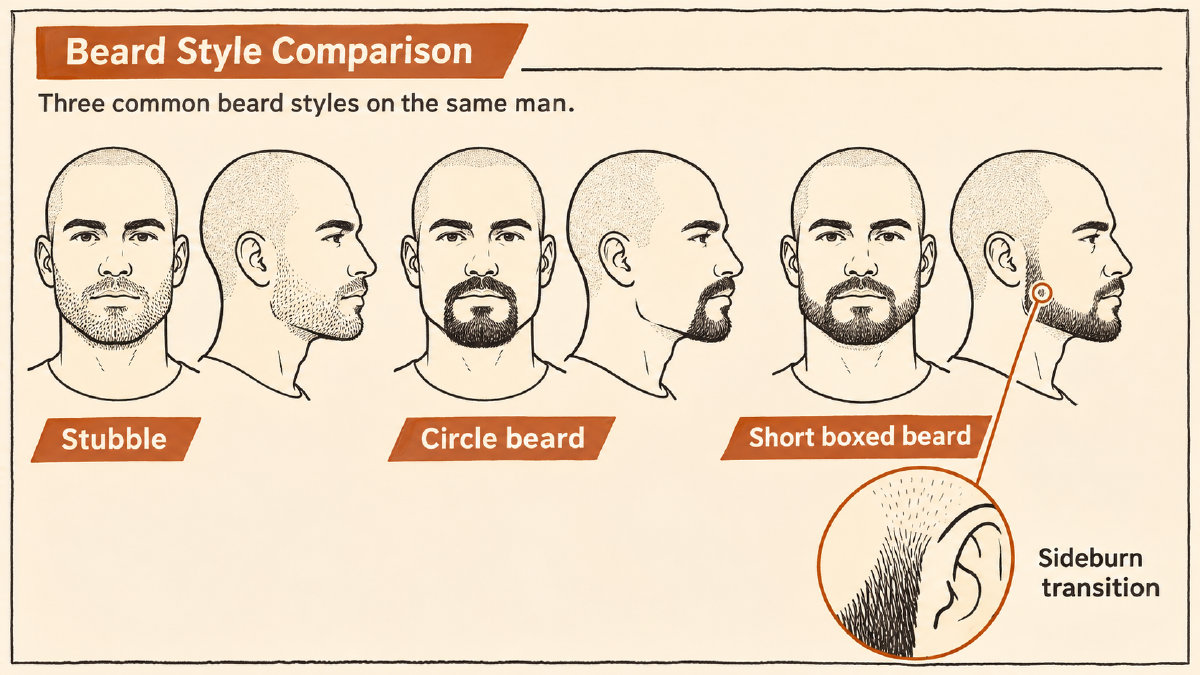
This is another great option if you’re going from no beard to a full beard. This guy has enough growth around his mouth to connect his mustache and goatee, so he doesn’t need any extra growth in order to make this work. He also has plenty of growth on his cheeks, so he doesn’t have to worry about making his beard too long.
Cheek-Free Style
I’m not sure how much growth he has right now, but I love how this style blends into the sides of his head. He’s got some cheek growth, so I’m not sure why he left his cheeks completely bare. Maybe it’s just because he’s used to having his cheeks shaved clean. Either way, this is a great example of a goatee style that looks great even without any growth on the cheeks.
Circle Outline
You can go with a rounded outline or a square version. In either case, it’s a great way to use the existing growth to create a subtle beard shape without requiring additional growth.
Stronger Mustache and Goatee
This is another great example of someone using the existing growth around his mouth to define his mustache and goatee. Since he keeps his cheeks patchy, he’s able to keep them at a stubble length while still emphasizing the growth on his lower face.
And if you don’t want to add any length, but still want to emphasize the growth around your mouth, here’s another option…
That’s a great example of how you can take advantage of the existing growth to emphasize your mustache and goatee. His beard is definitely a little patchy, but it’s not so patchy that it’s distracting. And since he’s keeping his cheeks at a stubble length, it gives him a really nice contrast between his cheeks and his goatee.
Now, let’s say you do want to grow out your beard. Then you’ll need to decide what kind of silhouette you want to achieve. Here’s a good example of someone who has grown his beard out quite a bit, but he’s keeping his cheeks pretty thin. That means that he’s not adding volume to his cheeks. Rather, he’s adding volume to his chin area.
So rather than a rounder silhouette, he’s opting for a longer one. This is a good example of how you can adjust the silhouette of your beard depending on how much volume you want in your cheeks versus your chin.
Beardbrand
Here’s another example of someone who has grown his beard out quite a bit, but he’s keeping his cheeks pretty thin. That means that he’s not adding volume to his cheeks. Rather, he’s adding volume to his chin area.
So rather than a rounder silhouette, he’s opting for a longer one. This is a good example of how you can adjust the silhouette of your beard depending on how much volume you want in your cheeks versus your chin. GQ’s guidance for a full-grown beard is to keep the neckline and upper cheeks clean, with shorter sides and more length below. For a sculpted full beard, bring the sides toward the chin with a rounded finish, rather than making it overly pointed.
GQ Executive Stubble
For those of you who aren’t familiar with GQ Executive Stubble, it’s basically a beard that’s kept at roughly 3–5 mm (approximately 1/8 inch) in length. Because of its relatively short length, it’s usually kept broadly uniform in length, although some people prefer a slightly patchier look. Regardless, it’s considered a low-maintenance beard, which is great for men who want to avoid spending hours every week trimming their facial hair.
Since it’s so short, you’ll want to keep the stubble at roughly the same length throughout. Even a few extra millimeters can completely change the look. So if you’re looking for a short beard that’s easy to maintain, then this is a great style to try.
Of course, it’s also a great option for men who have a lot of facial-hair density, but they want to keep their facial hair trimmed back to a shorter length.
As far as styling suggestions, the only real guidance I can give you is to follow your personal preference. If you prefer a more patchy look, then just leave it that way. If you’d rather have a more uniform look, then trim it accordingly. For a short boxed beard with a shaved head, GQ’s barber recommends tapering into the sideburns. If you want a faded beard, ask your barber to go progressively shorter toward the upper cheeks and sideburns, so the beard blends into your shaved head.
Beard Trimmer
In general, these are all great examples of how a short beard can still require careful upkeep. Just because you’re not trimming your beard every day doesn’t mean you won’t need to spend time maintaining it. A short beard requires precision trimming to retain its shape. With a minimal goatee, you’ll need to maintain the length, define the outline, and shave your cheeks and neck. GQ’s barber describes executive stubble as relatively low maintenance, while a sculpted full beard needs precision trimming to keep that shape.
If you’re looking for a barber to help you find the right beard style for you, then you’ll need to bring along a picture of what you want your beard to look like. If you’re unsure, then you can always show him this post.
Ultimately, the choice comes down to what you want your beard to look like. There are certainly styles that will work well for anyone who’s bald, but the exact details depend on your preferences and how much facial hair you have right now.
Sources
Measure your own face
Free, in your browser. Your photo is never uploaded.
- Attractiveness TestFace rating, PSL range and eye type.
- Face Symmetry TestHow evenly the two sides match.
- Jawline AnalyzerJaw angle, jaw width and chin taper.