
Is Your Face Shape Round? How to Check Your Measurements
Is your face shape round? Compare length, cheekbone width and jaw contours, distinguish oval and square shapes, and understand photo limits.
Table of Contents
It’s always so fun when I get a question that really makes me think. It’s like a challenge, but one that I love because it gets my brain going and thinking about the details of how we determine face shape.
I know that there are some people who feel that their face is round, but they’re not sure if it actually is. They want to know how to check. But even more than that, they want to know whether or not a “round” face shape is something that can be measured numerically, or if it’s just something that we describe based on appearance and proportions.
What Defines a Round Face Shape
So first, let’s talk about what exactly defines a “round” face shape.
The basic description is usually similar hairline-to-chin length and cheekbone width. But this leaves room for judgment rather than strict numerical thresholds. The term “similar” means that the measurements could vary slightly, which is why it’s difficult to define a specific number as a cut-off point.
According to Lashify:
Face shape: Round
Face proportions: Similar length and width
Hairline: Rounded
Cheekbones: Broad
Jawline: Rounded
Face length: Center of hairline to lowest point of chin
Forehead width: Hairline to hairline across forehead, halfway between hairline and eyebrows
Forehead tape: Straight rather than following head curvature
Cheekbone width: Highest cheekbone points, edge to edge
Cheekbone tape: Flat in front of face, away from skin
Jaw: Hinge near earlobe to center of lowermost chin tip
Jaw tape: Against skin, following curve
Jaw result: One-side measurement multiplied by two (contour length rather than straight horizontal width)
But then according to Women’s Health, the definition is different.
Round faces have a greater width than length.
So now you see where the confusion comes from. One source says that round faces have similar length and width, while another says that round faces have greater width than length.
Straight Line Measurements Versus Face Contours
I think the key here is that the difference is between the straight line measurements versus the actual contours of the face. For example, a square face will have equal length and width, but with a more pronounced forehead and jawline, and an angular jaw. A round face has a rounded hairline and jawline, and nearly matching curves.
So when you look at a person whose face has similar length and width, but a more rounded contour, you might say that they have a round face. But if you look at someone whose face has similar length and width, but a more square-shaped contour, you might say that they have a square face. With a square face, the forehead, cheekbones and jawline are also similar in width. Lashify describes an oval face as longer than it is wide, but still with a rounded hairline and jawline.
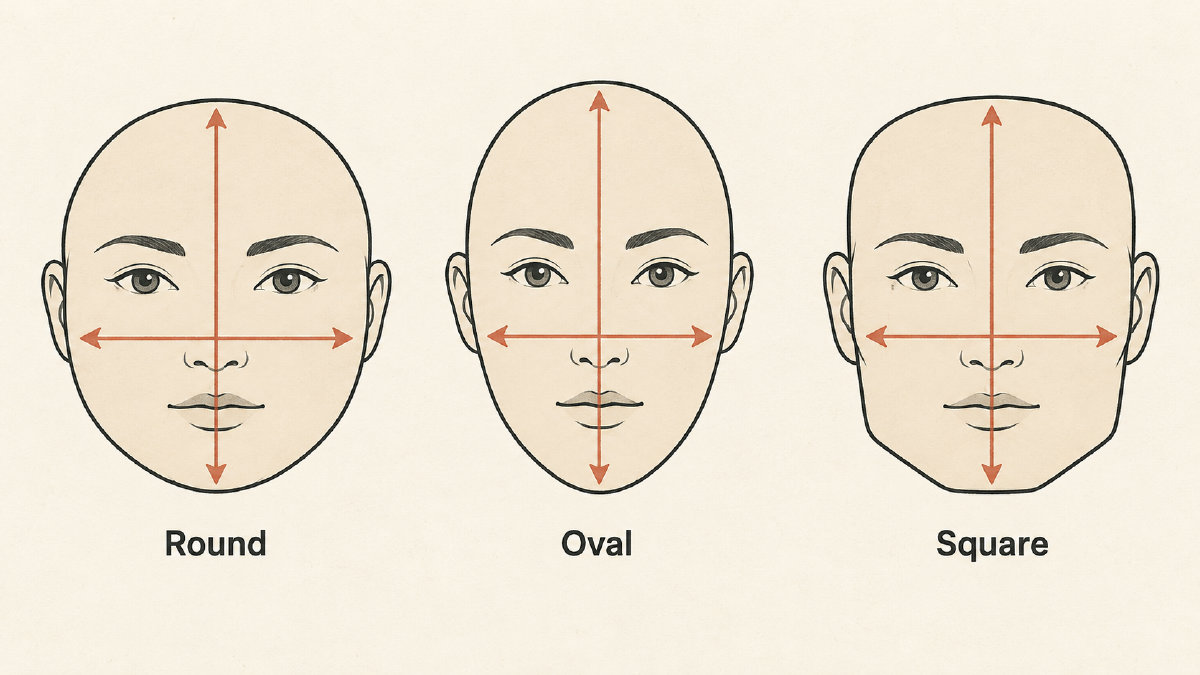
And that’s where it gets tricky. When looking at someone’s face, unless you can see the entire face, you can’t tell the difference between someone with a round contour and someone with a square contour. You can only see the general shape.
That’s why many sources say that round face shapes are defined by having similar length and width, and rounded contours. You can measure the length and width numerically, but judging the rounded contours still takes a look in the mirror.
Check Your Face With a Mirror and Tape
So then, if you can’t measure a round face numerically, how do you find out if your face is round?
There are several ways. First, measure your face directly in front of a stationary mirror using the tape method described by Lashify. This is a great way to get objective numbers to compare to other face shapes. If your numbers fall within the range of a round face shape, you’ll probably be okay calling yours round. But remember, no two people are exactly the same, and sometimes people fall outside of the categories.
Using Photographs to Judge Facial Proportions
If you don’t want to use the mirror-and-tape method, then you can use photographs. But again, keep in mind that taking a close-up selfie isn’t the best way to judge facial proportions. I’ve written about this before, but here’s a quick recap.
In a mathematical photography study published in 2018, researchers found that people tend to perceive others’ noses as broader when they are photographed from a shorter distance. In fact, the closer the camera is, the broader the nose appears relative to the bizygomatic breadth (the width of the face at the cheekbones). However, there was no established effect of roundness or validated classification of round faces.
So camera distance matters when judging facial proportions from photographs. In that study’s model, a portrait distance of 5 feet produced essentially no difference in perceived nose size relative to cheekbone width compared with an infinitely distant camera. So if you want to find out if your face is round, you should photograph yourself from a normal distance, then print the photo and trace the outline of your face on paper. Then measure the distances.
You’ll need to do this with several pictures taken from various angles. Once you have all of your measurements, you can start comparing to other face shapes. Keep in mind that some people may fall into multiple categories, and that doesn’t mean they’re any less beautiful. It simply means that their face shape is unique.
And once you know your face shape, you can move on to figuring out which hairstyles and beard styles will look best on you. There are already guides available for determining the best haircut for a round face, and the best beard styles for each face shape.
Sources
Measure your own face
Free, in your browser. Your photo is never uploaded.
- Attractiveness TestFace rating, PSL range and eye type.
- Face Symmetry TestHow evenly the two sides match.
- Jawline AnalyzerJaw angle, jaw width and chin taper.