
How to Match Face Shapes and Bangs to Your Styling Goals
Compare face shapes and bangs by forehead coverage, soft framing and a stronger outline, then choose fringe details that fit your texture and routine.
Table of Contents
When I’m cutting bangs for a client, the first thing I look at is their face shape. The bangs are supposed to frame your face in a flattering way, so it makes sense that I start there. But when I’ve worked with clients who don’t know much about haircuts, or who haven’t really thought about how their bangs can be used to enhance their features, they’ll often say something like, “I just want bangs that go with my face shape.”
And then I’ll have to explain that while that’s true, the bangs aren’t necessarily going to be the only thing framing your face. You’ll also have your hairstyle, your layers, your color, and your accessories (like glasses) playing into that equation. Ask about the shortest piece and how it connects to your layers. Your glasses, parting, and styling habits can affect the length and shape.
So instead of thinking of it as “bangs that go with my face shape,” it might help you to think of it more as “what features do I want to emphasize?”
For example, if you have a round face, but you’d prefer to highlight your cheekbones rather than draw attention to the fullness of your forehead, then you probably won’t choose a blunt fringe that covers your entire forehead. And if you have an oval face, but you’re looking for bangs that will make your jawline appear softer, then curtain bangs might not be your best option.
The beauty of having someone else cut your hair is that you can give them a general idea of what you’re looking for, and they’ll take care of the rest. But if you’re doing this on your own, then knowing how to match your face shape to your desired bangs will definitely help you get closer to the right cut.
Let’s begin by taking a look at each of the different face shapes, and the options available for each.
Round Faces
There are two main things you can do with round faces: 1) visually elongate your face with bangs that create a longer frame, or 2) soften the appearance of your face with bangs that create a softer frame around your jaw.
Visually Elongating Your Face With Round Bangs
If you’re looking for bangs that will make your face appear longer, then you need bangs that will frame your face vertically. Curtain bangs are perfect for this purpose. Curtain bangs should be grown out long enough to fall across your forehead, but since they’re parted down the middle, they’ll be shorter at one end and longer at the other. That means that the center piece of your curtain bangs will be shorter, but the side pieces will be longer, giving you a nice vertical framing effect.
Curtain bangs will also help lift your face slightly, which helps make your face appear longer. This works especially well for people whose bangs are pulled back away from the face, because that movement lifts the face even more.
Softening Your Jawline With Round Bangs
On the flip side, if you want to soften the appearance of your jawline, then curtain bangs aren’t your best bet. Curtain bangs tend to be pretty bold, and they’re meant to frame the face in a dramatic way. If you’re looking for something more subtle, wispy bangs are better suited for softening the appearance of your jawline.
Wispy bangs are usually textured at the ends, so they’ll fall in a more relaxed, natural-looking way. They’re also usually straight-across, so they’ll frame your face horizontally rather than vertically. Wispy bangs also add a little bit of volume around the cheeks, which can help reduce the sharpness of your jawline.
Square Faces
While square faces share some characteristics with round faces, the difference is that square faces have a more angular jaw that keeps more of the face’s width. So if you’re looking for bangs that will make your face appear longer, then curtain bangs are still a good option for square faces. However, if you’re looking for bangs that will make your face appear softer, then wispy bangs might be a better option.
You could also try layered, textured wisps that blend into your layers. These will frame your face softly, but they’ll also add a bit of dimension to your haircut.
Heart-Shaped Faces
Heart-shaped faces typically have a wider forehead and a narrow chin, so soft, curved bangs can help balance out your broader forehead. Curtain bangs work well for heart-shaped faces, but you’ll want to avoid overly long curtain bangs that might make your face appear too small.
Oval Faces
Oval faces are the most versatile of all, so you have a lot of flexibility when choosing bangs. Curtain bangs work great for oval faces, and they’ll give you a dramatic yet elegant look. Wispy bangs are also a great option, and they’ll give you a soft, romantic look.
Long or Rectangular Faces
Long or rectangular faces have more length relative to their width, rather than necessarily being wider than square faces. Curtain bangs work well for these faces, but you’ll want to avoid overly long curtain bangs that might make your face appear too small.
Bangs that are straight-across and textured are also a great option for long or rectangular faces. These bangs will frame your face softly, but they’ll also add a bit of dimension to your haircut. Straight-across bangs can emphasize your rectangular structure, while fuller curtain bangs can make your face appear shorter. Longer curtain or side-styled bangs are other options for long faces.
Choosing Your Preferred Style of Bangs
Now that you know what types of bangs work well for each face shape, let’s take a look at how to match your preferred style of bangs to your face shape.
First, decide whether you want bangs that will make your face appear longer or softer. Then, choose a type of bang that fits your preference. For example, if you want bangs that will make your face appear longer, then curtain bangs are a good option. If you want bangs that will make your face appear softer, then wispy bangs are a good option.
Next, decide how much coverage you want. Curtain bangs can be wispy too, so the coverage depends on how they’re cut and parted. If you want more coverage, then a fuller fringe with a smaller center opening is a good option. If you want less coverage, then a lighter fringe with a wider opening is a good option. Side bangs cross one side of your forehead, leaving the other exposed. Blunt bangs cover your forehead with a crisp line. Wispy bangs can be straight-across or curtain-shaped.
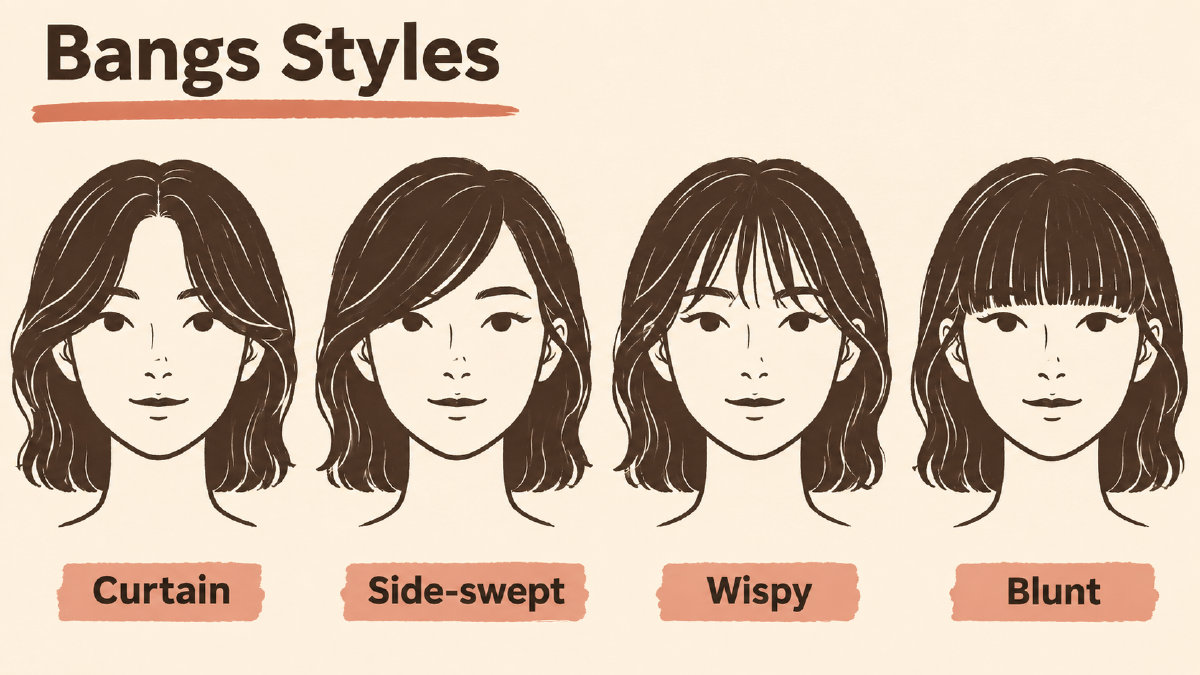
Finally, decide how much density you want. Curtain bangs can be fuller or more wispy, so if you want more density, then ask for a fuller cut that works with your hair’s natural thickness. If you want less density, then a lighter, wispy cut is a good option. Check how your waves or curls dry, because shrinkage changes the length. Fine hair may need a lighter fringe to leave enough fullness elsewhere. A strong cowlick can separate straight bangs, and blunt bangs on wavy hair may take more styling than you want.
Once you’ve decided on your preferred type of bangs, length, width, and density, you’re ready to find a stylist who offers those services. Bring two photos and explain what you like about each. You can also try a clip-in fringe before committing.
Sources
Measure your own face
Free, in your browser. Your photo is never uploaded.
- Attractiveness TestFace rating, PSL range and eye type.
- Face Symmetry TestHow evenly the two sides match.
- Jawline AnalyzerJaw angle, jaw width and chin taper.