
How to Identify and Style an Inverted Triangle Face Shape
Identify an inverted triangle face shape, compare heart and diamond outlines, and explore optional hair, brow and glasses choices.
Table of Contents
I’m always amazed at how many people think that their face shape is one thing, but when you look at the outline of their face, it’s something else. I’ve been told so many times by readers that they have a heart-shaped face, only to discover that their face shape is actually an inverted triangle. Or vice versa.
It seems like the confusion stems from a lack of understanding about what defines each face shape. So let me help clarify things a bit for you.
First, let’s talk about identifying your face shape.
Identifying Your Face Shape
The easiest way to identify your face shape is to look at the widest part of your face. If you’re unsure, then use this method…
-
Get a picture of yourself where your head is straight (no tilt) and your eyes are level with the camera (i.e., no up or down angle). The best place to take this photo is several feet away from you so that there isn’t any distortion caused by the lens of the camera. A selfie taken on a phone won’t do because the camera lens will distort your facial features.
-
Make sure that your hair is pulled back away from your forehead and temples. Don’t worry if you can’t get all of your hair off of your face — just make sure that nothing is covering up the sides of your face.
-
Now look at your forehead, cheekbones, jaw, and chin. Determine which of these areas is the widest. That area defines your face shape.
If you still aren’t sure, then here are some general guidelines.
Diamond: Your cheekbones are the widest.
Heart: Your forehead is the widest.
Inverted triangle: Your forehead and temples are the widest, tapering down to a narrower jaw.
Pear: Your jaw is the widest.
Triangle: Your jaw is the widest.
Widow’s peak: A hairline feature that alone doesn’t establish your face shape or which region is widest.
Wide-jaw triangle: Your jaw is the widest.
Heart and Inverted Triangle Overlap
But wait! There’s also the possibility that two of those shapes could overlap. For example, it’s possible for someone to have a heart-shaped face and also be an inverted triangle, right? But why would that happen?
Because there are overlapping boundaries between some of the labels. The definition of “heart” is sometimes used interchangeably with “inverted triangle.” And in some cases, the boundary between the two can be very subtle.
For instance, some people might define a heart as having a widow’s peak or a wide forehead, while others might define a heart as having a wider forehead than cheekbones, or a wider forehead than jaw. Some may even define a heart as having a narrower forehead than cheeks, but a wider forehead than jaw. Others may not define a heart at all, but rather see the distinction between a heart and an inverted triangle based on the presence of a widow’s peak or a flare in the cheekbones.
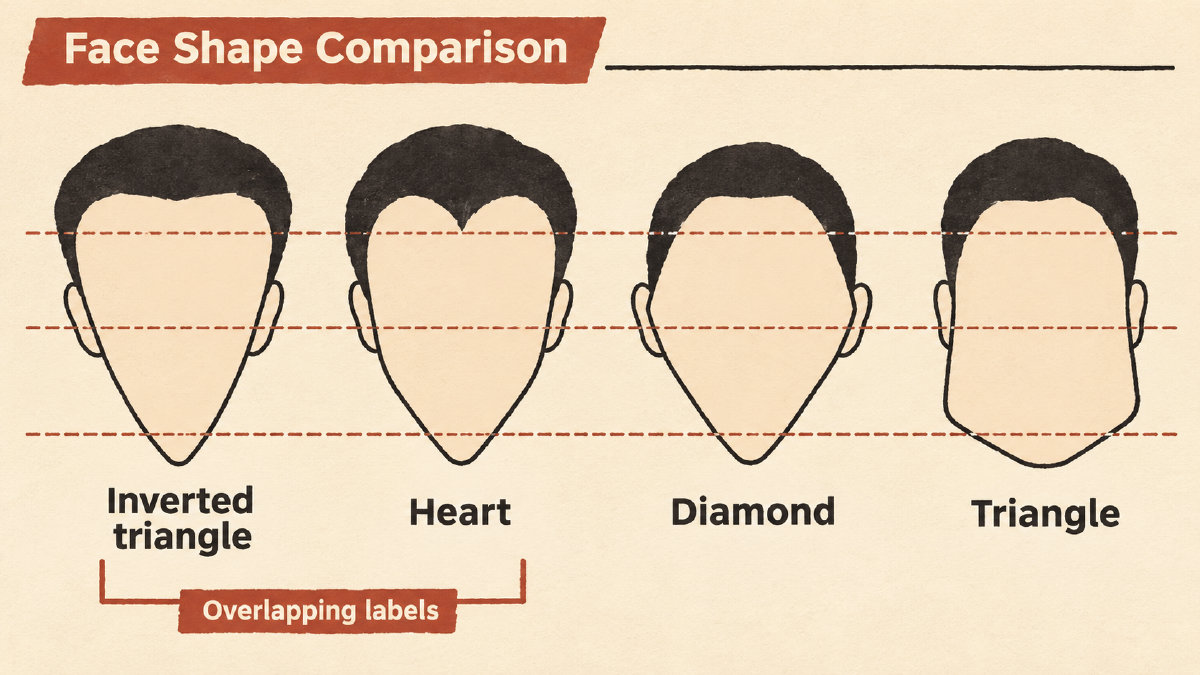
So if you don’t want to overcomplicate things, then just remember this…
The most commonly accepted definitions of face shapes are:
Diamond: Cheekbones are the widest.
Heart: Forehead is the widest.
Inverted triangle: Forehead and temples are the widest, tapering down to a narrower jaw.
Pear: Jaw is the widest.
Triangle: Jaw is the widest.
Widow’s peak: A hairline feature that alone doesn’t establish your face shape or which region is widest.
And while there are other variations, the above list covers the most common ones. As long as you know which of those areas is the widest on your face, you’ll be able to determine your face shape pretty easily.
There is currently no validated measurement protocol or numerical classifier for determining face shape, so there’s no definitive answer. It’s all qualitative. That means that every person has a slightly different interpretation of what qualifies as a specific face shape.
Now that we’ve got that cleared up, let’s move on to styling suggestions for inverted triangle face shapes.
Styling Suggestions for Inverted Triangle Face Shapes
The goal for inverted triangle face shapes is to reduce the emphasis on the forehead and add more apparent fullness lower down. This will create the illusion of a more balanced face.
Kristin Ess says you can leave your forehead uncovered if you like, but recommends avoiding heavy, straight-across bangs for inverted triangle face shapes. She suggests long bangs, curtain bangs, or side-swept bangs.
She also says that center or off-center parts are most flattering for inverted triangle face shapes, but not mandatory. Kristin recommends styling bangs or layers outward once they pass the eyes or eyebrows, so that the hair from the center part leads into layers near the cheekbones. Downward styling can emphasize length, which she recommends avoiding for inverted triangle face shapes.
The key point for inverted triangle face shapes is to reduce the emphasis on the forehead. That doesn’t mean you need to cover it up completely. It just means that you should minimize the emphasis placed on it through your hairstyle.
Some choices are optional depending on your preferred effect, but the following are my recommendations for inverted triangle face shapes.
• Avoid uncovered foreheads and bangs
• Use longer lengths (e.g., wavy bob or lob)
• Add texture and layers to emphasize the width of the cheekbones or jaw
• Choose styles that diffuse the width of the forehead and emphasize the width of the cheekbones or jaw
• Use a side part to allow the weight of the hair to fall away from the forehead
Of course, these results vary depending on your hair type and how well your hair holds style.
You can choose whichever of these options appeals to you the most. None of these choices are mandatory, and none of these choices will produce identical results. You’ll have to experiment to find out what looks best on you.
Other Options
You can also try softer brow contours if you’re looking for less angular emphasis. The Glow Memo recommends softer, rounded brows for inverted triangle face shapes, and I agree. Rounded, softly pointed brows will give you a much softer look than sharply defined, pointed brows.
And finally, you can also play around with frame details if you’re looking for less emphasis at the forehead. Styling-guide recommendations include thin or light upper rims, and visual weight below the brow line. Again, though, these are just styling-guide recommendations. No one frame shape is objectively ideal for inverted triangle face shapes. These are simply personal preferences.
Face shape advice is intended to support your own personal style choices. There is no obligation to change the appearance of your face. The purpose of knowing your face shape is to help you make informed decisions about what kinds of hairstyles, makeup, accessories, etc., will work best for you.
Sources
Measure your own face
Free, in your browser. Your photo is never uploaded.
- Attractiveness TestFace rating, PSL range and eye type.
- Face Symmetry TestHow evenly the two sides match.
- Jawline AnalyzerJaw angle, jaw width and chin taper.