
How to Recognize a Pointed Chin in Front-Facing Photos
Recognize pointed chin taper in front-facing photos, take consistent comparison shots, and understand what a chin-to-jaw width ratio can tell you.
Table of Contents
I’ve had a couple of people ask me if I can tell them whether they have a pointed chin. And while it’s true that I can give them an idea, I want to be clear about what the jawline analyzer does and doesn’t do.
It will not tell you if you have a pointed chin or not. But if you’re wondering how to recognize a pointed chin in front-facing photos, then here are some things to look for.
What a Pointed Chin Means
First, let’s get one thing straight. A “pointed” chin is something that is visible narrowing toward the chin in an adult front view. It’s not something that is measured by height, width, inclination, or projection. So when we talk about a “pointed” chin, we’re talking about relative width. In other words, how narrow the chin appears compared with the rest of the face.
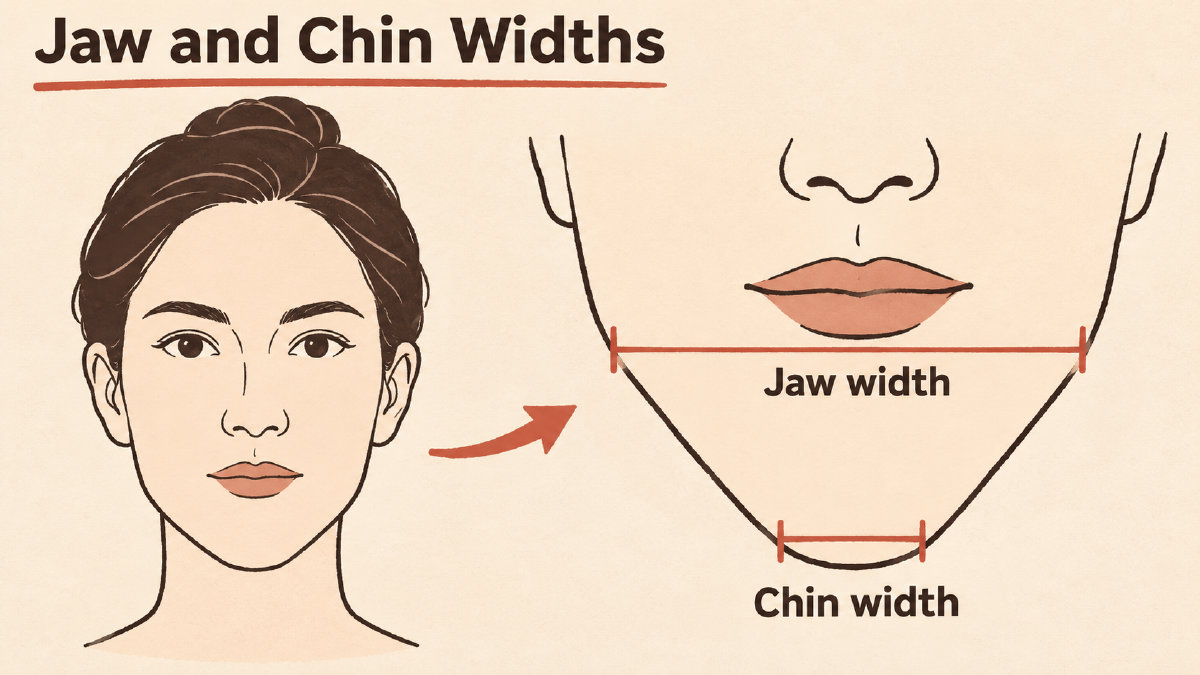
The jawline analyzer can establish from a frontal image if your chin is relatively narrow compared to the rest of your face. But that result cannot describe the side-profile projection of your chin (how far forward or back your chin projects). That’s because the jawline analyzer only measures dimensions that can be seen from a front-facing photo. The projection of your chin is not measurable from a front photo.
So, the jawline analyzer can help us determine if our chin is relatively narrow compared with the rest of our face, but it cannot tell us if our chin is projecting too far forward or backward. If you’re concerned about your chin’s forward or backward projection, you’ll need to look at a side profile.
But if you’re looking for a way to recognize a pointed chin in front-facing photos, then the jawline analyzer can definitely help.
Here’s how it works…
Chin Taper and Degree of Narrowing
When you take a front-facing photo of yourself, the chin will appear narrower than the jaw. This is called chin taper. But chin taper isn’t the same as having a pointed chin. A pointed chin is just a chin that appears significantly narrower than the jaw.
This person has a very narrow chin, but it’s not quite narrow enough to qualify as a pointed chin.
That person has a pointed chin.
So the key difference between a narrow chin and a pointed chin is the degree of narrowing.
Chin Width in the Reference Sample
To quantify that, I’ll use my reference sample.
In my reference sample, the chin width is 0.23 times the jaw width. That means that for every unit of jaw width, the chin is 0.23 units wide.
The typical chin-to-jaw width range is 0.22–0.24. That means that 0.23 is right in the middle of the typical range. Of course, there are always exceptions, so I’m not saying that everyone falls within that range.
But since I have over 100 faces rated by over 2,500 people, I can use that range to describe typical proportions. Falling inside or outside it doesn’t mean a face is more or less attractive. That range doesn’t give us a universal cutoff for a pointed chin. So I can’t use it to say that a chin is narrow enough to qualify as pointed.
Photo Setup for Consistent Comparisons
Of course, that’s not necessarily true for all people, and those measurements were taken from a specific set of photographs. I don’t have the exact photo instructions used for that reference sample. For consistent lighting, distance, posture, and expression in your own comparisons, here are the site’s documented instructions for analyzer users:
Even frontal light: facing a window or lamp so that even light hits the entire face.
Side or overhead light: shadows shifting apparent jaw, nose and eye corners.
Dark photos: rejected.
Camera at eye level.
Head level.
Arm’s length or farther away. Crop if needed.
Close phone: wider-looking nose and middle of face.
Relaxed expression.
Lips closed.
Eyes open normally.
Smiling: lifted cheeks and changed mouth, eye and jaw measurements.
Full face framed from forehead to chin.
Hair pushed away from jawline.
Glasses removed.
Two or three photos from the same spot.
Compare the resulting range.
Measurement Accuracy and Relative Chin Width
And since I didn’t do any independent testing myself for this article, I can’t vouch for how accurate this measurement is. But I do know that it’s based on actual data collected from actual people. I can’t confirm that this measurement has been repeatedly validated, so I’d use it to compare relative chin width in consistent front-facing photos.
So if you’d like to try it out for yourself, feel free! I’m sure you’ll find it interesting.
Other Factors That Affect Jawline Appearance
Also, keep in mind that if you wear a beard, the jawline analyzer may not give you the results you expect. That’s because a beard changes the appearance of the outline of your jaw. It doesn’t change the shape of your jaw itself, but it changes how the shape of your jaw is detected.
So if you have a beard, and you don’t like the way your jawline looks, you might want to consider experimenting with different beard outlines until you find one that makes your jawline look better.
You might also want to experiment with different ways of styling your hair. Long hair can make your jawline look much sharper and pointed. Head tilt can also affect the way your jawline is perceived.
Also, body fat distribution can affect the way your jawline is perceived. Fat around the neck area can make your jawline look much less defined.
If you want to try it out for yourself, you can follow the site-documented photo setup for consistent comparisons. Just remember that this is only a visual experiment, and there’s no established best beard shape for a pointed chin.
Measure your own face
Free, in your browser. Your photo is never uploaded.
- Attractiveness TestFace rating, PSL range and eye type.
- Face Symmetry TestHow evenly the two sides match.
- Jawline AnalyzerJaw angle, jaw width and chin taper.