
What Is Positive Canthal Tilt, and How Do You Measure It?
Positive canthal tilt means the outer eye corner sits higher. Learn how to measure it from a photo and why head position can change the result.
Table of Contents
Positive canthal tilt is defined as an upward direction. This is determined by looking at the actual eyelid junctions—the medial canthus (inner upper–lower eyelid junction) near the nose and the lateral canthus (outer upper–lower eyelid junction) near the temple—and the direction of their connecting line.
The calculator’s documented browser workflow provides both eye readings alongside their average for photo preparation.
The calculator’s stated correction estimated a whole-face roll from both eyes removed from eye angles. Sagittal head tilt (forward or backward movement) was also addressed, along with standardized frontal photographs and some statistical significance values. Tilting the head downward made positive intercanthal tilt more pronounced alongside other eye-area changes, so correcting sideways roll doesn’t remove every pose effect. The head-position study used standardized photos of 12 female volunteers, with a mean age of 27.5 years, and ratings from 11 blinded evaluators.
A definition of positive tilt is offered in comparison to community preferences, sample-based bands, and other attractiveness ratings. But it’s clear that there isn’t a requirement for a larger angle to make an entire face more attractive.
There may be differences between the measured angle and the overall impression of eye shape, though asymmetry remains visible.
For an optional styling example, we can look at cosmetologist Shun Pittman’s advice in wikiHow: cat eye eyeliner can add lift and help open the eyes. This changes the visual impression without actually altering the anatomical measurement of positive canthal tilt.
How to measure your own positive canthal tilt
To begin preparing the photo, you should:
Take a front-facing photo, making sure that your head is level, and the camera is at your eye level, so that you are gazing into the lens. If not, this will skew the results. Also, consider using a window or lamp to ensure even illumination across both sides of your face. Keep your expression relaxed, but avoid smiling: your mouth, eye and jaw measurements will change when you smile, raising your cheeks. Avoid lifting your chin, as that shortens the lower face; lowering your chin makes it appear longer. We’ve documented the hints of rejection that the site used to reject excessive tilt or turn in photos. We’ve retained those too.
Ensure that you’re able to see your actual visible eyelid corners. The endpoints of your eyeliner should be excluded from these calculations. With the 478 facial points placed within the browser, we’re ready to take measurements. All of these will be computed on the spot. The corner-to-corner angle is measured against a horizontal reference through the inner corner. You can inspect the measurement lines displayed on the photo to see where they meet the eyelid junctions.
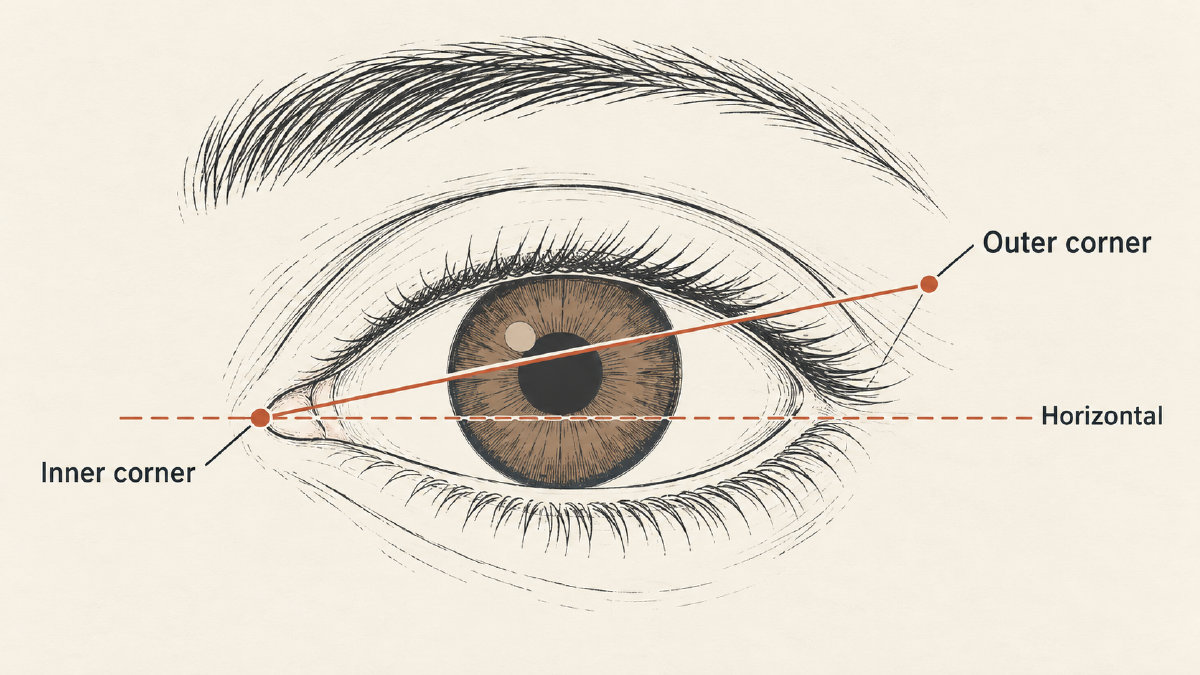
We’ll refer to the documentation about the site’s operations later, but what we see is a degree or two of side-to-side difference described as normal. Documented operation has been provided below.
As I’ve discussed before, while there are some independent hands-on accuracy tests, we have found no evidence of such here. Lighting, lens distance, head angle and expression could all influence the variability in the measurement, and comparing your results to others is best done via multiple similarly taken photos.
What is “positive” canthal tilt?
You might ask yourself, what exactly does a “positive” canthal tilt mean? As we said earlier, it means that the outer corner of your eye is higher than the inner one. While this term may imply that the preferred ranges must be somewhere around 5° to 8°, the site has no requirement that your upward angle lie within any particular interval.
However, the site described a convention that the community seems to prefer, roughly between 2° and 6°. According to the site, most of its calibration faces fall within approximately 0.6° to 7.4°, which we can assume is somewhat arbitrarily established. But neither band qualifies as either a definition of “positive” tilt or as a universal target. Rather, the 2° to 6° band describes the community’s general preference, while the 0.6° to 7.4° band describes most measured tilts in the calibration sample. Neither is an absolute beauty standard. Neutral or slightly negative tilt is common and not a flaw.
Why can’t attractiveness comparisons prove that a larger positive angle makes an entire face more attractive?
It turns out that the study we looked at wasn’t really trying to isolate the causal effect of canthal tilt on attractiveness—it was looking at the photography effects, as well as simultaneous changes in tilt, eyelid exposure and fold heights, brow and crease position.
The study didn’t attempt to find the ideal angle for all adults or predict attractiveness from that number. Rather, the website used a set of 101 adult faces rated by 2,513 people from the Face Research Lab London Set, created by DeBruine & Jones 2017, which is distributed under CC BY 4.0. The site calculated a geometry score based upon 12 points on the face, including the medial and lateral canthi, but found only partial agreement with the attractiveness ratings. Proportions matter, but they’re just part of attractiveness, the site says.
Can the measured angle differ from the overall impression of eye shape?
The site also notes that while the lid edges are clearly visible, it’s hard to tell whether there’s an asymmetry or whether any broader classification is appropriate. That is why we’ve separated the eye readings.
Differences between individual eye readings may be potentially concealed by the average. For instance, hooding, the shape of the eyelids and the amount of upper eyelid exposure affect the appearance of the eye, outside of the tilt number. And the site recognizes that you may need to identify both the upper and lower lid edges to properly identify the corners. However, the site’s hunter-eye classification includes tilt combined with eye shape and spacing. So simply having a positive tilt doesn’t necessarily indicate that the eyes would be labeled as “hunter eyes.”
Sources
Measure your own face
Free, in your browser. Your photo is never uploaded.
- Attractiveness TestFace rating, PSL range and eye type.
- Face Symmetry TestHow evenly the two sides match.
- Jawline AnalyzerJaw angle, jaw width and chin taper.