
How to Tell If You Have a Rectangle Face Shape
Identify a rectangle face shape using length, similar facial widths and jaw angles, then compare oblong and square outlines with photo perspective in mind.
Table of Contents
The first thing I want to do is clarify something. Many people confuse the rectangle face shape with the square face shape. But in this article, I’m going to use the term “rectangle” to refer to any face that has an elongated shape (i.e., longer than it is wide), and a similar width from the forehead to the cheekbones to the jawline.
If you’d rather have your face described as a square, then feel free to use those measurements for your face. And if you’re looking for help determining whether or not your face is actually a rectangle, then keep reading.
I’ll start by explaining how to prepare and measure a photo of your face so that we can compare facial proportions consistently. Tape and photo measurements can suggest different shapes because they don’t always measure the same thing. For example, wikiHow measures from one jaw corner to the chin and doubles that distance, while I’m measuring straight across between the jaw corners in a photo. A tape following the surface of your face also measures a different distance from a straight line between landmarks, so I wouldn’t mix those measurements. After that, I’ll clarify why I consider rectangle and square to be separate outlines, even though they’re sometimes used interchangeably.
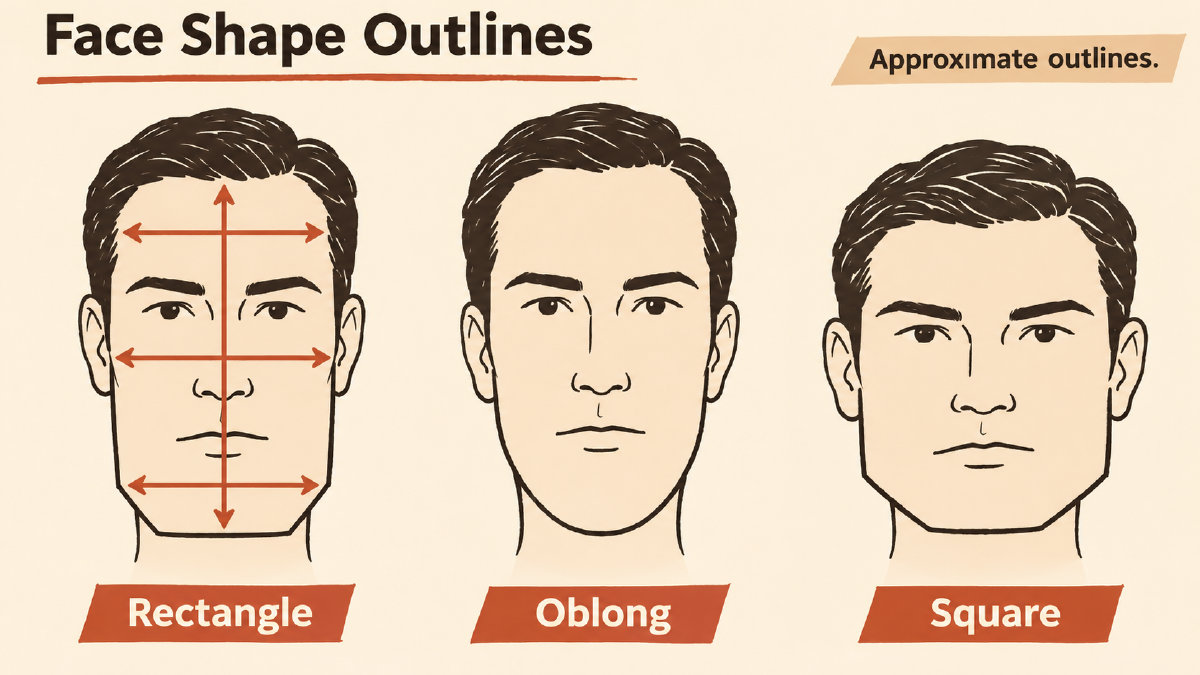
And finally, I’ll explain why I don’t think the terminology matters much, because no individual measurement establishes face shape on its own. Some proportion tools will give you a label based on a single measurement, but that’s misleading. In reality, there are no exact numerical boundaries between the face shapes. So you might end up with a mixed outline, which is just as useful a description as one specific label.
So let’s get started!
Prepare Your Face Photo
First, take a straight-on adult face photo. That means no head rotation, and no upward or downward tilt. Your camera should be moved back so that your face fills the frame, but you still have some room around your face. It should also be positioned so that the lens is at eye level.
My face.
What Makes a Rectangle Face Shape
That was easy, wasn’t it? 🙂 My face is definitely a rectangle. But what makes a rectangle face shape? Well, it’s basically an elongated face shape. The length of the face is greater than the width. Also, the forehead, cheekbones, and jawline are all about the same width.
But I know some of you are thinking, “Wait! What about my face? It doesn’t fit into that definition.” Well, that’s okay. There are many variations of each face shape, and I’m not saying that everyone has to fall neatly into one category. A lot of people fall between categories, and I think that’s perfectly fine.
Rectangle face shape.
Rectangle and Square Face Differences
See the difference? The first face is more square, while the second is more rectangular. Both have angular features, but the rectangle is longer and narrower.
Let’s break down the differences. First, the rectangle is longer than it is wide. The square is approximately the same length and width.
Second, both have defined cheekbones, but the square has broader cheekbones.
Third, both have angular jaw corners, but the square has broader jaw corners.
Fourth, the square has a relatively uniform width throughout its entire length, whereas the rectangle tapers slightly toward the bottom.
Fifth, both the square and the rectangle have angular jawlines; a softer jaw contour is more typical of an oblong outline.
Sixth, the square has a relatively broad chin, while the rectangle has a narrow chin.
Seventh, the square has a rounder, softer jaw contour, while the rectangle has a sharper, more angular jaw contour.
Eighth, the square has a very prominent jawline, while the rectangle has a less prominent jawline.
Ninth, the rectangle often has a high forehead, so a lower forehead isn’t what distinguishes it from the square.
Tenth, the square has well-defined cheekbones, while the rectangle has well-defined cheekbones.
Eleventh, the square has a somewhat higher cheekbone compared to the forehead, while the rectangle has a somewhat lower cheekbone compared to the forehead.
Twelfth, the square has a relatively flat nose bridge, while the rectangle has a relatively high nose bridge.
Thirteenth, the square has a relatively narrow nose, while the rectangle has a relatively wide nose.
Fourteenth, the square has a relatively short nose, while the rectangle has a relatively long nose.
Fifteenth, the square has a relatively narrow mouth, while the rectangle has a relatively wide mouth.
Sixteenth, the square has a relatively small mouth, while the rectangle has a relatively large mouth.
Seventeenth, the square has a relatively narrow chin, while the rectangle has a relatively wide chin.
Eighteenth, the rectangle typically has a flat chin, rather than a pointed one.
Nineteenth, the square has a relatively narrow neck, while the rectangle has a relatively wide neck.
Twentieth, the square has a relatively wide collarbone, while the rectangle has a relatively narrow collarbone.
Okay, that’s quite a list. And I didn’t even go through every single feature. 🙂
In addition to these differences, the square has a relatively shorter face length compared to the rectangle.
Measure Your Face
Now, let’s talk about measuring your face to determine if you have a rectangle face shape. First, find a good photo of your face, and print it out. You need to make sure that your face is centered in the middle of the paper, and that the whole face is visible.
Then, use a ruler or measuring tape to measure the length of your face. Start at the center of your hairline, and measure down to the bottom of your chin.
Next, measure the width of your forehead. Find the widest part of your forehead, and measure left to right across that point.
Measure the width of your cheekbones. Find the most prominent points of your cheekbones, and measure left to right across those points.
Finally, measure the width of your jaw. Measure straight-across your jaw, from one side to the other.
Compare your measurements. Does your face seem longer than it is wide, with similar forehead, cheekbone, and jaw widths and angular jaw corners? If those features fit together, then you probably have a rectangle face shape. Length alone isn’t enough—oval faces are longer than they are wide, too.
Rectangle and Oblong Terminology
Keep in mind that some of you may prefer to call your face a square instead of a rectangle. I’ve seen some descriptions that use the terms interchangeably. For example, here’s one source that describes the rectangle as follows:
“A rectangle face shape is usually considered to be a face that is longer than it is wide. This is sometimes referred to as an oblong face shape.”
And here’s another source that uses the term “oblong” to describe the rectangle face shape:
“Oblong faces are generally rectangular in shape. They’re longer than they are wide, and have a distinct jawline. Oblong faces are sometimes called rectangle faces.”
So, clearly, there’s overlap between rectangle and oblong terminology. But for the sake of clarity, I’ll continue to use the term “rectangle” to refer to any face that has an elongated shape (i.e., longer than it is wide), and a similar width from the forehead to the cheekbones to the jawline.
Of course, if you’d rather have your face described as a square, then that’s perfectly fine. Just use those measurements for your face.
Jawline Variations and Measurement Limits
One last thing I want to mention is that some people use the term “rectangle” to describe someone who has a very defined jawline, but a soft curve along the jawline, and a relatively narrow chin.
Rectangle face shape.
This person definitely has a rectangle face shape. But she also has a soft curve along her jawline, which is a bit more rounded than oval or rectangular outlines. Her jawline is also much softer than a square face shape. She also has a relatively narrow chin.
In my opinion, that’s just as valid a description of a rectangle face shape as a face with a hard, straight jawline. But I like to stick to the conventions I’ve been using since I started writing about face shapes, so I’ll continue to use the term “rectangle” to refer to any face that has an elongated shape (i.e., longer than it is wide), and a similar width from the forehead to the cheekbones to the jawline. If you use the site’s golden-ratio comparison, that can’t confirm that your face is a rectangle. It isn’t a validated threshold for identifying face shape. The jawline analyzer measures several separate properties of your lower face, and the site’s guide says those individual measurements can’t definitively identify your face shape.
I hope that helps!
Sources
Measure your own face
Free, in your browser. Your photo is never uploaded.
- Attractiveness TestFace rating, PSL range and eye type.
- Face Symmetry TestHow evenly the two sides match.
- Jawline AnalyzerJaw angle, jaw width and chin taper.