
How to Choose Round Face Shape Glasses That Fit
Choose round face shape glasses by comparing angular and softer frames, checking size markings and comfort, and understanding virtual try-on limits.
Table of Contents
If you have a round face shape, then you’re in luck. You have the most options of any face shape when it comes to glasses.
But I’ve also found that many people are confused about how to choose frames for their face shape. Some people think that there are strict rules about what types of frames will work best with their face shape. But if you look at those rules closely, they usually aren’t hard and fast rules — they’re just suggestions based on general observations.
So let’s start by talking about your face shape as a starting point, but not an absolute rule. The main thing to remember is that these guidelines are meant to give you a starting point, but they’re not necessarily rules that must be followed. If you like something that doesn’t quite fit your face shape, it’s okay to try it out. Just make sure that it fits your face well enough so that it looks good on you, and that it feels comfortable.
I’ll explain more about this below, but here are some things to consider:
• Face shape is a flexible starting point.
• Frame width matters much more than the exact measurements.
• Angular frames offer the strongest contrast.
• Softer frames still remain worth comparing.
• Don’t get hung up on frame size markings.
• A quick in-person check can save you from buying the wrong pair.
• Virtual previews help narrow down style choices.
Face Shape Is a Flexible Starting Point
I always recommend identifying your face shape before choosing glasses, but it’s important to remember that your face shape is only one factor to consider when choosing glasses.
I also know that sometimes people identify their face shape incorrectly. It’s easy to misidentify your face shape because it’s such a common question. In fact, I wrote an article specifically to help you identify your face shape.
But even if you do identify your face shape correctly, don’t get too hung up on it. While identifying your face shape can be helpful, it’s not a rigid set of rules that you must follow. And if you happen to find a frame that doesn’t quite fit your face shape, that doesn’t mean that you can’t wear it. It just means that it may not be your best choice.
The key thing to remember is that your face shape is only one of several factors to consider when choosing glasses. For example, I mentioned above that people often confuse their face shape, but even if you do identify yours correctly, you might not want to wear glasses that look exactly like your face shape. You might prefer a little bit of contrast.
And that’s where things get tricky. When I talk about choosing glasses for your face shape, it’s important to remember that “contrast” isn’t a universal concept. What seems to provide strong contrast to me may seem like a subtle difference to you. So while it’s possible to find a frame that strongly contrasts your face shape, it’s also possible to find a frame that provides very little contrast to your face shape.
That said, if you’re trying to determine which type of frame would suit your face shape best, then you should definitely consider how contrasting the lines of your frame are with your natural facial contours. Let’s take a look at two examples.
For the first example, imagine a woman who has a round face shape, and she’s wearing a square frame. Square frames have clear angles that contrast sharply against her naturally rounded contours. For the second, imagine a woman who also has a round face shape, but she’s wearing a rectangular frame. Rectangular frames have straighter lines, but they still contrast against her naturally rounded contours.
In both cases, the women chose frames that contrasted their faces. However, the amount of contrast each frame offered was different. One provided stronger contrast than the other.
You can achieve varying degrees of contrast depending on the corner shape and rim thickness of the frame. ZEELOOL suggests starting with square frames for clear angles, then varying rim thickness and corner shape to find the contrast you like.
So you see, if you really love angular frames, you can go with them. If you prefer softer frames, you can go with those as well. But regardless of what kind of frame you choose, keep in mind that the amount of contrast between your face shape and your frame is a matter of personal preference. There isn’t a right or wrong answer here. It’s all about what looks good on you.
Upper-Face Emphasis Is Another Styling Preference
One of the other things that determines whether a frame is right for your face shape is whether or not it emphasizes the upper part of your face. Again, this is a matter of personal preference.
Some people prefer frames that emphasize the upper part of their face (browline structure), while others prefer frames that emphasize the area around their eyes (cat-eye attention). Let’s take a look at a couple of examples.
Browline frames add definition and structure across the upper face.
Cat-eye frames draw attention toward the eyes and the eyebrow line.
Again, neither of these effects is a physical transformation. They’re simply stylistic choices. It’s all about what looks good on you.
Softer Frames Are Still Worth Considering
Another thing that determines whether a frame is right for your face shape is whether or not it’s a soft frame. Soft frames are typically round, oval, or semi-circular in shape, and they generally don’t have sharp corners.
Again, this is a matter of personal preference. Some people prefer the softness of round frames, while others prefer the sharper contrast of angular frames.
And again, it’s possible to find a frame that offers very little contrast to your face shape, and it’s also possible to find a frame that offers a lot of contrast. So if you’d rather go with a round frame, then that’s perfectly acceptable.
I actually have a few pairs of round-frame glasses that I wear regularly, including frames from Eyebuydirect and ZEELOOL, and ZEELOOL’s Mastin frame in Brown.
Each of these frames has a different level of contrast, but they’re all round frames, and they’re all styles that I enjoy. So clearly, there’s no need to eliminate round frames from consideration just because of your face shape.
Frame Size Markings Can Be Confusing
When looking at frame sizes, you’ll see something like this: 50 □ 18 - 140
That’s a frame with a 50 mm lens width, 18 mm bridge width, and 140 mm temple arm length.
It’s tempting to assume that there are strict numerical thresholds that dictate what sizes will work best for your face shape. But that’s not the case. There are no strict rules about what sizes will work best for your face shape.
What’s important is that the overall width of the frame is roughly as wide as your face, and that your eyes are roughly centered within each lens. If you end up with a frame that’s much wider than your face, then it’s likely that it will slide on your nose. If you end up with a frame that’s much narrower than your face, then it’s likely that it will pinch your nose.
But again, these are just generalizations. It’s possible to find a frame that’s slightly wider than your face, and yet still feels comfortable on your nose. Similarly, it’s possible to find a frame that’s slightly narrower than your face, and yet still feels comfortable on your nose. Zenni also suggests checking that your glasses stay in place without you having to keep nudging them back up, or leaving deep, sore marks on your nose.
Also, keep in mind that the numbers listed on frames are approximate. They’re not exact measurements, and they vary from brand to brand. So instead of relying on those numbers, I recommend using your existing pair of glasses as a reference point. Find a pair of glasses that you already own that fits comfortably, and then use that as a starting point for finding new frames that fit your face shape well.
In addition to the frame width, the bridge width and temple arm length are also important measurements. The bridge width is the distance between the lenses, and the temple arm length is the length of the temples. These measurements are especially important if you have a larger face.
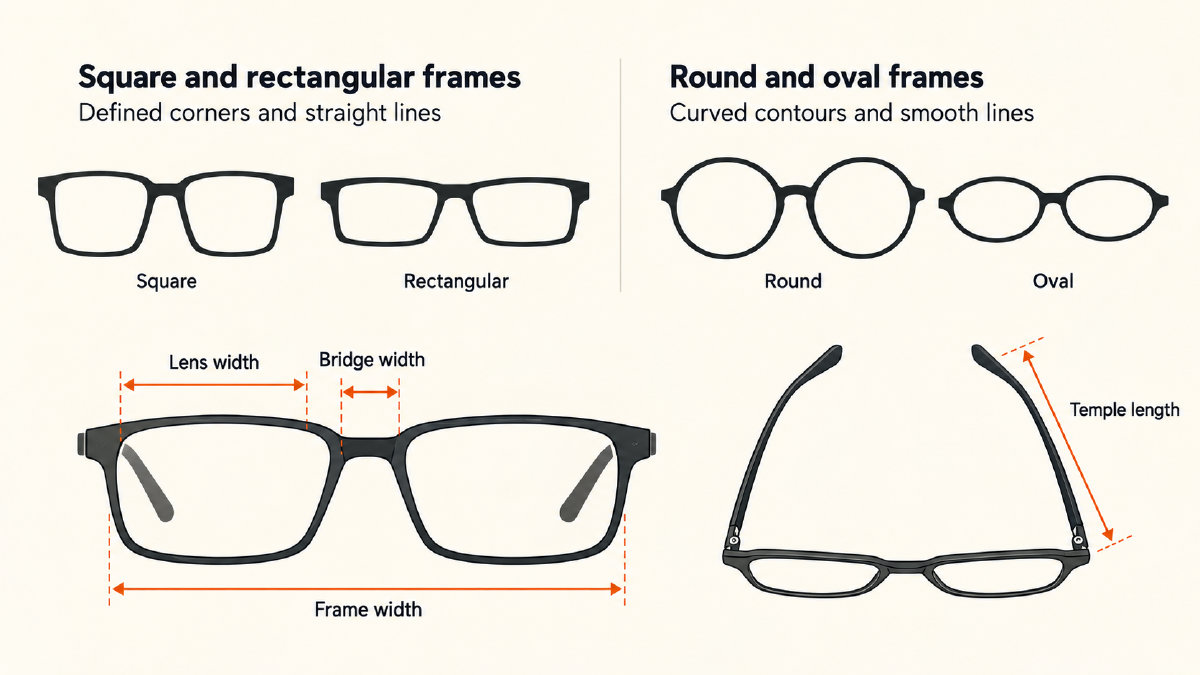
Of course, you can also compare actual frame widths, bridge widths, and temple arm lengths. Keep in mind that the numbers on frames are approximate, so it’s always a good idea to double-check actual frame measurements separately.
Don’t Get Too Hung Up on Frame Size Markings
Keep in mind that frame size markings are just approximate. They’re not exact measurements, and they vary from brand to brand. So instead of relying on those numbers, I recommend using your existing pair of glasses as a reference point. Find a pair of glasses that you already own that fits comfortably, and then use that as a starting point for finding new frames that fit your face shape well.
In addition to the frame width, the bridge width and temple arm length are also important measurements. The bridge width is the distance between the lenses, and the temple arm length is the length of the temples. These measurements are especially important if you have a larger face.
Of course, you can also compare actual frame widths, bridge widths, and temple arm lengths. Keep in mind that the numbers on frames are approximate, so it’s always a good idea to double-check actual frame measurements separately.
A Quick In-Person Check Saves You Time
I’m not a big fan of online shopping, but I am a firm believer in virtual previews. Before purchasing any frames online, I suggest checking out a retailer’s browser-based Virtual Try-On feature. This allows you to preview how frames will look on your face before purchasing.
This is a great way to narrow down your choices before you purchase anything. But keep in mind that the representation may vary, so I recommend checking the actual frame measurements separately.
For example, I use Zenni’s Virtual Try-On feature, and I recently used it to narrow my choices for frames. Here’s how it works…
Start by uploading a photo of yourself (or use your camera), and then select a frame. Zenni recommends good lighting and keeping your whole face within the preview.
After selecting a frame, click “Try On” to start the preview, then select “Enter PD” from the menu dropdown to enter your pupillary distance (PD) and improve the accuracy of the scale. The PD is the distance between your pupils, and it’s measured in millimeters. I’ve never had a problem with the scale accuracy, but I’ve heard that the built-in PD tool is pretty accurate, so if you’re unsure of your PD, I’d suggest using the built-in PD tool rather than entering a value manually.
After you enter your PD, take a look at the preview. Your browser will display a preview of how the frame will look on your face. If you’re satisfied with how it looks, then you can proceed with placing your order.
Keep in mind that the representation may vary, so I recommend checking the actual frame measurements separately.
Sources
Measure your own face
Free, in your browser. Your photo is never uploaded.
- Attractiveness TestFace rating, PSL range and eye type.
- Face Symmetry TestHow evenly the two sides match.
- Jawline AnalyzerJaw angle, jaw width and chin taper.