
What Is a Sloped Forehead? Profile Photos and Styling Options
Understand how a sloped forehead appears in profile, what consistent photos can show, and how bangs or a side part can change forehead coverage.
Table of Contents
There are quite a few things I want to talk about with regard to sloped foreheads, so let me start by defining what exactly a sloped forehead is.
What is a sloped forehead
A sloped forehead refers to the contour of the forehead when viewed from the side. The forehead slopes backward from the brow ridge toward the hairline. This gives the appearance of a recessed forehead in profile.
I’ll show you some examples below, but first I need to clarify that just because someone has a protruding brow ridge (i.e., a high or prominent brow), it doesn’t necessarily mean they have a sloped forehead. A protruding brow ridge can give the impression of a sloped forehead between the brows and the hairline, but the actual slope of the forehead is determined by how much the forehead itself slopes back from the brow ridge toward the hairline.
That said, if your forehead slopes back from the brow ridge toward the hairline, then you likely do have a sloped forehead. And this is something that you might notice on your own, as opposed to noticing how far your brow sits from your hairline.
Profile photos and posture
So here’s an example of a sloped forehead:
You can see how my forehead slopes back from my brow ridge toward my hairline. It also appears slightly recessed in profile.
You can see how my forehead slopes back from my brow ridge toward my hairline. But now that I’ve changed my posture, my forehead no longer appears recessed. In fact, it actually looks more prominent than it did before.
So why is that?
Because when we’re taking photos of ourselves, we often don’t have control over our posture. So if you’re photographing yourself, be aware that your posture can make a huge difference in how you appear in photographs. If you’re trying to determine whether or not you have a sloped forehead, then it’s best to use a repeatable posture for all of your profile pictures. That way, you won’t get conflicting information.
In order to get consistent results, I recommend that you try to keep your posture upright. And while looking at the camera, focus your eyes on a distant point at eye level. That will help ensure that your visual axis is horizontal.
Also, if you’re going to compare multiple profile photos, try to keep your camera position, viewing direction, and subject-to-camera distance consistent across all of the photos. Otherwise, you’ll end up comparing apples to oranges.
Measuring forehead slope at home
But even if you do manage to take great profile photos of yourself, there’s still no guarantee that you’ll get distortion-free images. Because of that, it’s probably best to avoid trying to measure the slope of your forehead at home. There are documented photographic studies that attempt to quantify facial features using photographs, but those usually require professional equipment and expertise. They also usually involve a number of people, and they generally don’t focus on measuring facial features such as forehead slope.
For example, one study used a tripod-mounted DSLR camera and took frontal facial photographs of 20 adults (both males and females, ages 18 to 28). These were taken with the head in a neutral position, lips at rest, and maximum intercuspation (the natural position of the teeth when the jaw is closed). The subjects were photographed at a constant distance of 5 feet.
They then compared these frontal facial photographs with frontal cephalograms (X-rays of the face). These X-ray images were used to identify frontal landmarks rather than to measure profile forehead slope.
But this study assessed frontal landmarks, so it doesn’t directly validate measuring forehead slope from profile photos.
So unless you’re doing research, and you have access to professional equipment and expertise, I wouldn’t recommend trying to measure your forehead slope at home.
So if you’re wondering if you have a sloped forehead, the easiest way to find out is to go to a professional photographer and ask them to take several side profile photos of you. Then show them to a dentist or orthodontist and see what they think.
But since that’s not always possible, I’ll just say that if your forehead slopes back from your brow ridge toward your hairline, then you likely do have a sloped forehead.
Styling options for a sloped forehead
So now that I’ve explained what a sloped forehead is, let’s move on to the next question…
What styling options do I have for a sloped forehead?
Well, the short answer is that there aren’t really any specific styling options that work better for a sloped forehead than for other forehead shapes. But there are definitely some styling options that could potentially minimize the appearance of a sloped forehead.
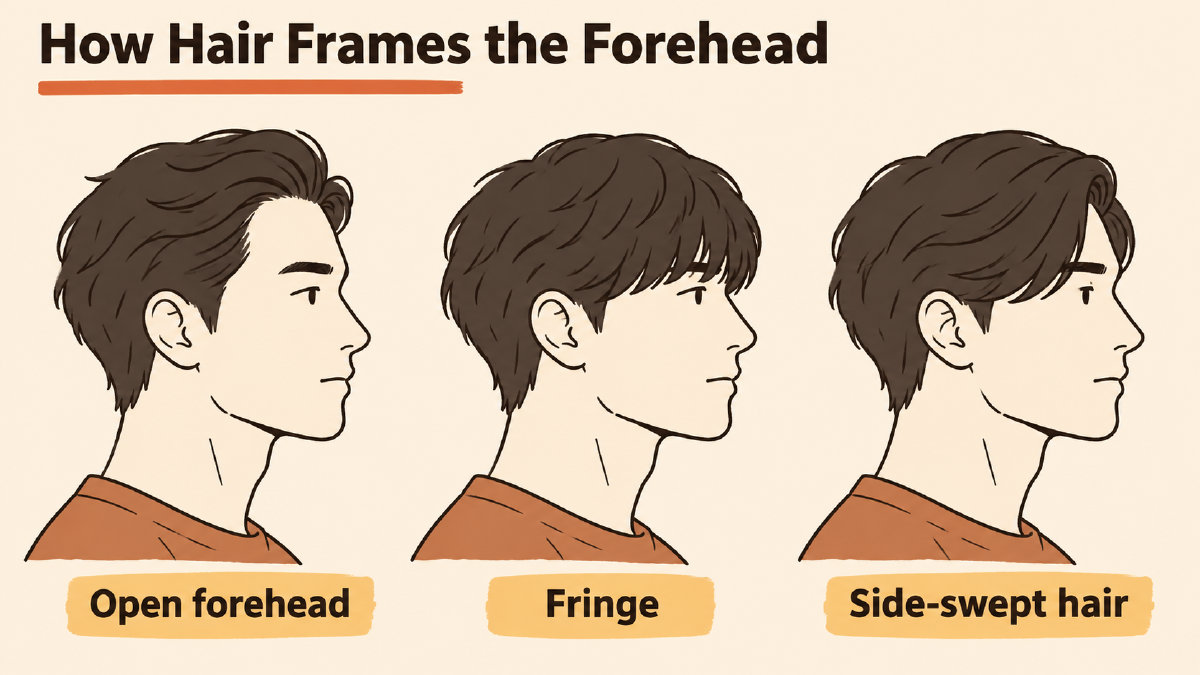
One option is bangs or fringe. Bangs are typically associated with women, but technically, a fringe is the term used for guys. So I’ll refer to both as bangs.
Bangs can make the forehead look smaller when that is the goal, so if you’d like less of your forehead to be visible, then bangs may be an option for you. But again, it depends on your individual face shape. Some people who have a sloped forehead don’t look good with bangs, and others who have a sloped forehead look great with bangs.
The choice of version should be discussed with a hair professional. Also, if you currently have your hair too short for bangs, growing it out may be an option. Keep in mind that bangs or fringe are optional. You don’t have to wear them, but they are an option.
Another option is a side part. If you have long enough hair, a side part combined with hair swept across the face can provide coverage for the forehead.
Jamie Bushman, a master hairstylist, explains,
“Anytime that you part the hair on the side of the head and sweep it across the face, it has the ability to kind of minimize the forehead a little bit.”
Keep in mind that this is just an opinion, and it’s based on her experience. She’s not making any claims that this will work for everyone. But it’s certainly worth considering as an option. It’s simply another way to style your hair, and if it makes your forehead look smaller, then it’s a great option.
Ultimately, this is a personal preference issue. Just like many other things, some people like their hair parted down the middle, while others prefer a side part. Some people love having their hair swept across their face, while others don’t like it at all. So there’s really no right or wrong answer here. It’s all about what looks best on you.
Sources
Measure your own face
Free, in your browser. Your photo is never uploaded.
- Attractiveness TestFace rating, PSL range and eye type.
- Face Symmetry TestHow evenly the two sides match.
- Jawline AnalyzerJaw angle, jaw width and chin taper.