
How to Identify and Style a Wider-Jaw Triangle Face Shape
Identify a wider-jaw triangle face shape, distinguish it from an inverted triangle, and compare hair and glasses options for your styling goals.
Table of Contents
I’ve written many articles about how to identify face shapes, and I’ve also written many articles about how to style different face shapes. But in the process of writing those articles, there has been quite a bit of confusion about what’s considered “wider-jaw” versus “narrower-jaw.” And that confusion comes from the fact that some people use “triangle” and “inverted triangle” to refer to opposite proportions.
Triangle and inverted triangle terminology
For example, one source will define a triangle as:
“A triangle face shape is characterized by a narrow forehead, wide cheekbones, and a wide jaw.”
And then another source will define an inverted triangle as:
“An inverted triangle face shape is defined by a wide forehead, medium cheekbones, and a narrow chin.”
So when someone refers to a “wider-jaw triangle,” they’re actually referring to a triangle with a narrower forehead and wider jaw. But when someone refers to an “inverted triangle,” they’re referring to a triangle with a wider forehead and narrower jaw.
That’s why it’s so important for me to clarify this terminology before I go any further. So let me just spell out exactly what I’m talking about when I talk about a “wider-jaw triangle” or “narrower-jaw triangle.”
In my opinion, a triangle face shape is generally defined as having the widest part of the face at the jaw, narrowing toward the cheekbones and the forehead. The opposite would be an inverted triangle face shape, which is generally defined as having the widest part of the face at the top (forehead), narrowing toward the middle (cheekbones) and the bottom (jaw). In other words, if you look at your face from the front, the width of your forehead should be more than the width of your cheeks, and the width of your cheeks should be more than the width of your jaw. That’s the general idea behind an inverted triangle face shape.
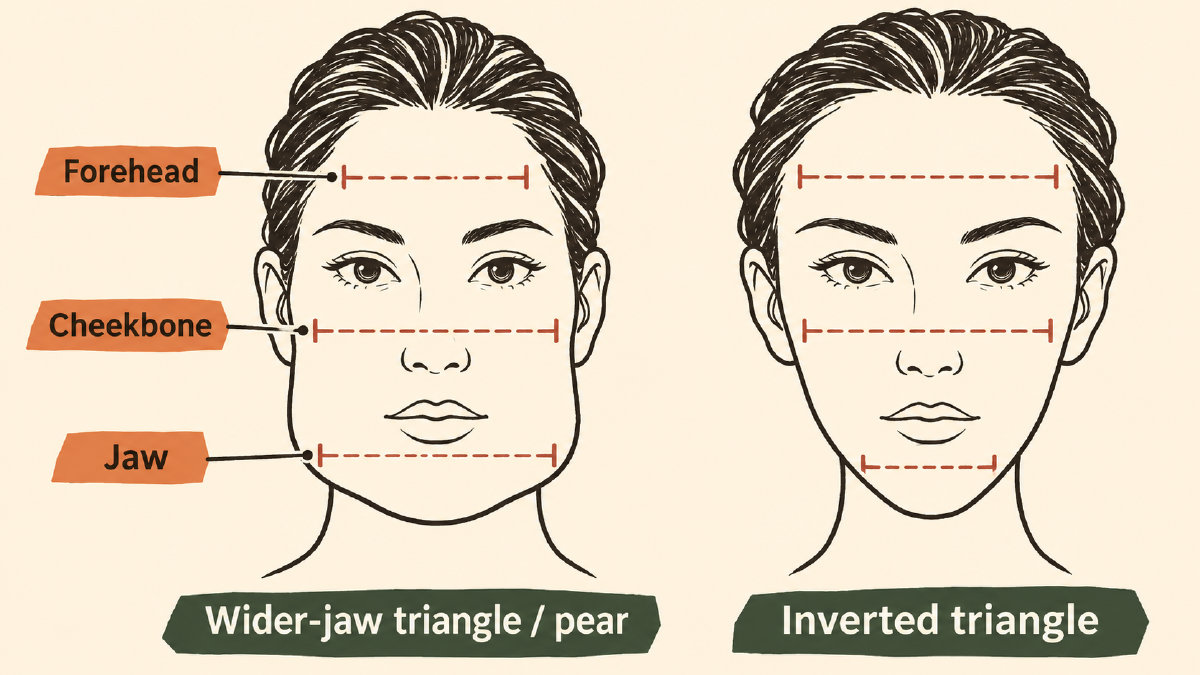
But I have also seen triangle used differently. Some sources define triangle as a face shape that is broader at the top (forehead) and narrower at the bottom (jaw), while others define triangle as a face shape that is broader at the bottom (jaw) and narrower at the top (forehead).
It seems like the latter definition is more common these days. For example, here’s how Allure defines triangle:
“The triangle face shape is the most common face shape, but it can still be tricky to find flattering styles. This face shape features a broad forehead and a narrow jawline. Because of its triangular shape, it can seem angular, especially if you have a prominent brow bone.”
And here’s how About.com defines triangle:
“The triangle face shape is defined by a broad forehead and small chin. It tapers toward the center of the face, giving the illusion of a V-shape. These faces are often described as oval-shaped, but they aren’t quite as rounded as ovals.”
And here’s how BellaOnline defines triangle:
“A triangle face shape is defined by a broad forehead and small chin. It tapers toward the center of the face, giving the illusion of a V-shape.”
So again, we see the same thing. Some people use triangle to mean the opposite of inverted triangle, and others use triangle to mean the opposite of a square.
How to identify a wider-jaw triangle face shape
To avoid confusion, I’ll define “wider-jaw triangle” as a face shape where the forehead is visibly narrower than the jaw, with the widest point of the face being at the jaw, and the opposite being a “narrower-jaw triangle” where the forehead is visibly wider than the jaw, with the widest point of the face being at the top (forehead). To check yours, try a straight-on photo with your hair pulled back. Compare straight horizontal spans across your forehead, outer cheekbones, and jaw corners. For the jaw, you’re measuring from corner to corner, rather than tracing the outline.
So now that we’ve established what a wider-jaw triangle is, let’s talk about how to style it. If you’re still comparing shapes, a square has roughly equal forehead, cheekbone, and jaw widths. A diamond is widest at the cheekbones, while a heart is wider at the forehead and tapers toward the chin. There are a few things you can do to bring attention toward the upper face, thereby making the lower portion of the face appear smaller.
First, adding volume to the temple and crown areas of the hair will create the illusion that your upper face is wider than it actually is. That will help to make the lower half of your face appear smaller in comparison.
Second, avoiding long hairstyles that hang down over your ears can help to draw attention away from your jawline. While longer hairstyles won’t necessarily hide your jawline completely, they will certainly draw attention away from it. Shorter styles can definitely work too, but they may require more frequent maintenance. If you’re considering a longer hairstyle, consider layers with soft movement instead of a rigid length rule.
Third, avoid styles that emphasize your jawline by drawing attention to it. For example, styles with bangs that fall across the forehead usually don’t work well on a wider-jaw triangle because they draw attention to the forehead. Styles with bangs that fall across the eyes or middle of the face usually work better.
Here’s a great example of a short haircut that works well on a wider-jaw triangle. This is a rounded layered short cut with fullness above the ears, and it’s styled with soft layers. Notice that even though the sides of the hair are very short, the top is much fuller.
If you prefer a longer style, try waves or soft layers that move away from the face rather than straight down. Avoid styles that are straight down, since they’ll only emphasize the jawline.
Of course, if you choose a longer hairstyle, you’ll probably need to add some volume to the top of your head to compensate for the extra length. Here’s a great example of a longer hairstyle that works well on a wider-jaw triangle. This is a light, wispy side-swept fringe that draws attention diagonally toward the eyes and the middle of the face. It’s partly visible, so it doesn’t emphasize the forehead quite as much as a bang that falls directly across the forehead.
Glasses that draw attention upward
And finally, glasses can be a great way to add some interest to your face and to draw attention upward. When selecting frames, opt for ones that add detail, color, or weight to the upper rim of the frame. You could even choose a pair with an interesting browline, such as cat-eye frames that have upswept outer corners. The added width of the outer corners gives the impression that the temples are as wide as the brows. If you see Yesglasses recommending less forehead emphasis for a triangle, remember that it uses triangle for the broad-forehead, small-chin pattern. That advice doesn’t carry over to the wider-jaw proportions I’m discussing here.
Now, I know some of you might have questions about part placement, so let me address that as well. First, keep in mind that no matter what type of face shape you have, you’ll never get perfect results from styling your hair without knowing your face shape. A face-shape label alone won’t guarantee effortless results. You’ll still have to experiment and find out what works best for you. That said, I think part placement is a very good question to ask when determining your face shape, because it can give you an idea of what direction you should take with your hair.
For example, if you have a square face shape, you’ll want to avoid parts that run right down the middle of your forehead, because that tends to emphasize the forehead. Instead, a part that starts at the middle of your forehead and goes slightly off-center toward the temple area can give the illusion of two long, narrow portions of hair.
But for a wider-jaw triangle, I’d suggest avoiding center parts altogether. A center part emphasizes the narrowness of the forehead, which isn’t what we want for a wider-jaw triangle. Instead, I recommend trying a middle part in a long hairstyle. A middle part gives the illusion of length, which will make your upper face appear larger in proportion to your lower face. These suggestions have different goals: FaceShapeTool generally discourages center parts for triangles, while TheHairStyler describes a middle part with long hair as emphasizing length. So consider whether you want to emphasize width or length.
Keep in mind that the exact placement of your part will depend on your hair texture and density. Some people can pull off a very close-to-the-middle part, while others will need to place their part closer to the temples. The same goes for the haircut itself. If you bring in a reference photo, have the style adapted to your hair type and density.
Beards and your jawline
And if you have a beard, you’ll probably want to avoid anything that will emphasize your jawline. But if you don’t have a beard, then feel free to experiment with whatever makes you happy!
Sources
Measure your own face
Free, in your browser. Your photo is never uploaded.
- Attractiveness TestFace rating, PSL range and eye type.
- Face Symmetry TestHow evenly the two sides match.
- Jawline AnalyzerJaw angle, jaw width and chin taper.